
Rakhi 2026 Custom Photo Wishes Card Maker Online: Test It First
Run seven checks on any rakhi card maker before you spend 40 minutes in it: export, watermark, link expiry, post-send editing, forced signup, photo handling, phone rendering. Applied honestly to SubhSandesh, including the two we fail.
Make this into a page you can send
Photos, a message, music and a ready-to-share link — in a couple of minutes.
or browse all occasionsKey takeaways
- • Raksha Bandhan 2026 is Friday 28 August, a working day — 2025 was a Saturday, so timing advice restamped from last year is wrong.
- • Seven pre-flight checks decide whether a card maker will strand you: export, watermark, link lifespan, post-send editing, signup gating, photo handling, phone rendering.
- • SubhSandesh fails the export check outright — no JPG, PNG, PDF or MP4 — and its only rakhi template is written brother-first.
- • SubhSandesh passes the editing and phone checks: median first-save-to-last-edit gap 6.9 hours (n=914), and 51.8% of shared pages open on a phone (17,101 of 33,007 views).
- • Of 15 pages ranking for this query on 19 August 2026, three still carried an earlier year and nine carried no year at all.
On this page
Rakhi 2026 Custom Photo Wishes Card Maker Online: Test It First
Before you commit 30 to 45 minutes to any rakhi 2026 custom photo wishes card maker online, run seven checks on it: can you export the file, does the free output carry a watermark, does the share link expire, can you edit after sending, does it force a signup before you see the result, what does it do with your uploaded photo, and does the output render on a phone.
All seven are answerable in a minute, and each is a way a finished card gets stranded. On SubhSandesh, 99.4% of started pages are actually published and shared (2,722 of 2,739) and 51.8% of shared pages are opened on a phone (17,101 of 33,007 views), so the phone check is the one we would fail hardest. Below: the checklist, applied to us including where we lose, and what Raksha Bandhan falling on Friday 28 August 2026 changes about when you send.
What a card maker pre-flight check is
A pre-flight check is a short set of questions you ask a tool before you invest effort in it, chosen so each answer is visible from outside. The cost is asymmetric: learning at minute two that a tool will not let you download costs nothing, learning it at minute forty costs you the card.
Regulators now describe the failures this catches as deceptive design. The European Data Protection Board's Guidelines 03/2022 on deceptive design patterns, adopted in version 2.0 on 14 February 2023, sorts them into six named categories: Overloading, Skipping, Stirring, Obstructing, Fickle and Left in the dark. Five of the seven checks below are simply "Left in the dark" questions asked out loud.
Seven checks to run before you start building
Run these in order. The first three decide whether the output can leave the tool at all, which is the thing that actually strands people.
1. Can you export what you made?
Look for a Download button before you start, not after. Some makers produce a file (JPG, PNG, PDF); others produce a page on their own domain and share it from there.
Neither is wrong, but they fail differently: a file survives the site shutting down, and a page survives your brother's phone deleting the image. If the interface never says which you are getting, assume the second, because a tool with a real download almost always advertises it.
2. Does the free output carry a watermark?
Watermarking free output is legitimate business practice, but it should be stated before you design, not revealed at the export step. Check the pricing page and the FAQ for the words "watermark" or "free version". A revealed-at-checkout condition is close to what the Central Consumer Protection Authority's Guidelines for Prevention and Regulation of Dark Patterns, 2023, issued on 30 November 2023 and listing 13 specified dark patterns, treats as an unfair trade practice under the Consumer Protection Act, 2019.
3. Does the link expire?
If the tool gives you a shareable URL rather than a file, the URL is the gift, and its lifespan is the gift's lifespan.
Look for a stated retention period. Free-tier links that quietly die after 7 or 30 days are common, and nobody discovers it on the day — they discover it a year later, scrolling back. If no policy is published, treat the link as temporary and keep your own copy of the photo and the text.
4. Can you edit it after you send it?
This is the check people skip and then need most. A downloaded JPG is frozen the second it leaves your phone: a wrong spelling of your brother's name is now permanently in his chat history. A hosted page can be corrected in place, with the same URL, so the recipient sees the fixed version.
On SubhSandesh the median gap between a page's first save and its last edit is 6.9 hours, sampled on the "I love you" page with n=914, which tells you people genuinely come back and change things after they have shared.
5. Does it demand a signup before you see the result?
Forced registration before the preview is a measurable manipulation, not a preference. In the CHI 2020 study Dark Patterns after the GDPR, Nouwens and colleagues scraped the five most popular consent platforms across the top 10,000 UK websites (n=680) and found only 11.8% met minimal legal requirements, and that removing the opt-out button from the first screen increased consent by 22 to 23 percentage points.
Small placement changes move behaviour by 20 points. Assume the signup wall is placed deliberately.
6. What does it do with your photos?
You are uploading a picture of a family member, so read the two lines that matter: how long the image is kept, and whether it can be used elsewhere.
Notice what the law does not give you here. India's Digital Personal Data Protection Act, 2023, gazetted on 11 August 2023, grants correction and erasure under section 12 and grievance redressal under section 13 — but the word "portability" appears nowhere in the Act. Getting your creation back out is a product promise, never a legal right.
7. Does the output render on a phone?
Build on a laptop, then open the result on a phone before you send it. Card makers are designed on wide screens and the failure is always the same: text sized for a 1440-pixel canvas becomes unreadable at 390 pixels. On our own data 51.8% of shared pages are opened on a phone and 52.0% of views come from a touch device, so a card that only works on desktop is a card half the audience cannot read.
The same seven checks, applied to SubhSandesh
We fail two of these outright, and it would be dishonest to publish the checklist without saying so. The first-party column below is measured from our own database on 2026-08-19, not estimated.
| Check | What to look for in any tool | SubhSandesh's honest answer (measured 2026-08-19) |
|---|---|---|
| Export a file | A Download button visible before you design | No. No JPG, PNG, PDF or MP4 export exists. You get a page on subhsandesh.in |
| Watermark on free output | The word "watermark" on the pricing page | No image watermark, but the shared page carries our logo and a Create link — branding by another name |
| Link lifespan | A published retention period | Links stay live; pages have accumulated 33,007 views across 2,739 creations, averaging 12.1 views each |
| Edit after sending | Same URL, updated content | Yes. Median first-save-to-last-edit gap is 6.9 hours (n=914) |
| Signup before the result | Whether the preview is gated | Preview is free; publishing needs an account. 99.4% of started pages still get published (2,722 of 2,739) |
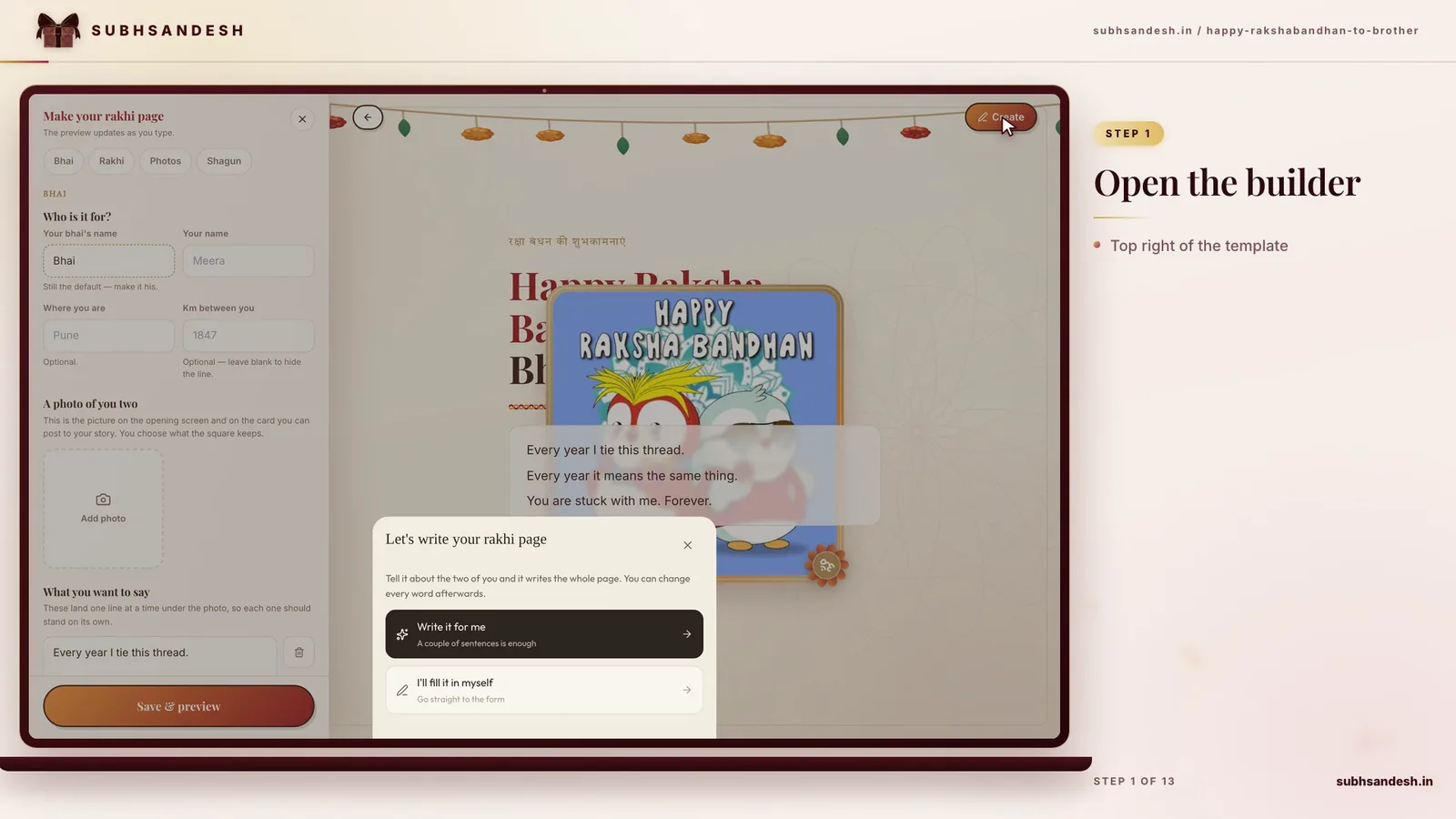
The pattern is that we are strong on the hosted-page checks and simply absent on the file checks. If you want a JPG you can forward, our Raksha Bandhan page for a brother is the wrong tool and a frame-and-download site is the right one.
What the pages ranking for this query actually look like
I fetched the pages ranking for this phrase on 19 August 2026, and the finding explains the shape of this post. Of 15 commercial results, three still carry an earlier year in their title or body — one is stamped 2024 in its title tag and repeats 2024 five times, another carries 2021, a third carries 2024 and 2025.
Three are explicitly stamped 2026. The remaining nine carry no year at all, which is the actual mechanism: a year-agnostic page written in 2023 keeps answering a 2026 query forever.
Not one of the pages I could read mentions which day of the week the festival falls on. Two of the biggest names return HTTP 403 to any crawler, so an answer engine cannot read them either. And one site ranking for "card maker" links to its own Raksha Bandhan editor, where the URL returns a 404.
What 2026 actually changes: Friday 28 August
Raksha Bandhan 2026 falls on Friday 28 August 2026. That is not a cosmetic difference from last year. In 2025 the festival was on Saturday 9 August, and in 2024 it was Monday 19 August, so a page restamped from 2025 is quietly assuming a weekend and giving you the wrong send timing.
Three things follow from the Friday. First, most people are at work, so the ritual gets compressed into the morning or the evening rather than spreading across the day. Second, the message competes for attention: a card sent at 11am on a working Friday is opened between other things, whereas one sent by 8am is opened properly.
Third — and this is the useful part — Saturday 29 and Sunday 30 August are free. A Friday festival splits naturally into three days: the wish on Friday morning, the video call or the visit on Saturday, the photographs and the shared album on Sunday.
That is also an argument for a hosted page over a downloaded image this particular year. A page you can add to over three days ends up carrying the Saturday photos; a JPG sent on Friday morning is finished at 8:01am.
When a SubhSandesh page is the wrong choice
Three cases, plainly. If the recipient has no smartphone or no reliable data, a link is worse than a printed card — 51.8% of our views are on phones because a link assumes a phone. If you need a file to forward, print or set as a WhatsApp status image, we cannot give you one, and design quality does not compensate for a missing Download button.
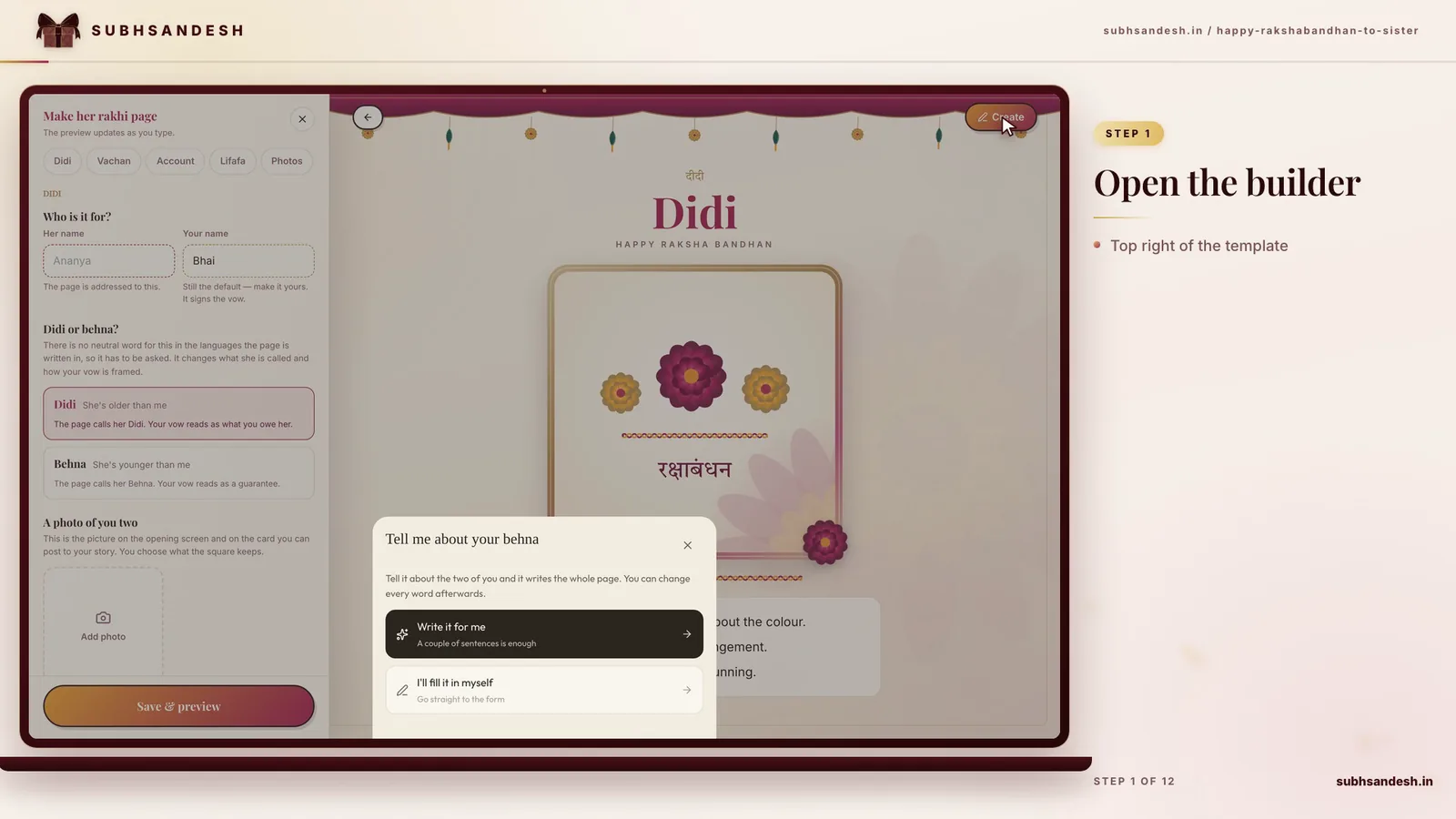
And if you are a brother writing to a sister, our single rakhi template is written brother-first: it addresses a brother, so a sister-directed card means editing around the copy rather than with it. The rest of the SubhSandesh template gallery covers birthdays, anniversaries and apologies, but rakhi is not among the 13 page types we have first-party data for, which is why every number in this post is platform-wide rather than rakhi-specific.
Sources
- Mathur et al., "Dark Patterns at Scale", ACM CSCW 2019 — 1,818 instances of 15 dark pattern types across 1,254 of about 11,000 shopping sites (11.1%).
- Nouwens, Liccardi, Veale and Karger, "Dark Patterns after the GDPR", CHI 2020, 25 April 2020.
- European Data Protection Board, Guidelines 03/2022 on deceptive design patterns, version 2.0, 14 February 2023.
- Digital Personal Data Protection Act, 2023, Gazette of India, 11 August 2023.
- Ministry of Consumer Affairs, CCPA Guidelines for Prevention and Regulation of Dark Patterns, 2023, 8 December 2023.
Frequently Asked Questions
Turn this inspiration into an unforgettable surprise
Build a page with photos, a heartfelt message, music and a ready-to-share link.
- Photos, message & music
- Ready-to-share link

Written by
Suyash Agrahari
Founder
Suyash Agrahari is a Software Engineer at HireQuotient and the founder of SubhSandesh and DrawFlow (drawflow.in). He builds AI agents and full-stack products with Next.js, Node.js, and the OpenAI and LangChain ecosystems, having shipped autonomous multi-agent systems, AI copilots, and large-scale outreach platforms — and scaled side projects from a few hundred to millions of users. He writes about AI engineering, web development, and building products that grow through SEO and organic reach.
Stay Connected
Follow SubhSandesh
New templates, festival ideas and step-by-step walkthrough videos — first on our socials.
Product guide
See it built, step by step
Keep reading
Thala Deepavali: A Couple's First Deepavali at the Bride's Home
Thala Deepavali is a Tamil couple's first Deepavali after marriage, at the bride's home. In 2027 it is Thursday 28 October, oil bath 4:40–6:01 AM in C…
 Suyash Agrahari· 9 min
Sugar-Free Diwali Sweets: Swaps, Label Warnings and the Evidence
Five original no-added-sugar Diwali sweets, why jaggery and honey do not count, the warnings FSSAI requires on a sugar-free box, and what an Indian su…
Suyash Agrahari· 9 minShort Diwali Quotes: 34 Original One-Liners Under 10 Words
34 original short Diwali quotes, each under ten words and marked with its word and character count, grouped by mood: lamps, family, friends, gratitude…
Suyash Agrahari· 9 min