
Rakhi Message for a Brother Far Away in Another Country
What to write for a brother abroad depends on how long he has been gone, not which country he is in. Messages by years away, whether to ask when he is coming home, and the four things not to say.
Make this into a page you can send
Photos, a message, music and a ready-to-share link — in a couple of minutes.
or browse all occasionsKey takeaways
- • Group the message by years away, not by country — what works in his first year abroad reads as a rebuke in his ninth.
- • Think before asking when he is coming home: the OECD finds return least likely once children's schooling is underway, with half of surveyed Latvian emigrants reluctant for exactly that reason.
- • About one in ten adults in a 1,005-person survey were separated from a sibling by a national border — the researchers call it an "intimate, but different" solidarity.
- • A line in his mother tongue lands harder the longer he has been away; add a transliteration, and never correct his reply.
- • Assume it is read more than once: 51.9% of shared SubhSandesh pages open on a phone and a page averages 12.0 views (measured 2026-08-18).
On this page
Rakhi Message for a Brother Far Away in Another Country
What to write for a brother in another country depends far less on which country he is in than on how long he has been gone and what he has built there — and the decision that shapes the whole message is whether you ask when he is coming home. A message that works in his first year abroad reads as a rebuke in his ninth. Send it phone-first: 51.9% of shared SubhSandesh pages are opened on a mobile (16,952 of 32,683 views, measured 2026-08-18), and a shared page averages 12.0 views, so what you send is usually read more than once and often shown to someone else. Below: what changes once a border is involved, the "when are you coming home" question, messages grouped by years away, and the things not to say.
Why another country is a different message from another city
A brother in Pune and a brother in Toronto are not the same writing problem. Three things change once a border is involved, and none of them is sentiment.
He may not have been back in years, so the message is doing more work than a greeting. The festival day does not overlap his day, so a wish sent on the Indian date can land on his previous evening. And a posted rakhi now involves customs, not just distance.
This is not a rare situation. In a representative Lithuanian survey of 1,005 adults, 63.9% had at least one sibling, and 9.3% said a brother had moved abroad while 12.6% said a sister had — about one in ten people separated from a sibling by a national border (Budginaitė‐Mačkinė and Juozeliūnienė, Social Inclusion 11(1), 2 March 2023). The same study names what these relationships become: an "intimate, but different" kind of solidarity. Different is the operative word. The message should acknowledge the difference rather than write over it.
First, decide whether to ask when he is coming home
This is the loaded question in every diaspora phone call, and putting it in a rakhi message changes what the message is. Ask it and you have sent a request. Leave it out and you have sent a wish.
Before you ask, know what the research says about the answer. Return is most likely when children are either very young or close to school age, and reluctance rises sharply once schooling is underway: in a large-scale survey of Latvian emigrants, half of respondents were reluctant to return over doubts about their children adapting to the origin-country education system, rising to 59% among those with lower education and 57% among minority groups (OECD, Return, Reintegration and Re-migration, 2024). The same report notes that mixed couples are a major barrier to considering return at all.
Read plainly: if his children are in school there, "when are you coming home" is a question he has already answered and would rather not answer again.
Better versions exist. "When do you think we'll see you?" asks about a visit rather than a relocation. "Is there a month that's easier for us to come to you?" moves the cost to your side. Both leave him somewhere to stand.
Messages by how long he has been away
Group by years, not by country. What he needs to hear changes with the length of the absence.
Year one
He is still converting everything into rupees and still homesick. Send: the specifics of home he is missing — who came, what was cooked, what the house sounded like. "The thali was set at 7, Amma asked twice whether you'd call, and I tied the rakhi on your photo like a mad person. Happy Raksha Bandhan. Come back for at least one of these." Avoid: telling him it is all fine without him.
Two to four years
The routine has set and the visit that was supposed to happen did not. Send: something that proves the relationship is being maintained rather than remembered. Reference something from this year of his life — his job, his flat, his city — not something from childhood. Avoid: the phrase "you've changed".
Five years or more
His life is there now. This is where "when are you coming back" stops sounding like affection and starts sounding like an accusation. Send: a message about the bond as it currently exists, in the present tense. "You've been away nine years and you have not missed one of these. That is the whole point of the thread." Avoid: nostalgia used as leverage.
He has children born there
Your rakhi is now also about a niece or nephew who may have never seen the ritual performed. Send: the wish, plus one line addressed to the child, plus an offer — a video of the thali, an explanation they can actually follow. Avoid: implying the children are missing out on something.
He has taken another citizenship
For many families this is the moment the absence stops feeling temporary. Send: nothing about the passport. The thread is not a nationality test. Avoid: "so you're not Indian any more?", even as a joke, even with a laughing emoji.
The relationship has thinned to festival messages only
Two messages a year is still a relationship, and pretending otherwise in a rakhi message tends to end the exchange. Send: short, warm, no audit of who called last. If repair is what is actually owed, send that separately — an apology page does that job better than a festival greeting, which will read as an attempt to change the subject.
What each stage needs, at a glance
Years away, what he is likely missing, and what the format data says. First-party figures are from SubhSandesh's own 2,718 created pages and 32,683 views (measured 2026-08-18).
| Years away | What he is most likely missing | What the message must do | What our data suggests |
|---|---|---|---|
| Under 1 | The sensory detail — food, sound, the house | Report home in specifics | Assume a phone screen; 51.9% of opens are mobile |
| 2–4 | Being current, not remembered | Reference this year of his life | A page averages 12.0 views, so it gets re-opened |
| 5–9 | Being treated as present, not absent | Speak in the present tense | Give it a day: median 6.9 h between first save and last edit |
| 10+ or citizenship | Being asked about his life, not his return | Drop the return question entirely | 99.4% of started pages do get published and shared |
The pattern: the longer he has been gone, the less the message should be about the gap and the more it should be about the present.
Write in the language he is losing
A line in Hindi, Marathi, Tamil or Punjabi does something an English line cannot, and it lands harder the longer he has been away.
There is a real phenomenon behind this. First-generation migrants' own first language can shift over time — a 2024 review in Bilingualism: Language and Cognition sets out the evidence that parents who are the main source of input to their children may themselves show first-language attrition (Montrul, published online 13 December 2024). The language he replies in may not be quite the one he left with.
Two practical rules. Add a transliteration if his reading has gone rusty or his children might read it over his shoulder. And do not correct his reply — a message that becomes a language test stops being a wish.
What not to say
Four things reliably land badly, and all four are common in messages sent with good intentions.
Do not use guilt as warmth: "we managed without you" is not a joke, whatever tone it is sent in. Do not compare him to the cousin who stayed. Do not put family health news into a festival message — bad news arriving inside a wish makes the wish the thing he remembers about it, and it deserves its own call. And do not send a paragraph that could have gone to anyone; a message with no specific detail reads as a forward, because most of what he receives that day is one.
What he is scanning for is evidence of attention. In a pilot study of nine family members in Kisumu supporting relatives who had moved to the UK, US and Canada, the support flowing from home to the migrant was primarily psychological and social rather than material (Journal of Global Health Reports, 1 April 2019). It is a small pilot, and it is not about India — but it names the direction of the flow correctly. The message is the support.
Sending the rakhi itself, and when a page is wrong
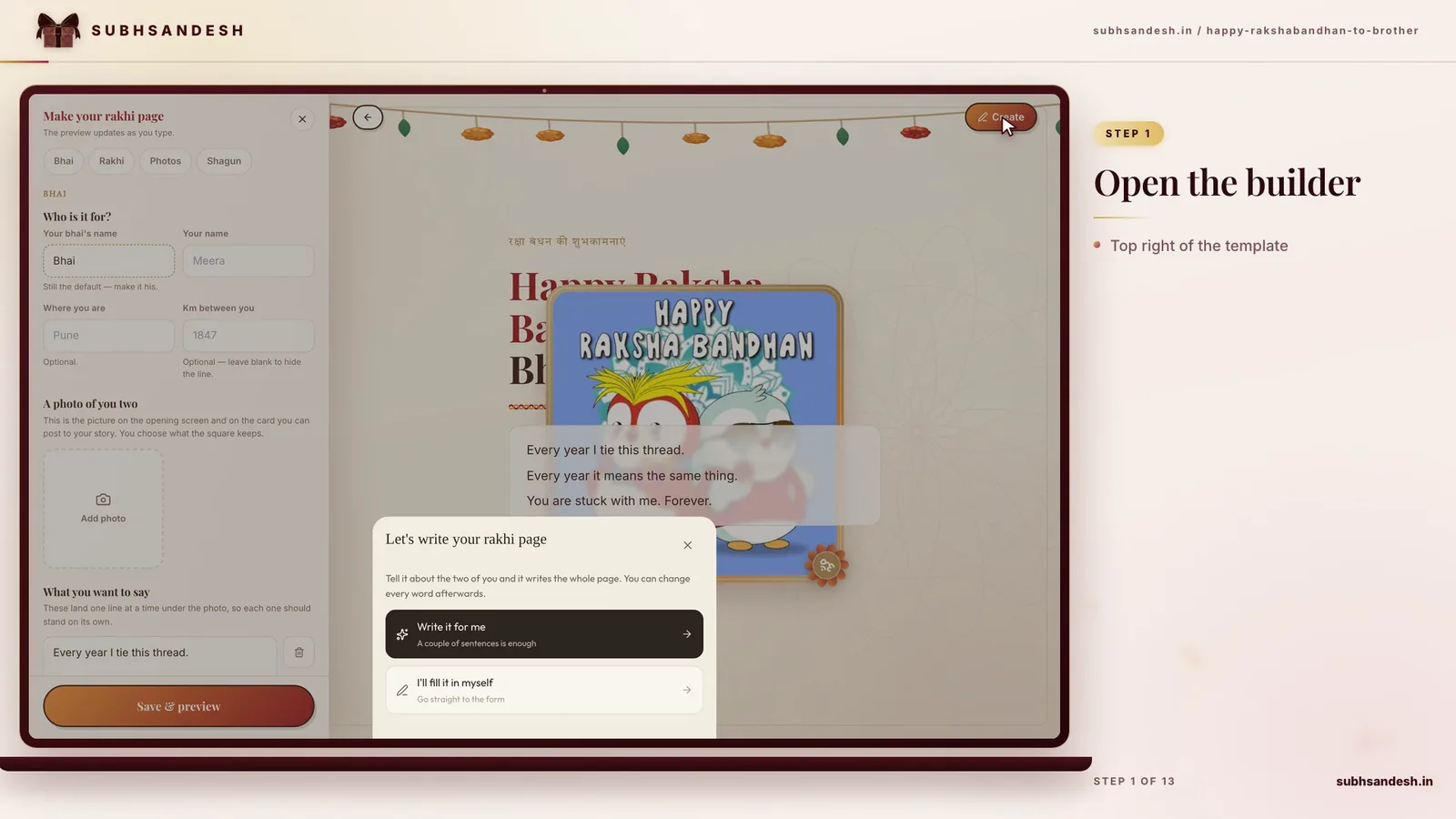
If you are posting a physical rakhi across a border, it needed to leave weeks ago; after that, send the thread with someone travelling, or send a digital page and post the rakhi to arrive late and on purpose. A ready-made Raksha Bandhan page for a brother arrives instantly and carries his name, your photos and a message; the wider template gallery has the other occasions.
Two honest limits. A page is the wrong choice if he has been waiting all year for a call — building something is not a substitute for your voice, and he will notice which one you chose. And 44.3% of our creators password-protect a page before sharing it, which is sensible for a private message but adds a step for someone in a different timezone who cannot text you for the password at 3 a.m.
Sources
- Budginaitė‐Mačkinė and Juozeliūnienė, Siblings as Overlooked Potential for Care and Support Across Households and Borders — Social Inclusion 11(1), 2 March 2023
- OECD, Return, Reintegration and Re-migration — OECD Publishing, 2024
- Montrul, Intergenerational attrition: direct or reverse language transmission? — Bilingualism: Language and Cognition 28(3), 13 December 2024
- Transnational family support and perspectives from family members back home: a pilot study in Kisumu, Kenya — Journal of Global Health Reports, 1 April 2019
Frequently Asked Questions
Turn this inspiration into an unforgettable surprise
Build a page with photos, a heartfelt message, music and a ready-to-share link.
- Photos, message & music
- Ready-to-share link

Written by
Suyash Agrahari
Founder
Suyash Agrahari is a Software Engineer at HireQuotient and the founder of SubhSandesh and DrawFlow (drawflow.in). He builds AI agents and full-stack products with Next.js, Node.js, and the OpenAI and LangChain ecosystems, having shipped autonomous multi-agent systems, AI copilots, and large-scale outreach platforms — and scaled side projects from a few hundred to millions of users. He writes about AI engineering, web development, and building products that grow through SEO and organic reach.
Stay Connected
Follow SubhSandesh
New templates, festival ideas and step-by-step walkthrough videos — first on our socials.
Product guide
See it built, step by step
Keep reading
Thala Deepavali: A Couple's First Deepavali at the Bride's Home
Thala Deepavali is a Tamil couple's first Deepavali after marriage, at the bride's home. In 2027 it is Thursday 28 October, oil bath 4:40–6:01 AM in C…
 Suyash Agrahari· 9 min
Sugar-Free Diwali Sweets: Swaps, Label Warnings and the Evidence
Five original no-added-sugar Diwali sweets, why jaggery and honey do not count, the warnings FSSAI requires on a sugar-free box, and what an Indian su…
Suyash Agrahari· 9 minShort Diwali Quotes: 34 Original One-Liners Under 10 Words
34 original short Diwali quotes, each under ten words and marked with its word and character count, grouped by mood: lamps, family, friends, gratitude…
Suyash Agrahari· 9 min