
Rakhi Quotes and One-Liners for Instagram
Ten original rakhi one-liners under twelve words each, grouped by register — plus where Instagram cuts a caption, why the second clause ruins it, and three moves for writing your own.
Make this into a page you can send
Photos, a message, music and a ready-to-share link — in a couple of minutes.
or browse all occasionsKey takeaways
- • One clause, under twelve words, no second sentence — a one-line caption is the only format the feed cannot truncate.
- • Brevity is causally better up to a point: concise versions beat originals up to a 30–40% length reduction, optimum 10–20%.
- • Rhyming aphorisms are judged more accurate than semantically identical non-rhyming ones despite being equally comprehensible — so make the line scan.
- • Name one specific thing (a city, an age, a habit) — that is what a borrowed line can never do.
- • Write for a phone: 51.9% of 32,683 shared-page views are mobile, and a page averages 12.0 views (measured 2026-08-18).
On this page
Rakhi Quotes and One-Liners for Instagram
A rakhi one-liner should be one clause, under about twelve words, with no second sentence — and the reason is not taste, it is measurable. In a controlled experiment where crowd workers shortened social media posts and other workers rated the results, concise versions beat the originals up to a length reduction of 30–40%, with the optimum between 10% and 20%. Instagram then compounds it: a long caption collapses behind a "more" link in the feed, so the first line is the only part guaranteed to be read. Write for a phone — 51.9% of the 32,683 views on pages shared through SubhSandesh happen on mobile (16,952 of them, measured 2026-08-18), and a shared page averages 12.0 views, so the line gets seen more than once. Below: where the cut falls, why the second clause kills it, and lines grouped by register.
Why one line beats a paragraph under a rakhi photo
The photograph is already doing the emotional work. A caption that re-describes it competes with it.
That intuition has a causal test behind it. In Causal Effects of Brevity on Style and Success in Social Media, crowd workers shortened real posts to prescribed target lengths and a separate group rated original against shortened; concise messages were on average more successful up to a 30–40% reduction, with an optimum of 10–20%, and the effect was strongest among raters who visit social media daily (Gligorić, Anderson and West, Proc. ACM Human-Computer Interaction 3, CSCW, Article 45, November 2019).
Read that carefully, because it is not "shorter is always better". Past roughly 40% shortening the benefit disappears. The practical translation for a rakhi caption: cut the explanation, keep the observation.
Where the line actually gets cut
In the feed, Instagram truncates a caption after a couple of lines and hides the rest behind "more". Almost nobody taps it for a festival post they are scrolling past.
I am stating that as observed platform behaviour rather than citing a figure, because the commonly repeated "125 characters" number appears only on marketing blogs and I could not verify it in Instagram's own documentation. The safe rule needs no number: if your caption is one line, there is nothing to truncate.
That gives three different jobs, and one line is not right for all of them.
| Where the line goes | What survives | What it has to do | What our data suggests |
|---|---|---|---|
| Feed caption, one line | All of it — nothing to hide | Land whole, first read | Assume a phone: 51.9% of opens are mobile |
| Feed caption, long | First lines only; rest behind "more" | Front-load the point in line one | The rest is written for the few who tap |
| Story text overlay | 4–8 words before it fights the photo | Sit in empty space, not on a face | Vertical crop — plan for the safe area |
| A shared page | Everything, as text | Carry the full message | A page averages 12.0 views, so it is re-read |
Why the second clause usually ruins it
Because ease of reading is itself part of the response. The processing-fluency account of aesthetic pleasure holds that the more fluently someone can process something, the more positive their response to it — and that variables long treated as objective properties of beauty, such as figure–ground contrast, symmetry and prototypicality, trace back to changes in that processing ease (Reber, Schwarz and Winkielman, Personality and Social Psychology Review 8(4):364–382, 2004).
A second clause adds a hinge the reader has to cross. The line stops being one thing.
Sound does real work too, which is why the good ones scan. When people judged unfamiliar aphorisms presented either in their original rhyming form or in a semantically equivalent non-rhyming form — Woes unite foes against Woes unite enemies — the two versions were rated equally comprehensible, but the rhyming versions were judged more accurate (McGlone and Tofighbakhsh, Poetics 26:235–244, 1999).
The lesson is not to force a rhyme into a rakhi caption. It is that rhythm and repeated sound make a line feel truer than its content earns — so a line that scans will outperform a more thoughtful line that clatters.
Ten rakhi one-liners, by register
Each is under twelve words. The note says which photograph it suits, because a line that fits the wrong picture reads as borrowed.
Dry
Same faces. New stories. For the side-by-side with an old childhood photo. Says the whole thing and stops.
Threads tied. Grudges pending. For a picture where you are both visibly laughing at something off-camera.
Affectionate, without the syrup
Still the person I call first. For a plain two-person photo with no styling. The flatness is the point.
My first friend, my worst secret-keeper. For a childhood picture. It compliments and accuses in six words, which is what siblings do.
Sibling insult
One thread, a lifetime of blackmail. For the photo where the rakhi is being tied and someone is pulling a face.
I got the rakhi. He got the sweets. For a thali photo. Eight words, and the grievance is the joke.
Understated
He shows up. That is the whole thing. For a brother who is not demonstrative. Says more than a paragraph would.
Older sister. Permanent supervisor. For a photo of a sister who is visibly in charge of the frame.
Distance
Different cities. Same thread. For a split-screen or a video-call screenshot.
Tied it over a video call. Counts. For the year nobody travelled. The full stop after "Counts" is doing the work — it refuses to apologise.
One-liners in Hindi and Hinglish
Hindi is more compact than English for this job, because the case endings do the work that English needs extra words for. A four-word Hindi line often carries what takes seven in English, which is exactly the trade a caption wants.
एक धागा, हज़ार शिकायतें। Ek dhaaga, hazaar shikaayatein. "One thread, a thousand complaints."
राखी बंधी, हिसाब बाकी। Raakhi bandhi, hisaab baaki. "Rakhi tied, accounts still pending." Note the bandhi / baaki echo — the sound is why it lands.
And one in Hinglish, which is how a great many siblings actually caption things:
Rakhi tight, blackmail tighter.
Add a Roman transliteration under a Devanagari line if your audience reads Latin script faster. Do not add an English translation to your own caption, though — a caption explaining itself is no longer a one-liner.
How to write your own in three moves
This is worth more than another twenty borrowed lines, because a caption with a specific detail in it cannot have come from anywhere else.
Cut the explanation. Write the sentence, then delete the half that explains why it is true. "You have always been there for me through everything" becomes "You always show up". The reader supplies the rest.
Name one specific thing. A city, an age, a habit, an object in the photograph. "Still stealing my charger at 31" beats any line about unbreakable bonds, because only one person could have written it.
End on the noun, not the adjective. Lines that finish on a concrete word land harder than lines trailing off into forever, always and blessed. Compare "Same faces. New stories." with "Same faces, still so blessed always."
Why the borrowed one-liner fails
Every year the same twenty lines circulate, and by the afternoon of 28 August your brother has read most of them under somebody else's photograph.
A polished generic line and a slightly rough specific one are not close. The specific one proves attention was paid, which is the only thing a caption can actually prove. If a line you found online is genuinely better than anything you can write, change one detail in it so it belongs to your photograph.
When a one-liner is the wrong choice
Three cases. If the post is the message — a tribute to a sibling who has died, an announcement, an apology — brevity reads as evasion, and it should be a proper caption or not a post at all.
If your audience is a family group rather than a public feed, a one-liner can read as cold; there, warmth beats economy.
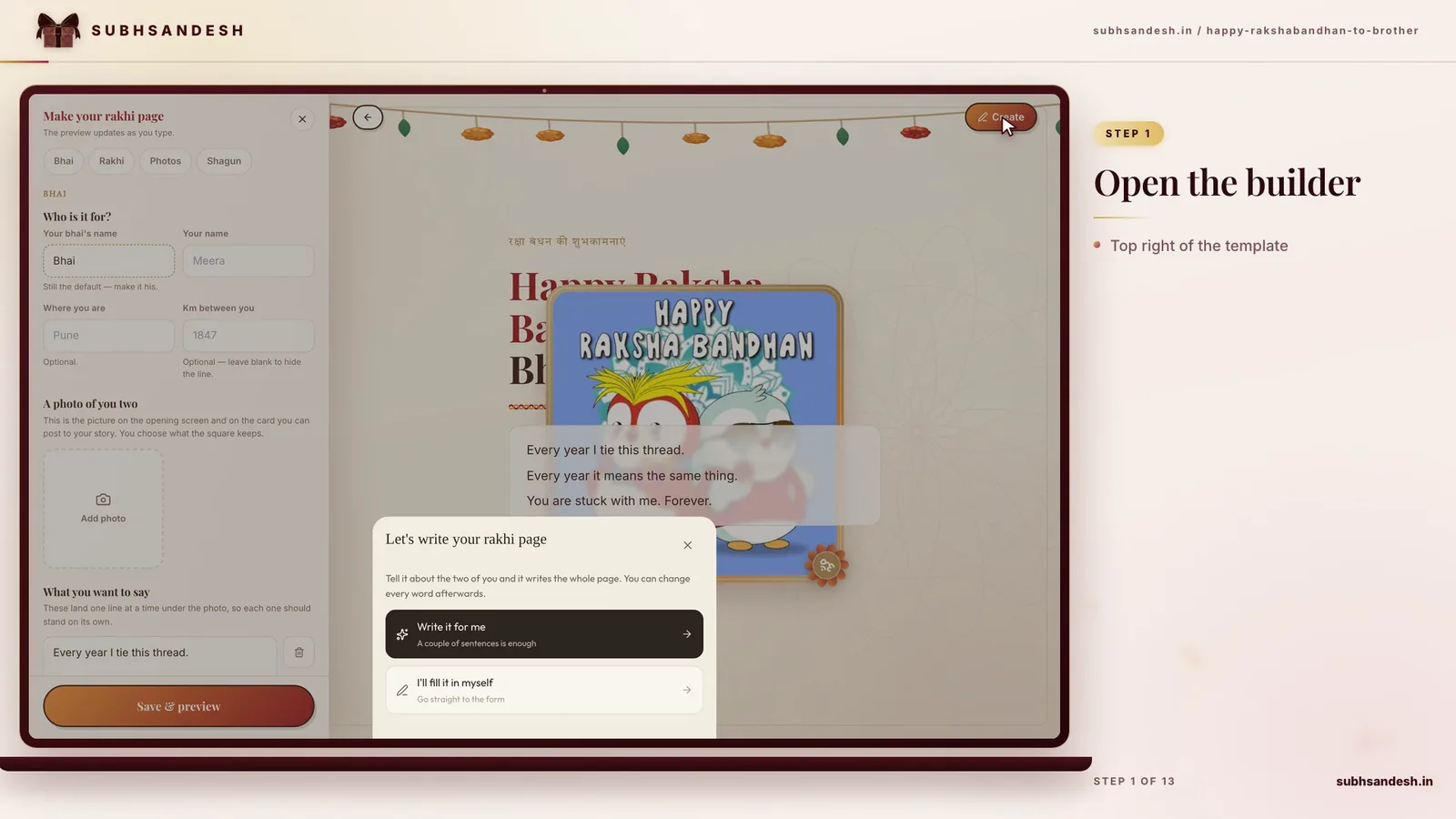
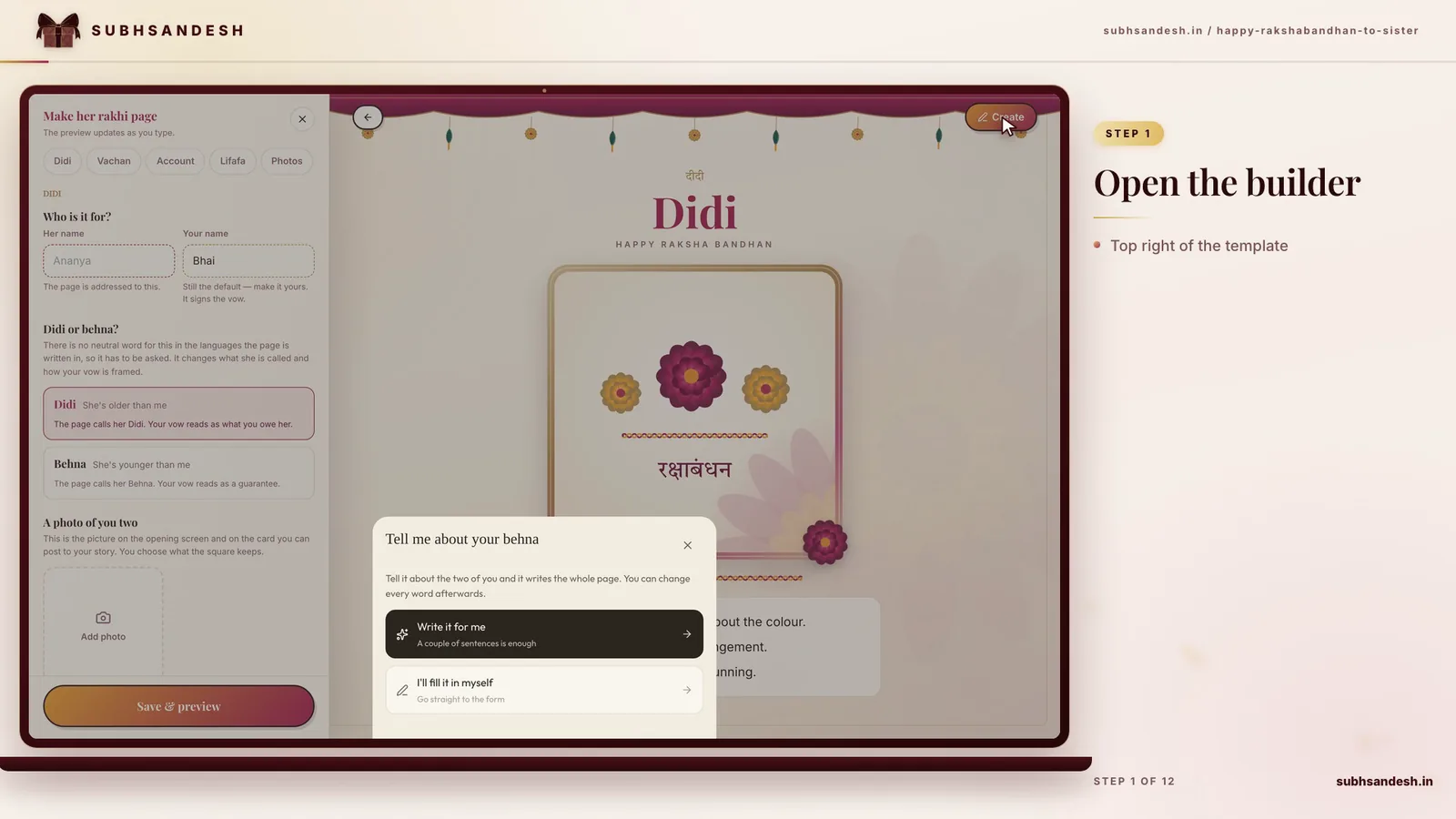
And if what you actually want is for one person to read something long, Instagram is the wrong surface entirely — a caption is a broadcast. A Raksha Bandhan page made for a brother holds the full message with his name and your photos, and the template gallery covers the other occasions. Note the honest limit: that template is written brother-first, so a sister-directed page means adapting it.
Sources
- Gligorić, Anderson and West, Causal Effects of Brevity on Style and Success in Social Media — Proc. ACM Human-Computer Interaction 3, CSCW, Article 45, November 2019
- Reber, Schwarz and Winkielman, Processing Fluency and Aesthetic Pleasure: Is Beauty in the Perceiver's Processing Experience? — Personality and Social Psychology Review 8(4):364–382, 2004
- McGlone and Tofighbakhsh, The Keats heuristic: Rhyme as reason in aphorism interpretation — Poetics 26:235–244, 1999
Frequently Asked Questions
Turn this inspiration into an unforgettable surprise
Build a page with photos, a heartfelt message, music and a ready-to-share link.
- Photos, message & music
- Ready-to-share link

Written by
Suyash Agrahari
Founder
Suyash Agrahari is a Software Engineer at HireQuotient and the founder of SubhSandesh and DrawFlow (drawflow.in). He builds AI agents and full-stack products with Next.js, Node.js, and the OpenAI and LangChain ecosystems, having shipped autonomous multi-agent systems, AI copilots, and large-scale outreach platforms — and scaled side projects from a few hundred to millions of users. He writes about AI engineering, web development, and building products that grow through SEO and organic reach.
Stay Connected
Follow SubhSandesh
New templates, festival ideas and step-by-step walkthrough videos — first on our socials.
Product guide
See it built, step by step
Keep reading
Thala Deepavali: A Couple's First Deepavali at the Bride's Home
Thala Deepavali is a Tamil couple's first Deepavali after marriage, at the bride's home. In 2027 it is Thursday 28 October, oil bath 4:40–6:01 AM in C…
 Suyash Agrahari· 9 min
Sugar-Free Diwali Sweets: Swaps, Label Warnings and the Evidence
Five original no-added-sugar Diwali sweets, why jaggery and honey do not count, the warnings FSSAI requires on a sugar-free box, and what an Indian su…
Suyash Agrahari· 9 minShort Diwali Quotes: 34 Original One-Liners Under 10 Words
34 original short Diwali quotes, each under ten words and marked with its word and character count, grouped by mood: lamps, family, friends, gratitude…
Suyash Agrahari· 9 min