
Rakhi Wishes to Brother Who Is Far Away, Rewritten
The recycled rakhi wish fails because it could have been sent to anyone's brother. Seven before-and-after rewrites with the move that fixed each, a ten-second specificity test, and why nostalgia reads worse than the present tense.
Make this into a page you can send
Photos, a message, music and a ready-to-share link — in a couple of minutes.
or browse all occasionsKey takeaways
- • A rakhi wish fails the specificity test if the same sentence could be sent, unchanged, to anyone else's brother — cover his name and see whether three other people would still fit.
- • "Miles apart but close at heart" is trait language: across two experiments, trait descriptions of a person drew lower attention and poorer recall than descriptions of what that person did (ter Doest, Semin & Sherman, 2002).
- • Length is not warmth. 35 words carrying three specifics beat 65 carrying none, and 51.8% of the 33,007 recorded views of SubhSandesh pages happen on a phone, which shows only the first two lines.
- • SubhSandesh creators already revise: the median gap between a page's first save and its last edit is 6.9 hours (n=914, measured 2026-08-19). This post is about what to change in that window.
- • With no detail to offer, ask rather than assert — question-asking raised liking across four studies, including a speed-dating field study of 1,961 observations.
On this page
Rakhi Wishes to Brother Who Is Far Away, Rewritten
The best rakhi wishes to brother who is far away are the ones that could not have been sent to anyone else's brother, so the fastest edit is to delete every sentence that could. On SubhSandesh the median gap between a page's first save and its last edit is 6.9 hours (sampled on the /love-gf page, n=914, measured 2026-08-19), and 99.4% of started pages get published anyway (2,722 of 2,739). People already rewrite; what they lack is a rule for what to change.
Below are seven before-and-after pairs, the move that fixed each, a ten-second test, and why "miles apart but close at heart" fails — which is not that it is a cliché. Raksha Bandhan 2026 falls on Friday 28 August.
Why "miles apart but close at heart" is dead language
The problem is not overuse. It is that the line makes a claim nobody can check and everybody can make: "close at heart" describes a state, not an event, so nothing in it belongs to your brother rather than to any brother alive.
Psycholinguistics separates the two. Trait wording sits at high linguistic abstraction; a described action sits at low abstraction. In two experiments comparing trait descriptions with action-verb descriptions of the same person, ter Doest, Semin and Sherman (2002) found the trait versions drew lower attention and were recalled more poorly than the behavioural ones.
So the recycled line does not just bore him; it is the part he is least likely to remember.
The ten-second specificity test
The specificity test is one question: could this exact sentence have been sent, unchanged, to anyone else? If yes, it fails. Running it on four lines takes about ten seconds.
Two passes. Cover his name and read it aloud; if three other people could receive it unedited, it has failed. Then count the proper nouns, dates, amounts and objects: zero is a fail, one is thin, three or more could only have gone to him.
"I love you and I miss you" passes nothing. Keep it; just never let it be the only content.
Seven rewrites: the before, the after, and the move
Each move is named so you can reuse it.
1. Name the object, not the feeling
Before: "No matter how far you are, you are always in my heart. Happy Raksha Bandhan!" After: "Happy Raksha Bandhan, bhaiya. Your rakhi from last year is still tied to the mirror in the Alto. I am not taking it off."
The move is a physical object with a location. "In my heart" is unfalsifiable; a thread on a car mirror exists, and does the emotional work without announcing it.
2. Put a date on it
Before: "It has been so long since we celebrated together." After: "The last rakhi we did in the same room was August 2022, when the power went out mid-aarti."
The move is a date plus one detail from that day. "So long" is a feeling; "August 2022" is something he can check against his own memory, which is what makes him reply.
3. Use a number instead of "so much"
Before: "I miss you so much this Raksha Bandhan." After: "Three rakhis by courier now. This is the first year Amma did not ask when you were flying in, and I noticed."
The move is a count — the cheapest specificity there is, and the second line lands only because the first measured something.
4. Replace the adjective with what he actually did
Before: "You have always been the best brother, so caring and supportive." After: "You sat on a call with me at 3 a.m. your time in March while I cried about the Pune job. I never thanked you properly for that."
The move is other-praising: naming what he did rather than describing how you feel. Across two samples of couples in video-recorded gratitude conversations (n = 370), Algoe, Kurtz and Hilaire found the expresser's other-praising behaviour, not their self-benefit talk, tracked how responsive the recipient felt them to be — though the correlations were modest, r = .30 and r = .25.
5. Admit something
Before: "Our bond will never change, no matter the distance." After: "We text less than we used to and I think that is mostly on me. Tying this rakhi on a photo of you is not the same, but I am doing it anyway."
The move is an admission. A wish that concedes something does work no template can fake, and the concession makes the affection believable rather than decorative.
6. Move from "we" to "you"
Before: "Our bond is unbreakable and our love only grows stronger." After: "You have been in that Ahmedabad flat eleven months and you still call it 'the new place'. Happy Raksha Bandhan to the most stubborn man I know."
The move switches the subject from the relationship to him. "Our bond" claims something about an abstraction; an observation about him proves you are paying attention now.
7. End on a question, not a full stop
Before: "Hope you have a wonderful Raksha Bandhan, brother!" After: "Did you find sweets there, or is it a Cadbury and a video call again? Send a photo of whatever you end up with."
The move is a question with an answerable shape. It turns a broadcast into an opening, and gives him something easier than composing a reply from scratch.
Why three specific lines beat one long emotional paragraph
Long does not read as more heartfelt; it reads as padding, because of where the extra words go. In a 60-word rakhi paragraph, roughly 40 words are usually a simile explaining the feeling — oceans, lighthouses, threads crossing continents — and only a handful are evidence of it. Explanation is what you reach for when you have no detail.
Concreteness has measurable pull, too. Analysing 15,565,582 tweets, Hu, Pilgrim, Zhao and Hills found more concrete posts were more likely to be retweeted, with the same direction across 50,000-plus Reddit posts and in a pre-registered forced-choice experiment. The authors note engagement also depends on factors they did not model, such as follower count.
The phone column matters because 51.8% of the 33,007 recorded views of SubhSandesh pages happen on a phone (17,101 of 33,007, measured 2026-08-19), and a phone shows only the first two lines at a glance.
| Wish type | Words, and what a phone shows first | Names, dates or amounts | Sendable to any brother |
|---|---|---|---|
| Recycled distance line | 8–12; all of it visible | 0 | Yes |
| Long emotional paragraph | 45–70; roughly the first 25 words | 0–1 | Usually yes |
| Nostalgia-only wish | 25–40; all of it visible | 1–2, all past tense | No, but reads closed |
| Three specific lines plus a question | 30–40; all of it visible | 3 or more | No |
The takeaway is not "write short": 35 words carrying three specifics outperform 65 carrying none, and a phone widens the gap.
Present tense beats nostalgia, even when the present is thin
Wishes drift into childhood because childhood is the part of him you still know in detail. Construal-level theory predicts it: the further away something is, the more abstractly you represent it, so his current life arrives as a vague shape while 2009 arrives in high resolution.
The cost is tonal. A wish built entirely of past tense implies the evidence for the relationship stopped accumulating, which is why all-nostalgia messages read less like a celebration than a eulogy. Use at most one past-tense sentence, and only to set up a present-tense one.
When you genuinely do not know his life now, do not invent detail and do not retreat into 2009. Name the most recent concrete thing you do know, date it, and admit the edge of your knowledge: "You mentioned a new manager in May and I never asked how that went." Specific, honest about the gap, impossible to have sent to anyone else.
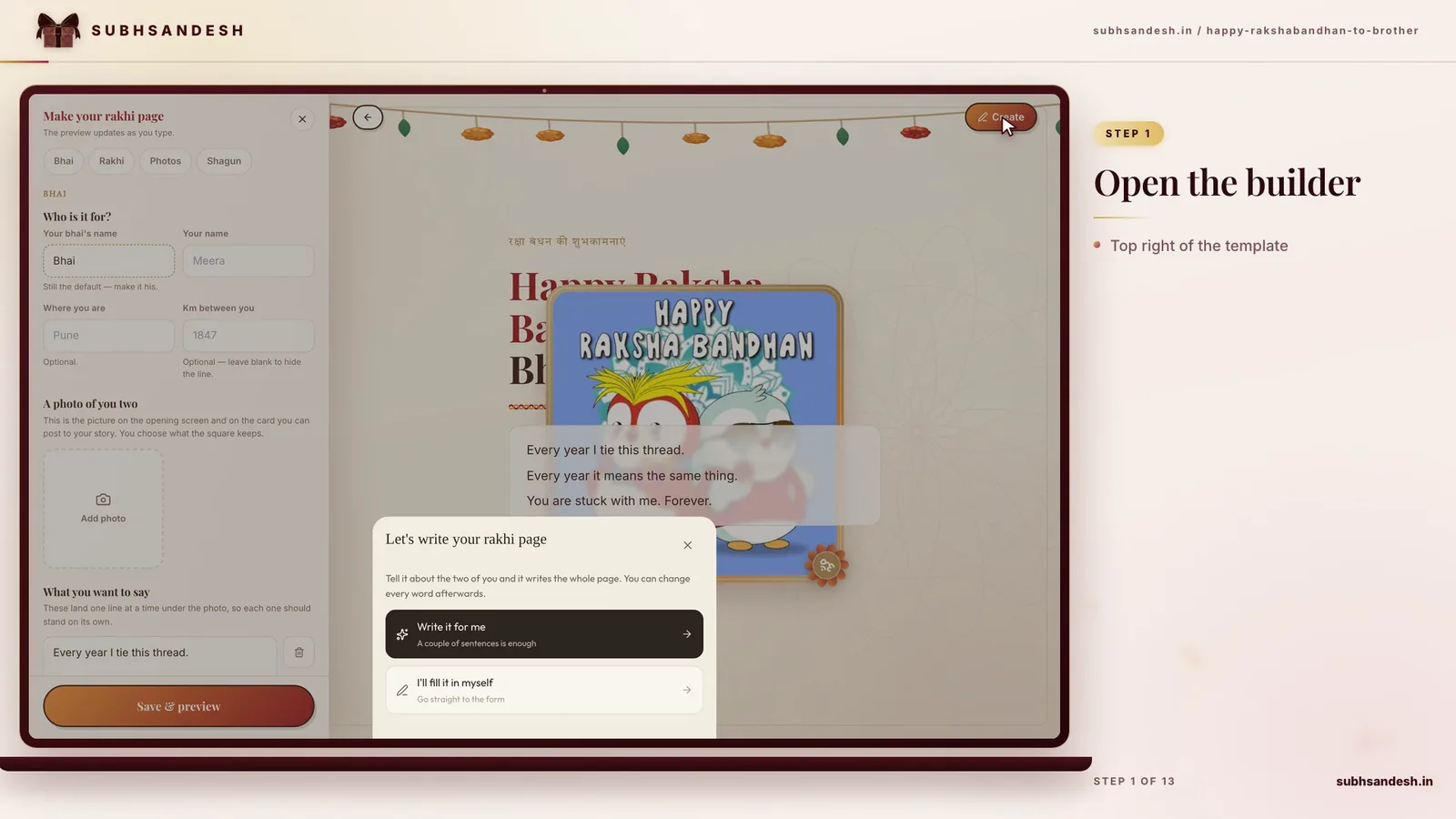
If the past must carry weight, put it in pictures instead of words: a Raksha Bandhan page for a brother holds the old photographs while the text stays present-tense.
What to write when you have nothing specific to say
Ask something. With no detail to offer, the honest move is a question rather than an assertion: it requires you to know nothing and hands him the easier job.
This is not just politeness. Across four studies, Huang, Yeomans, Brooks, Minson and Gino found question-asking causally increases liking by drawing the other person into self-disclosure; in their speed-dating field study of 1,961 observations, where 46.8% wanted a second date, asking more questions predicted getting one. One detail matters: the effect appeared for people inside the conversation, not third-party observers — so this belongs in a message to him, not a public status.
Three that work when you have nothing: "What does 28 August actually look like where you are — are you working?" "What do you want couriered that you cannot get there?" "Tell me one thing about this year I do not know."
When a shareable page is the wrong container for this
If the rewrite gets you to 35 good words, send 35 good words on WhatsApp. A page earns its place when you have photographs, a voice note or a video to hold; wrapping four lines in a template adds a click for him and nothing for you.
Two further limits. Rakhi is not one of the 13 page types in our own data, so we have no rakhi-specific numbers and will not pretend otherwise.
And 44.3% of creators password-protect a page before sharing (1,213 of 2,739, measured 2026-08-19) — sensible for a proposal, irritating for a brother who must now ask you for a password on a working Friday. If you do want the photo version, start in the SubhSandesh template gallery; every move above still applies to the words inside it.
Sources
- ter Doest, Semin & Sherman (2002), Journal of Language and Social Psychology 21, 195–221 — trait versus action-verb descriptions of a person, VU Research Portal
- Algoe, Kurtz & Hilaire (2016), Social Psychological and Personality Science — other-praising behaviour and perceived responsiveness, n = 370, UNC Carolina Digital Repository
- Hu, Pilgrim, Zhao & Hills (2025 accepted version), Quarterly Journal of Experimental Psychology — concrete language and sharing across 15,565,582 tweets, Warwick Research Archive
- Huang, Yeomans, Brooks, Minson & Gino (2017), Journal of Personality and Social Psychology — question-asking and liking, Harvard DASH
- SubhSandesh first-party figures, measured 2026-08-19.
Frequently Asked Questions
Turn this inspiration into an unforgettable surprise
Build a page with photos, a heartfelt message, music and a ready-to-share link.
- Photos, message & music
- Ready-to-share link

Written by
Suyash Agrahari
Founder
Suyash Agrahari is a Software Engineer at HireQuotient and the founder of SubhSandesh and DrawFlow (drawflow.in). He builds AI agents and full-stack products with Next.js, Node.js, and the OpenAI and LangChain ecosystems, having shipped autonomous multi-agent systems, AI copilots, and large-scale outreach platforms — and scaled side projects from a few hundred to millions of users. He writes about AI engineering, web development, and building products that grow through SEO and organic reach.
Stay Connected
Follow SubhSandesh
New templates, festival ideas and step-by-step walkthrough videos — first on our socials.
Product guide
See it built, step by step
Keep reading
Thala Deepavali: A Couple's First Deepavali at the Bride's Home
Thala Deepavali is a Tamil couple's first Deepavali after marriage, at the bride's home. In 2027 it is Thursday 28 October, oil bath 4:40–6:01 AM in C…
 Suyash Agrahari· 9 min
Sugar-Free Diwali Sweets: Swaps, Label Warnings and the Evidence
Five original no-added-sugar Diwali sweets, why jaggery and honey do not count, the warnings FSSAI requires on a sugar-free box, and what an Indian su…
Suyash Agrahari· 9 minShort Diwali Quotes: 34 Original One-Liners Under 10 Words
34 original short Diwali quotes, each under ten words and marked with its word and character count, grouped by mood: lamps, family, friends, gratitude…
Suyash Agrahari· 9 min