Rakhi Wishes With Brother Name and Photo: How to Edit Them
Editing a rakhi wish with your brother's name and photo has an order: words, then name, then photo, then colour. Here is that order, the difference between an editable master and a flattened JPG, how to reuse one design for several brothers, and what is actually recoverable once you have sent it.
Make this into a page you can send
Photos, a message, music and a ready-to-share link — in a couple of minutes.
or browse all occasionsKey takeaways
- • Edit in one order — words, then name, then photo, then colour — because a layout tuned to a short name breaks the moment the name gets longer.
- • A downloaded JPG cannot be edited back; a live page can, and the median SubhSandesh page is still being edited 6.9 hours after its first save (n=914, measured 2026-08-19).
- • For a second brother, duplicate the finished master and change two fields — but name every version after its recipient first, because 44.3% password-protection will not save you from sending the wrong link.
- • Only a live link is genuinely recoverable after sending: WhatsApp's Help Center warns recipients may see a message before it is deleted and that deletion can fail silently.
- • Stop when your changes become word swaps — in Sommers' revision data 283 of 333 student changes were single-word substitutions and deletions.
On this page
Rakhi Wishes With Brother Name and Photo: How to Edit Them
Editing rakhi wishes with brother name and photo means changing something that already exists, and the order matters: fix the words first, then the layout, then the colour, because each pass invalidates the work downstream of it. On SubhSandesh the median gap between a page's first save and its last edit is 6.9 hours — sampled on the "I love you" page (/love-gf), n=914, measured 2026-08-19 — so returning to revise is the normal case, not the exception. Across 2,739 personalised pages created since 2026-03-12, 99.4% are eventually published and shared (2,722 of 2,739).
Raksha Bandhan 2026 is Friday 28 August. Below: what to change and in what order, why an editable master beats a downloaded JPG, how to run one design past three brothers, and what is genuinely recoverable after you have sent the wrong version.
What editing a rakhi wish actually means
On the generator sites, "edit" means filling in a form once — type a name, upload a photo, press download. That is creation. Editing is the second and third pass, after you have looked at the thing and decided the second line is wrong.
Writing research separates the two cleanly. In Nancy Sommers' study of eight student and seven experienced writers, only 10 of 333 recorded changes happened at the "thema" level — the level of a whole idea — while 143 were deletions and 140 were substitutions, mostly of single words.
Left alone, people polish vocabulary and never revisit the point. A rakhi card fails the same way: three rounds of font changes around a first line nobody meant.
Change things in this order: words, name, photo, finish
Four passes, in this sequence. The reason is mechanical, not aesthetic: a layout tuned to a 40-character line breaks the moment the line becomes 60 characters.
Pass 1 — the words, before you touch the design
Read the message out loud with the design closed, and cut anything you would not say to him on the phone. It is the only pass that can change what the card is for, so it comes first: a beautiful card carrying a sentence you did not mean is a total loss. Two minutes, and it is the pass most people skip.
Pass 2 — the name, spelled the way he writes it
Now fix the name: full name, nickname or kinship term, spelled the way he actually spells it, and checked against a message he sent you rather than against memory. Name length drives everything downstream — "Bhai" and "Siddharth" do not occupy the same box — which is why this precedes layout rather than following it. One minute.
Pass 3 — the photo and the crop
Swap or re-crop the photo only once the text is final, because the safe area for a face depends on where the words sit. If the card will be opened on a phone, check it on a phone: 51.8% of views of shared SubhSandesh pages are on one (17,101 of 33,007, measured 2026-08-19). Three to five minutes, most of it spent finding the photo.
Pass 4 — colour, font and the finish
Last: palette, font weight, background — the changes that feel like progress and change the least. Ten minutes here is fine; forty is a sign you are avoiding Pass 1, and going back to Pass 1 afterwards costs you this pass entirely.
The editable master versus the flattened export
This distinction decides whether next year is a five-minute swap or a rebuild. A JPG is pixels: no name layer to change, no text object to retype. The name has become part of the picture, permanently.
An editable master is anything that still holds the parts separately: a project file in a design tool, or a live page whose fields you can reopen. Keep one, export as many flat copies as you like from it, and treat the flat copy as disposable.
| Artefact | Change the name later? | What next Raksha Bandhan costs | Measured behaviour |
|---|---|---|---|
| Downloaded JPG | No — the name is pixels | Rebuild from scratch | — |
| Project file in a design tool | Yes, if you still have the file and its fonts | 5–10 minutes to swap name and photo | — |
| Live page behind a link | Yes, and the link does not change | Under 5 minutes | Median 6.9 h from first save to last edit, n=914 |
| A copy someone forwarded | No, and you cannot reach it | Rebuild | 12.1 average views per created page |
The takeaway: the only row where an edit reaches a card that has already been sent is the live page. Everything else means making a new file and asking him to look again.
One design, three brothers — without rebuilding it
Finish one card properly, then duplicate the finished master and change only the name and the photo. That is two fields, not a second design session. Our Raksha Bandhan page for a brother works this way: the same scene, different name, different photo, a separate link each.
There is a real argument for building two or three variants side by side first. In an experiment with 33 novice designers, ads created in parallel significantly outperformed ads created by serial refinement on live click-through — the top two click-through rates in the study, 735 and 578 clicks per million impressions against an overall average of 424, were both parallel designs. The authors' warning about serial iteration is the useful bit: it "can also give rise to fixation, continuously refining one option without considering others."
The failure this workflow invents is specific: three near-identical cards, three near-identical links, and you send Chintu's to Siddharth. Two habits stop it — name every version by its recipient before duplicating anything, and paste a link into a chat only after opening it once from that chat.
Password-protecting each one helps too. 44.3% of SubhSandesh creators do it before sharing (1,213 of 2,739), and a wrong link with a wrong password gets queried rather than read.
After you have sent the wrong version: what is recoverable
Interactive-systems research draws the line precisely. Backward error recovery restores the previous state — undo, cancel, stop — and is "the only real recovery function", because the effects of the mistake are removed entirely. Forward error recovery means doing extra work to reach a state that is never quite as good: you glue the broken plate.
Editing a live page you have already shared is backward recovery. Fix the name, save, and the link the recipient already has now shows the corrected card. Nothing else on this list qualifies.
A JPG already delivered is forward recovery only. So is a screenshot, and so is a copy he forwarded to the family group — that copy is outside your reach permanently.
WhatsApp's own Help Center is careful about Delete for Everyone, and so should you be: it is offered for exactly this case, "if you sent a message to the wrong chat or if the message you sent contains a mistake", but the same page states that recipients might see your message before it is deleted, that deletion can fail, and that you will not be notified when it does. It also leaves a visible "This message was deleted" in the chat, and the window for using it is limited — check the option in the app rather than trusting a figure from a blog.
The research on post-hoc regret says the same thing from the user's side. Across 569 Facebook users studied by Wang and colleagues, 66 of 321 survey respondents (21%) reported regretting something they posted, and deleting was the most common response — but, in the authors' words, "by the time a user deletes a post it may be too late to avoid a negative consequence if the post has already been viewed."
So: if it is wrong and it is a link, edit it. If it is wrong and it is an image, send the corrected one with one sentence of explanation and stop. A second apology is worse than the typo.
Version fatigue: knowing when to stop editing
There is a point where more editing makes a greeting worse. It arrives when your changes stop being about meaning and become substitutions — swapping "always" for "forever", then back. In Sommers' data that pattern accounted for 283 of 333 changes: it feels like work and moves nothing.
A stop rule that holds up: after Pass 4, read the card once, aloud, and send it unless something is factually wrong — a misspelled name, the wrong photo, the wrong brother. Style disagreements with yourself are not defects.
Read the 6.9-hour median edit gap honestly: it is evidence people return and revise, not evidence that seven hours of revision is good. Most of that gap is someone walking away and coming back once.
When editing is the wrong answer, and where we lose
If the card is already sent, correct, and merely not perfect, editing is self-indulgence — he read it in eight seconds and moved on.
And a live page is the wrong artefact in real cases. If your brother is in the same house, hand him something instead.
If he has no data connection when he opens his phone in the morning, a JPG sitting in the chat wins, and our template gallery will not help you there. If he never opens links from anyone, the format is the problem, not the design.
One honest limit on the numbers above: none of them is measured on a rakhi page. Rakhi is not among the 13 page types in the data, and the 6.9-hour edit gap is sampled on the "I love you" page. They describe how people revise personalised greetings on this platform, which is the closest available evidence, not a measurement of rakhi cards.
Sources
- Sommers, Revision Strategies of Student Writers and Experienced Adult Writers, ERIC ED220839, 12 June 1982 — files.eric.ed.gov
- Dow et al., Parallel Prototyping Leads to Better Design Results, ACM TOCHI 17(4), December 2010 — hci.stanford.edu
- Jambon, Error Recovery Representations in Interactive System Development, ERCIM Workshop, November 1997 — hal.science
- Wang et al., "I regretted the minute I pressed share": Regrets on Facebook, SOUPS 2011, 20 July 2011 — cups.cs.cmu.edu
- WhatsApp Help Center, How to delete messages, no date stated — faq.whatsapp.com
Frequently Asked Questions
Turn this inspiration into an unforgettable surprise
Build a page with photos, a heartfelt message, music and a ready-to-share link.
- Photos, message & music
- Ready-to-share link

Written by
Suyash Agrahari
Founder
Suyash Agrahari is a Software Engineer at HireQuotient and the founder of SubhSandesh and DrawFlow (drawflow.in). He builds AI agents and full-stack products with Next.js, Node.js, and the OpenAI and LangChain ecosystems, having shipped autonomous multi-agent systems, AI copilots, and large-scale outreach platforms — and scaled side projects from a few hundred to millions of users. He writes about AI engineering, web development, and building products that grow through SEO and organic reach.
Stay Connected
Follow SubhSandesh
New templates, festival ideas and step-by-step walkthrough videos — first on our socials.
Product guide
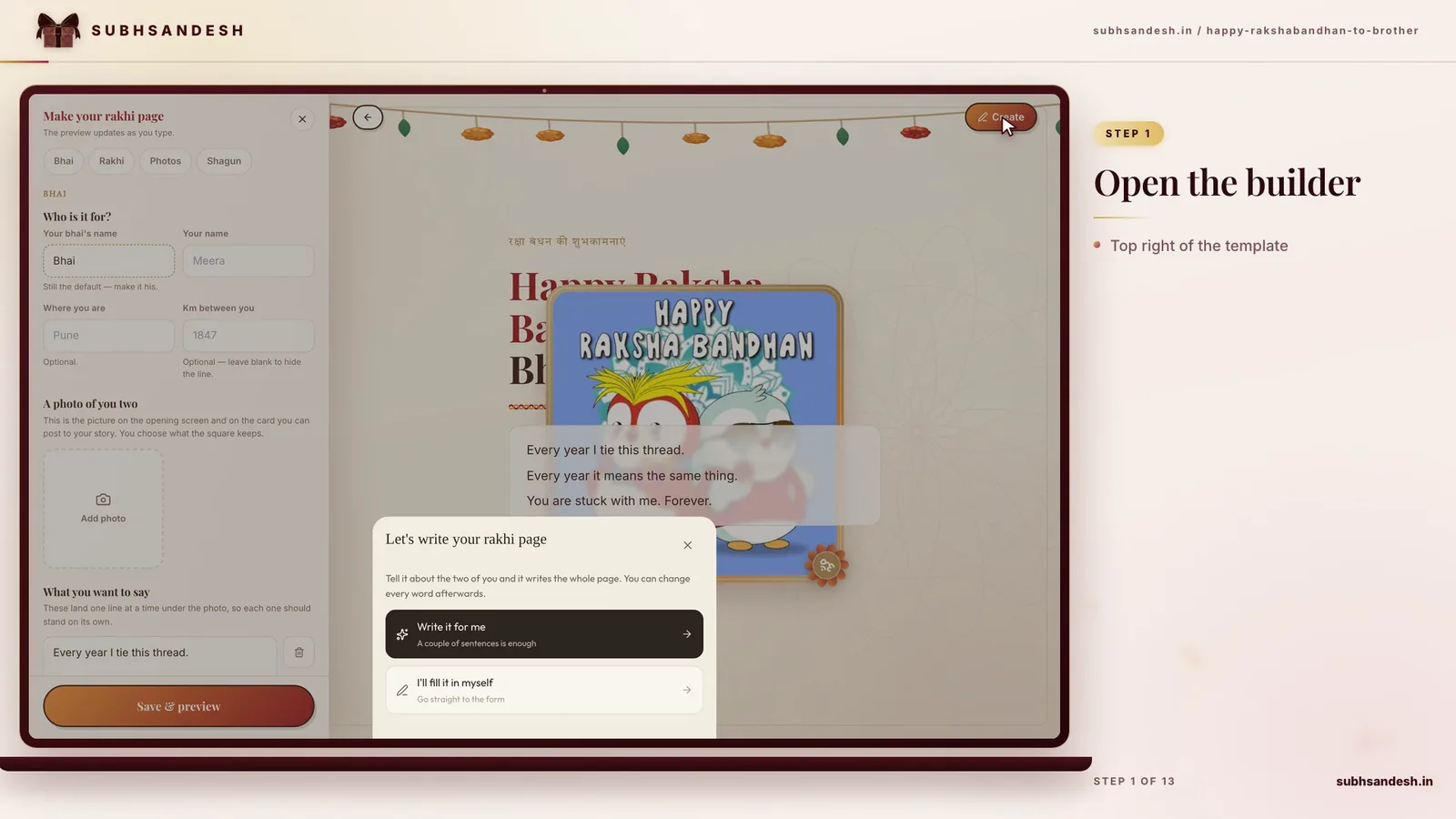
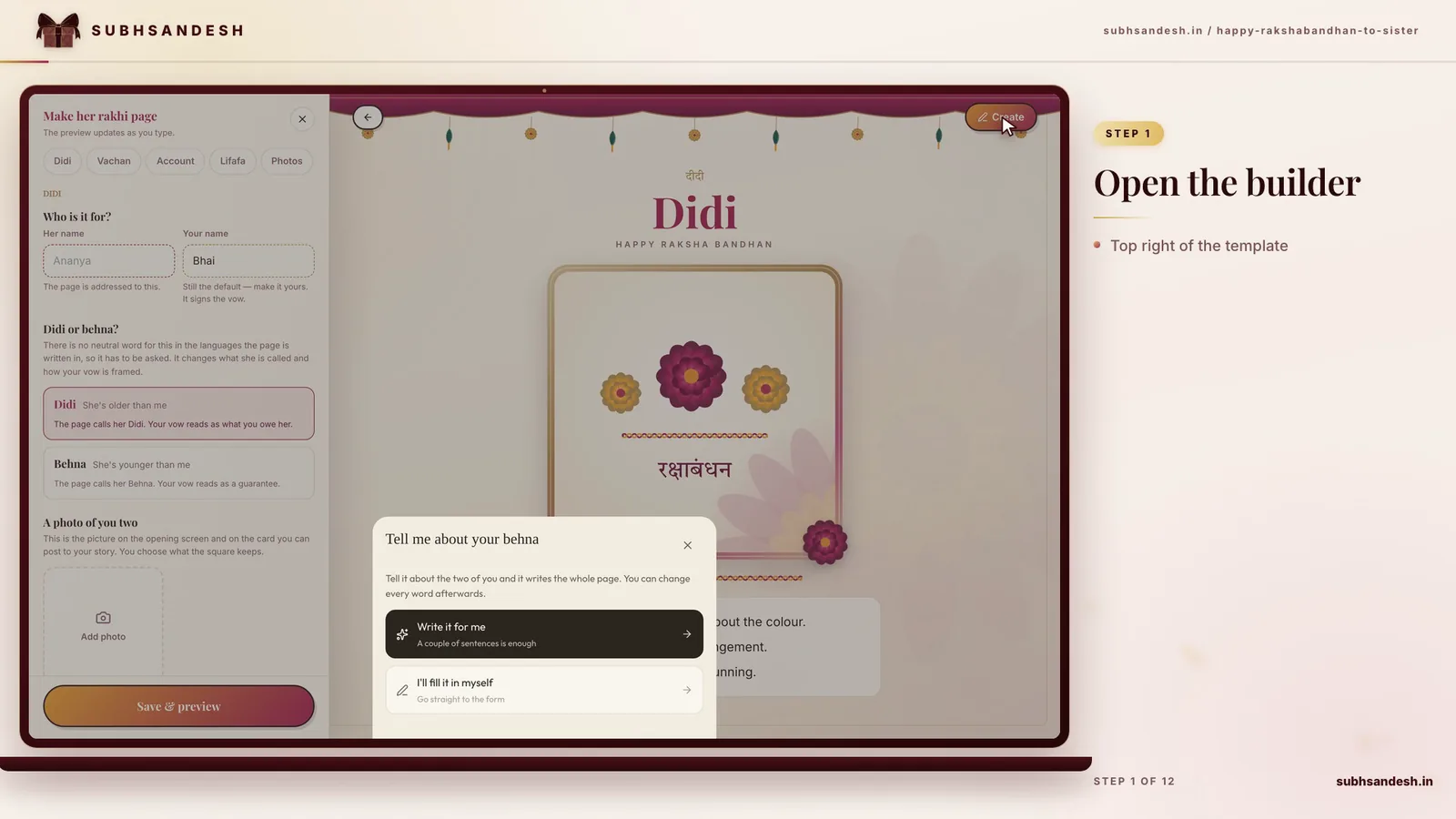
See it built, step by step
Keep reading
Thala Deepavali: A Couple's First Deepavali at the Bride's Home
Thala Deepavali is a Tamil couple's first Deepavali after marriage, at the bride's home. In 2027 it is Thursday 28 October, oil bath 4:40–6:01 AM in C…
 Suyash Agrahari· 9 min
Sugar-Free Diwali Sweets: Swaps, Label Warnings and the Evidence
Five original no-added-sugar Diwali sweets, why jaggery and honey do not count, the warnings FSSAI requires on a sugar-free box, and what an Indian su…
Suyash Agrahari· 9 minShort Diwali Quotes: 34 Original One-Liners Under 10 Words
34 original short Diwali quotes, each under ten words and marked with its word and character count, grouped by mood: lamps, family, friends, gratitude…
Suyash Agrahari· 9 min