
Raksha Bandhan 2026: Date, Muhurat and the 27th-vs-28th Mix-Up
Raksha Bandhan 2026 is Friday 28 August. The rakhi window closes at 9:48 AM IST everywhere — the instant Shravan Purnima ends — but opens at local sunrise, so Kolkata gets 4h 27m and Mumbai 3h 22m. Bhadra falls on the 27th and clears before sunrise on the 28th.
Make this into a page you can send
Photos, a message, music and a ready-to-share link — in a couple of minutes.
or browse all occasionsKey takeaways
- • Raksha Bandhan 2026 is Friday 28 August, and the rakhi window closes at 9:48 AM IST — the instant Shravan Purnima ends.
- • Bhadra falls on 27 August 2026 and ends before sunrise on the 28th, so it does not touch the morning muhurat at all.
- • The 9:48 AM close is national; the open is local sunrise — 5:21 AM in Kolkata against 6:26 AM in Mumbai, a 65-minute gap.
- • It is a public or regional holiday in only nine states and UTs, and a restricted holiday — item 22 of 35 — for central government offices.
- • NASA puts greatest eclipse of the 28 August 2026 partial lunar eclipse at 09:44 IST, four minutes from the panchang's tithi end; India is not in the visibility zone.
On this page
Raksha Bandhan 2026: Date, Muhurat and the 27th-vs-28th Mix-Up
Raksha Bandhan 2026 falls on Friday, 28 August 2026, and the rakhi-tying window closes at 9:48 AM IST — the instant Shravan Purnima ends. It opens at your local sunrise, which is why Kolkata gets 4 hours 27 minutes of it and Mumbai gets 3 hours 22.
We build the shareable pages people send on mornings like this: 2,973 personalised pages across 15 page types, made by 2,466 registered creators since 12 March 2026. Which is why this guide leads with clock times: the two questions we get asked on a festival morning are what time and will it arrive.
The confusion over 27 versus 28 August is not a rumour. Purnima genuinely begins on the 27th. Bhadra genuinely covers most of that day. Below: the tithi, the Bhadra verdict, the muhurat for six cities, which nine states get the day off, and the one astronomical detail that makes 2026 unusual.
Is Raksha Bandhan on 27 or 28 August 2026?
The 28th. Both dates appear in calendars because Shravan Purnima straddles them: it begins at 9:08 AM on 27 August and ends at 9:48 AM on 28 August in Delhi, per Livemint's 25 August 2026 timing report. Prokerala's panchang puts the start at 09:09 AM — a one-minute convention difference, not a disagreement.
The tie-break is the udaya tithi rule: the festival takes the day on which the relevant tithi is present at sunrise. On 27 August, Purnima arrives more than three hours after sunrise. On 28 August it is already running when the sun comes up, and it holds until 9:48 AM. So the 28th wins.
The Government of India agrees, which is the cleanest confirmation there is. The 2026 list of restricted holidays circulated under DoPT's OM No. 12/2/2023-JCA carries "Raksha Bandhan — August 28 — Friday" as item 22 of 35. A gazette does not hedge.
Does Bhadra kaal touch the 2026 morning muhurat?
No. This is the year's genuinely good news, and it deserves a plain sentence rather than the usual "avoid Bhadra" boilerplate. Bhadra falls on 27 August and ends before sunrise on 28 August, so it does not overlap the rakhi-tying period at all — Livemint states this directly, and the Times of India's 22 August explainer puts Bhadra on the 27th "till dusk".
That is the actual mechanism behind the date confusion, and almost nobody spells it out. Purnima starting on the 27th would ordinarily make it a candidate; Bhadra sitting on those hours removes it, leaving a clean window on the morning of the 28th.
Practically: on 28 August 2026 you need not time the ceremony around Bhadra at all. Every minute of the morning window is usable, which is unusual — in several recent years Bhadra ate the morning and pushed families into the afternoon.
Rakhi muhurat 2026, city by city
Here is what the news coverage misses. The closing time is national; the opening time is not. 9:48 AM IST is the instant Purnima ends, and a tithi ends everywhere at once. The window opens at local sunrise, and India is 2,900 km wide.
Muhurat windows for 28 August 2026, from Prokerala's location-aware panchang:
| City | Window opens (local sunrise) | Window closes (IST) | You get |
|---|---|---|---|
| Kolkata | 05:21 AM | 09:48 AM | 4 h 27 m |
| Delhi | 06:01 AM | 09:48 AM | 3 h 47 m |
| Chennai | 06:01 AM | 09:48 AM | 3 h 47 m |
| Bengaluru | 06:12 AM | 09:48 AM | 3 h 36 m |
| Mumbai | 06:26 AM | 09:48 AM | 3 h 22 m |
Kolkata gets 65 more minutes than Mumbai for the same festival. Ujjain, the classical reference meridian for Indian panchang, opens at 06:11 AM.
One honest wrinkle: Livemint and the Times of India both give Delhi as 5:57 AM to 9:48 AM, a window of 3 hours 51 minutes, where Prokerala says 06:01 AM. Four minutes, from a different sunrise convention. Livemint also notes Gurgaon at 5:58 AM. If you are in a third city, look up your own sunrise rather than borrowing Delhi's — that is precisely how a panchang page computed for the wrong location ends up giving Indian readers a European muhurat.
Where 28 August 2026 is an actual holiday
Raksha Bandhan is not a national holiday, and this catches people out every year. For central government offices it is a restricted holiday — item 22 of the 35 in that DoPT list — which means an employee must spend one of their limited optional days on it. The office itself stays open.
Nine states and union territories have declared it a public or regional holiday for 28 August 2026, according to LatestLY's state-wise holiday breakdown: Chhattisgarh, Dadra and Nagar Haveli, Daman and Diu, Gujarat, Haryana, Madhya Pradesh, Rajasthan, Uttarakhand and Uttar Pradesh. Banks are shut in five of them — Gujarat, Madhya Pradesh, Rajasthan, Uttarakhand and Uttar Pradesh.
The pattern is obvious: the holiday follows the festival's north-and-west heartland. If you are in Bengaluru, Chennai, Hyderabad, Kolkata or Mumbai, 28 August 2026 is a normal working Friday, and the 9:48 AM deadline lands inside your commute.
What makes 2026 different: an eclipse four minutes from the tithi's end
Purnima ends at the moment the moon is exactly full. Which means there is an independent way to check the panchang, and in 2026 it is unusually clean.
NASA's Goddard Space Flight Center lunar eclipse canon for 2021–2030 lists a partial lunar eclipse on 28 August 2026, greatest eclipse at 04:14:04 TD, Saros series 138, umbral magnitude 0.930, partial phase lasting 3 hours 18 minutes. Convert 04:14 UT to Indian time and you get 09:44 IST — four minutes from the panchang's 09:48 AM tithi end. Two entirely separate computations, one Vedic and one astronomical, landing within four minutes of each other on the same instant.
Does it affect the ritual? No, and here is why: NASA lists visibility as the eastern Pacific, the Americas, Europe and Africa. India is not on that list. The moon is below the horizon in India at 09:44 IST, so there is no visible eclipse and, by the usual rule, no sutak to observe.
Two more 2026 specifics: 28 August is the second-latest Raksha Bandhan of the decade — 19 days after 2025's 9 August, beaten only by 30 August 2023 — and it falls on a Friday, a working day in most of the country.
If you miss the 9:48 AM window
Plenty of families will. A 3-hour-22-minute window in Mumbai on a working Friday is tight, and the fallbacks are ranked, not equivalent.
1. Aparahna, roughly 1:38 PM to 4:11 PM in Delhi
The afternoon division, and the conventional second choice. Prokerala gives 01:38 PM to 04:11 PM for Delhi; Livemint puts it at roughly 1:46 PM to 4:20 PM. Note the tension nobody mentions: Purnima ended at 9:48 AM, so this window sits outside the tithi. Many households use it anyway, and many priests accept it.
2. Pradosh, roughly 6:43 PM to 8:59 PM in Delhi
The dusk division, and the third choice. Same caveat, further from the tithi. Prokerala's Delhi figures are 06:43 PM to 08:59 PM, with sunset at 06:43 PM.
3. A link timed to open at the muhurat
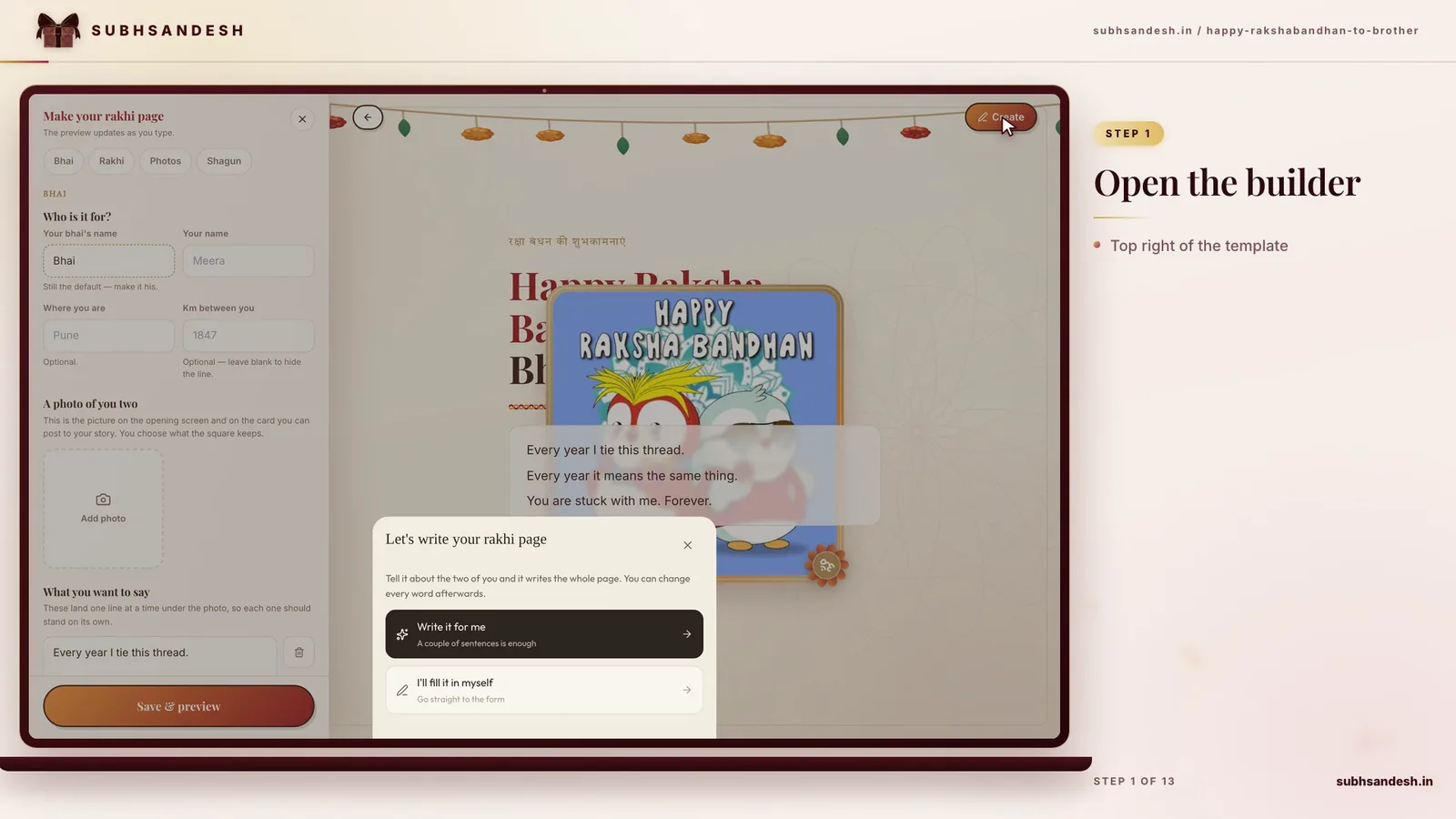
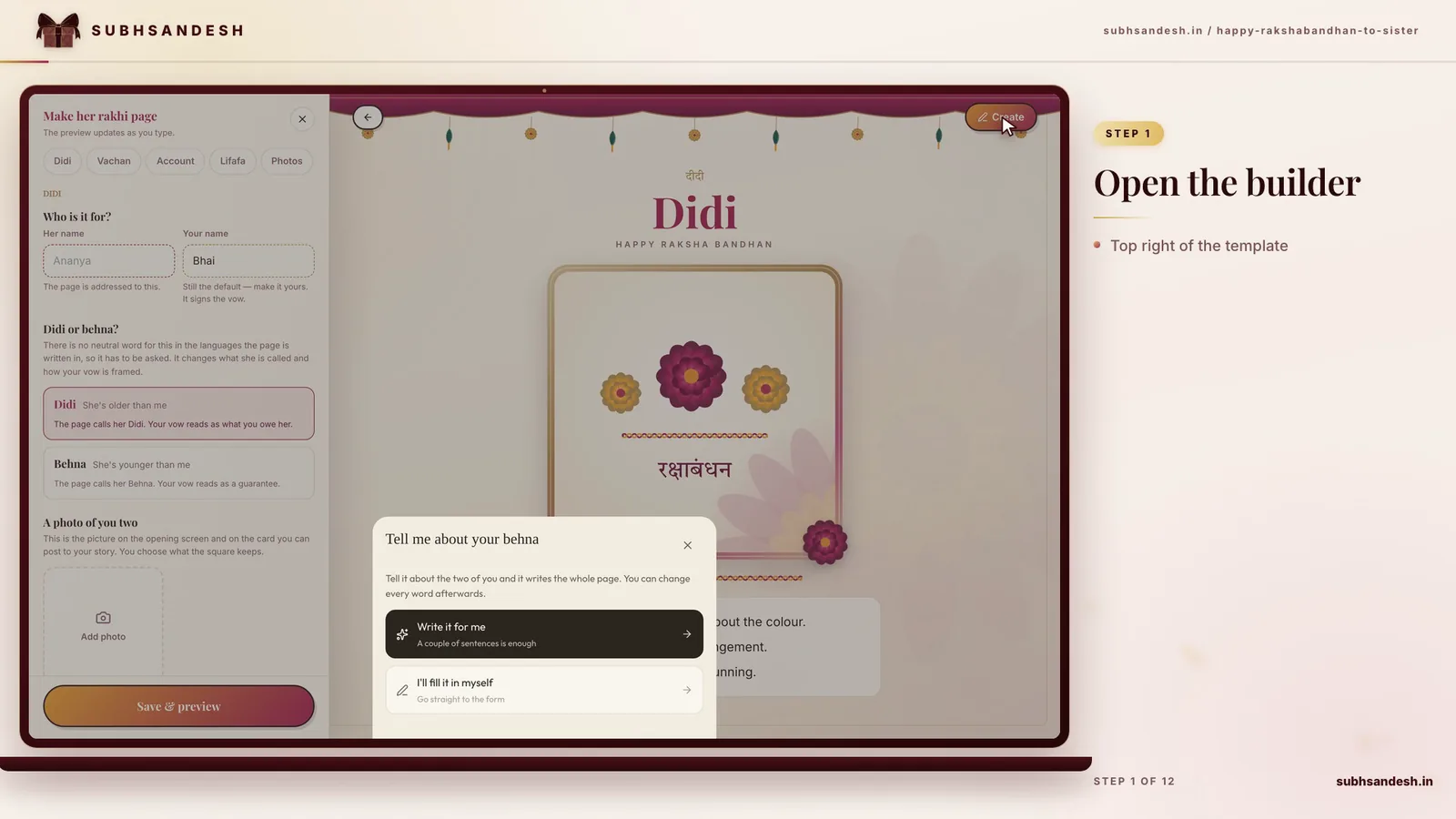
If the person is not in the room, the ceremony is a phone screen either way. A Raksha Bandhan page for a brother or the sister version takes a few minutes with a photo and a name, and can be built the night before to land inside the window. Across our platform, 51.1% of shared pages are opened on a phone and each one averages 12.2 views, so a link sent at 6 AM tends to be reopened through the day rather than seen once.
4. Nothing digital at all
If you are in the same house, put the phone down and tie the thread — a link is the wrong choice and we will say so. Our own numbers also say the rakhi templates are barely tested — 3 of those 2,973 pages are Raksha Bandhan pages, with 39 recorded views between them. Too few to draw any conclusion from, and worth saying out loud. What we do have volume on is everything else:
| Page type | Pages created (of 2,973) | Share of all pages |
|---|---|---|
| "I love you" page (/love-gf) | 931 | 31.3% |
| Digital bouquet (/bouquet-gf) | 732 | 24.6% |
| Apology dashboard | 628 | 21.1% |
| Birthday page for a partner | 188 | 6.3% |
The reassuring number is completion: 99.4% of started pages get published and shared, 2,956 of 2,973. People who begin one finish it. You can browse every SubhSandesh template if the rakhi pages are not the right fit.
Raksha Bandhan 2027 falls on Tuesday 17 August
Prokerala's 2020–2030 festival table gives Tuesday, 17 August 2027 — 11 days earlier than 2026, because the lunar calendar drifts against the Gregorian one. A Tuesday is a working weekday in every state, holiday or not, so 2027 is the year to plan the ritual around office hours rather than assume a long weekend. Our sibling guides to Rakhi 2027 wishes and quotes cover the message itself.
One curiosity worth logging now: NASA's canon puts a penumbral lunar eclipse on 17 August 2027 too, at 07:14:59 TD, Saros 148, visible only from the Pacific and the Americas. Two consecutive Raksha Bandhans on eclipse days is full-moon geometry, not an omen — but expect the question.
To re-date this page for 2027, only four values change: the date, the Purnima start and end, the per-city sunrise column, and the holiday notifications. Everything else — the udaya-tithi rule, the Bhadra mechanism, the national-close-local-open logic — holds every year.
Sources
- Livemint, Raksha Bandhan 2026 date: August 27 or 28? — 25 August 2026. Purnima and Bhadra timings; Delhi and Gurgaon muhurat.
- The Times of India, Is Raksha Bandhan on August 27 or 28? — 22 August 2026. Bhadra on the 27th; Delhi window of 3 h 51 m.
- LatestLY, Is it a public holiday in your state? — 5 August 2026. State-wise and bank holiday status.
- Prokerala, Raksha Bandhan festival panchang — location-aware muhurat, Aparahna and Pradosha windows, 2020–2030 date table.
- Government of India, List of Restricted Holidays 2026 (DoPT OM No. 12/2/2023-JCA) — Raksha Bandhan as item 22 of 35.
- NASA Goddard Space Flight Center, Lunar Eclipses: 2021–2030 — the 2026 and 2027 eclipses. Undated reference publication.
Frequently Asked Questions
Turn this inspiration into an unforgettable surprise
Build a page with photos, a heartfelt message, music and a ready-to-share link.
- Photos, message & music
- Ready-to-share link

Written by
Suyash Agrahari
Founder
Suyash Agrahari is a Software Engineer at HireQuotient and the founder of SubhSandesh and DrawFlow (drawflow.in). He builds AI agents and full-stack products with Next.js, Node.js, and the OpenAI and LangChain ecosystems, having shipped autonomous multi-agent systems, AI copilots, and large-scale outreach platforms — and scaled side projects from a few hundred to millions of users. He writes about AI engineering, web development, and building products that grow through SEO and organic reach.
Stay Connected
Follow SubhSandesh
New templates, festival ideas and step-by-step walkthrough videos — first on our socials.
Product guide
See it built, step by step
Keep reading
Thala Deepavali: A Couple's First Deepavali at the Bride's Home
Thala Deepavali is a Tamil couple's first Deepavali after marriage, at the bride's home. In 2027 it is Thursday 28 October, oil bath 4:40–6:01 AM in C…
 Suyash Agrahari· 9 min
Sugar-Free Diwali Sweets: Swaps, Label Warnings and the Evidence
Five original no-added-sugar Diwali sweets, why jaggery and honey do not count, the warnings FSSAI requires on a sugar-free box, and what an Indian su…
Suyash Agrahari· 9 minShort Diwali Quotes: 34 Original One-Liners Under 10 Words
34 original short Diwali quotes, each under ten words and marked with its word and character count, grouped by mood: lamps, family, friends, gratitude…
Suyash Agrahari· 9 min