
Raksha Bandhan Messages for a Step Brother or Step Sister
Zero of the five pages ranking for this query mention step-siblings at all. Six Raksha Bandhan messages graded by how long you have been family and how old you both were when it happened, plus whether to tie a rakhi and how to ask.
Make this into a page you can send
Photos, a message, music and a ready-to-share link — in a couple of minutes.
or browse all occasionsKey takeaways
- • Across 14,843 words on the five pages ranking for this query on 19 August 2026, "step-brother", "step-sister" and "step-sibling" appear zero times.
- • Drop the protection-since-childhood line: it is false for most step-siblings, and naming the year your family actually started is warmer than blurring it.
- • Grade the message by shared time and the age you both were — in Landon's 2020 study of 25 stepchildren and 71 stepsiblings, interaction depended first on opportunity.
- • In the first year, ask before tying: Cannon's 1986 survey of 75 respondents found being informed about the remarriage was significantly related to how stepsiblings felt.
- • Assume an audience beyond the recipient — SubhSandesh pages average 12.0 views each, and 44.3% of creators password-protect before sharing.
On this page
Raksha Bandhan Messages for a Step Brother or Step Sister
A Raksha Bandhan message for a step brother or step sister should describe the years you have actually had and nothing before them. The borrowed rakhi line — "you have protected me since childhood" — is simply untrue in most step-sibling pairs, and pretending otherwise is the failure that makes an otherwise kind message land badly. Across the 2,718 personalised pages SubhSandesh creators have made since 2026-03-12 in 13 page types, the ones people reread are the specific ones, and each page averages 12.0 views, so assume more than one person reads what you write.
Below are six scripts graded by how long you have been family and how old you both were when the households merged, plus the first Raksha Bandhan after a remarriage, whether to tie an actual rakhi, and where the half-sibling distinction sits. Raksha Bandhan 2026 falls on Friday 28 August.
What a step-sibling rakhi message has to do that a standard one does not
A step-sibling message has to be accurate about a relationship that began mid-story: you did not grow up inside this ritual together, and you did not choose each other. That single difference rules out most of what is available to copy.
I read the five pages ranking for this query on 19 August 2026. Between them they carry roughly 14,800 words of rakhi wishes, and the strings "step-brother", "step-sister" and "step-sibling" appear zero times. "Half-sibling" appears zero times too.
The closest anyone comes is a section addressed to cousins.
Family-communication research explains why a borrowed line misfires. In interviews with 53 members of blended families, Braithwaite, Baxter and Harper (1998) found that rituals worked when they paid homage to both the old family and the new one, and stalled when the new arrangement was laid straight over the old. A message that claims a shared childhood does exactly that — it writes over the history your step-sibling actually had.
Six Raksha Bandhan messages, graded by how long you have been family
Shared time and the age you both were are the two variables that change what is honest to say. Olivia Landon's 2020 grounded-theory thesis at the University of Missouri, built from 25 stepchildren describing 71 stepsiblings, found that interaction between stepsiblings depended first on opportunity — shared time, shared space, the ability to interact at all. The Nebraska group behind the ritual study above, drawing on 980 pages of interview transcripts covering the first four years of blended family life, traced five different developmental pathways rather than one shared timetable.
So pick the script that matches your opportunity, not the one that sounds warmest.
1. Together since primary school
Fits a step-sibling you were both under ten for, ten or more years ago. Say something only a shared house produces: "We have split one bathroom queue, one Wi-Fi password and one set of parents since Class 3, and I would pick you again. Happy Raksha Bandhan." Avoid "from the day you were born" — the date the two of you start is a real date, and naming it is warmer than blurring it.
2. Merged as teenagers, several years in
Fits a merge at twelve to eighteen, now four or more years old. Teenagers get the hardest version of this, so say the difficulty out loud: "We met at fifteen with nothing in common except a first floor. Six years on, you are the person I text first when something goes wrong. Happy Raksha Bandhan." Avoid retroactive claims about protection; describe the present instead.
3. The first Raksha Bandhan after the wedding
Fits year one, at any age. Offer rather than assume: "This is our first Raksha Bandhan and I am not going to pretend I know you yet. I would like to. If you want to do the rakhi properly, I am in; if you would rather skip it this year, that is completely fine." Avoid an inherited nickname — "bhai" on day forty can read as a claim rather than affection.
4. Met as adults, and it worked
Fits meeting at your parent's second wedding in your twenties or thirties. Name the oddness of the timing, because it is genuinely funny and it dodges every false note: "I acquired a brother at twenty-nine, which is not the usual delivery schedule. Best surprise of that year. Happy Raksha Bandhan." Avoid "always" and "since forever" in any form.
5. Warm with you, contested elsewhere in the family
Fits the case where the two of you are fine and other relatives are still arguing about the remarriage. Your message has an audience beyond its recipient, so make your position explicit: "Whatever anyone else has decided about Papa's marriage, my side of it is simple — you are my sister, and I am glad about it. Happy Raksha Bandhan." Avoid naming the objectors.
6. Barely a relationship
Fits step-siblings who have exchanged perhaps twenty sentences. A short courteous message is the honest maximum, and it is not a failure: "Happy Raksha Bandhan, Aditi. I hope this year is a good one for you." Avoid the apologetic addendum — "even though we aren't close" tells someone their distance is a problem you have noticed and minded.
The first Raksha Bandhan after the merge: offer, do not assume
In year one the ritual can read as an imposition rather than a welcome, because a rakhi tied without agreement is a public claim made in front of relatives. Sharon Cannon's 1986 Utah State thesis on stepsibling closeness surveyed 75 usable respondents and found something that has aged well: whether the child had been informed about the parental remarriage was significantly related to how they felt about their stepsiblings at the time it happened. Being consulted mattered; the data on whether they lived together showed no discernible effect on closeness.
The practical form of that is a message three or four days before 28 August that offers two acceptable answers: "Rakhi is on Friday. Happy to do the whole thing with the thali if you want it, happy to just eat the sweets if you don't. Either is genuinely fine."
Then take the answer at face value, without a second ask.
Utah State Extension's 2007 guide to building rituals in stepfamilies makes two points worth borrowing: changing too many rituals at once increases stress and reduces the sense of belonging, and a newly remarried couple's plans for closeness can generate conflict with teenagers rather than reduce it. Its advice, that you keep inviting while respecting a no, is the right posture for a first rakhi.
Step-sibling and half-sibling are not the same thing
A half-sibling shares one parent with you by birth. A step-sibling shares no parent with you by birth — only a marriage. Both are siblings, and neither is a lesser version of anything.
The practical consequence for a message is small but useful. A half-sibling born after the remarriage has usually been in the family since their first day, so a childhood line may be perfectly true for them and false for their older step-sibling in the same house — which means one group message can be wrong for half the room. Write separately.
Worth stating plainly: this research base is almost entirely North American and European. Searching OpenAlex for open-access work on "stepfamily India", "remarriage India" and "step-parent India" returns no open study of Indian step-sibling relationships, so nothing here is calibrated to Indian blended families specifically, and the ritual layer is not studied at all.
What to send in four common step-sibling situations
The four rows below pair each situation with a message length, whether to ask before tying a rakhi, and the SubhSandesh number that decides the format.
| Situation | Message length | Ask before tying a rakhi? | First-party signal that shapes it |
|---|---|---|---|
| Together since primary school | 3–4 sentences, one named year | No | 51.9% of shared pages are opened on a phone |
| Merged as teens, 4+ years ago | 2–3 sentences, present tense only | Once, by text | Median 6.9 hours between first save and last edit |
| First Raksha Bandhan after the merge | 2 sentences plus an offer | Yes, 3–4 days ahead | 99.4% of started pages get published |
| Contact but no closeness | 1–2 sentences, no photo | No | 12.0 average views per page |
The takeaway: the weaker the shared history, the shorter the message and the more the asking matters.
When a message is the wrong move, and where SubhSandesh loses
If you and your step-sibling are estranged rather than merely distant, a Raksha Bandhan message is a contact attempt wearing a festival costume, and it should be sent as one or not at all. Say what you want plainly instead of letting the occasion make the request for you.
A shared page is also the wrong container for anything private. Pages here average 12.0 views, which is exactly what you want when the relationship is warm and the extended family is watching, and exactly what you do not want when the remarriage is contested and one relative will screenshot it. Send those as plain WhatsApp text, or use the password option that 44.3% of creators already switch on.
One more limit, stated plainly: our Raksha Bandhan page for a brother is written brother-first, with tilak and rakhi-tying scenes addressed to him. For a step-sister you will be adapting the wording, or picking something from the full template gallery that carries no sibling assumption at all. And if you are in the same room on Friday, say the sentence out loud — the page is for the step-sibling in another city.
Sources
- Braithwaite, D. O., Baxter, L. A., & Harper, A. M. (1998). The role of rituals in the management of the dialectical tension of "old" and "new" in blended families. Communication Studies, 49(2).
- Braithwaite, D. O., Olson, L. N., Golish, T. D., Soukup, C., & Turman, P. (2001). "Becoming a family": developmental processes represented in blended family discourse.
- Landon, O. (2020). Conflict engagement and management among stepsiblings. MS thesis, University of Missouri.
- Cannon, S. D. (1986). The effect of geographical setting, duration in a single parent family, sex and dethronement on stepsibling relationships after parental remarriage. Utah State University.
- Allgood, S., Higginbotham, B., Crook, R., & Skogrand, L. (2007). Creating rituals in stepfamilies. Utah State University Extension.
Frequently Asked Questions
Turn this inspiration into an unforgettable surprise
Build a page with photos, a heartfelt message, music and a ready-to-share link.
- Photos, message & music
- Ready-to-share link

Written by
Suyash Agrahari
Founder
Suyash Agrahari is a Software Engineer at HireQuotient and the founder of SubhSandesh and DrawFlow (drawflow.in). He builds AI agents and full-stack products with Next.js, Node.js, and the OpenAI and LangChain ecosystems, having shipped autonomous multi-agent systems, AI copilots, and large-scale outreach platforms — and scaled side projects from a few hundred to millions of users. He writes about AI engineering, web development, and building products that grow through SEO and organic reach.
Stay Connected
Follow SubhSandesh
New templates, festival ideas and step-by-step walkthrough videos — first on our socials.
Product guide
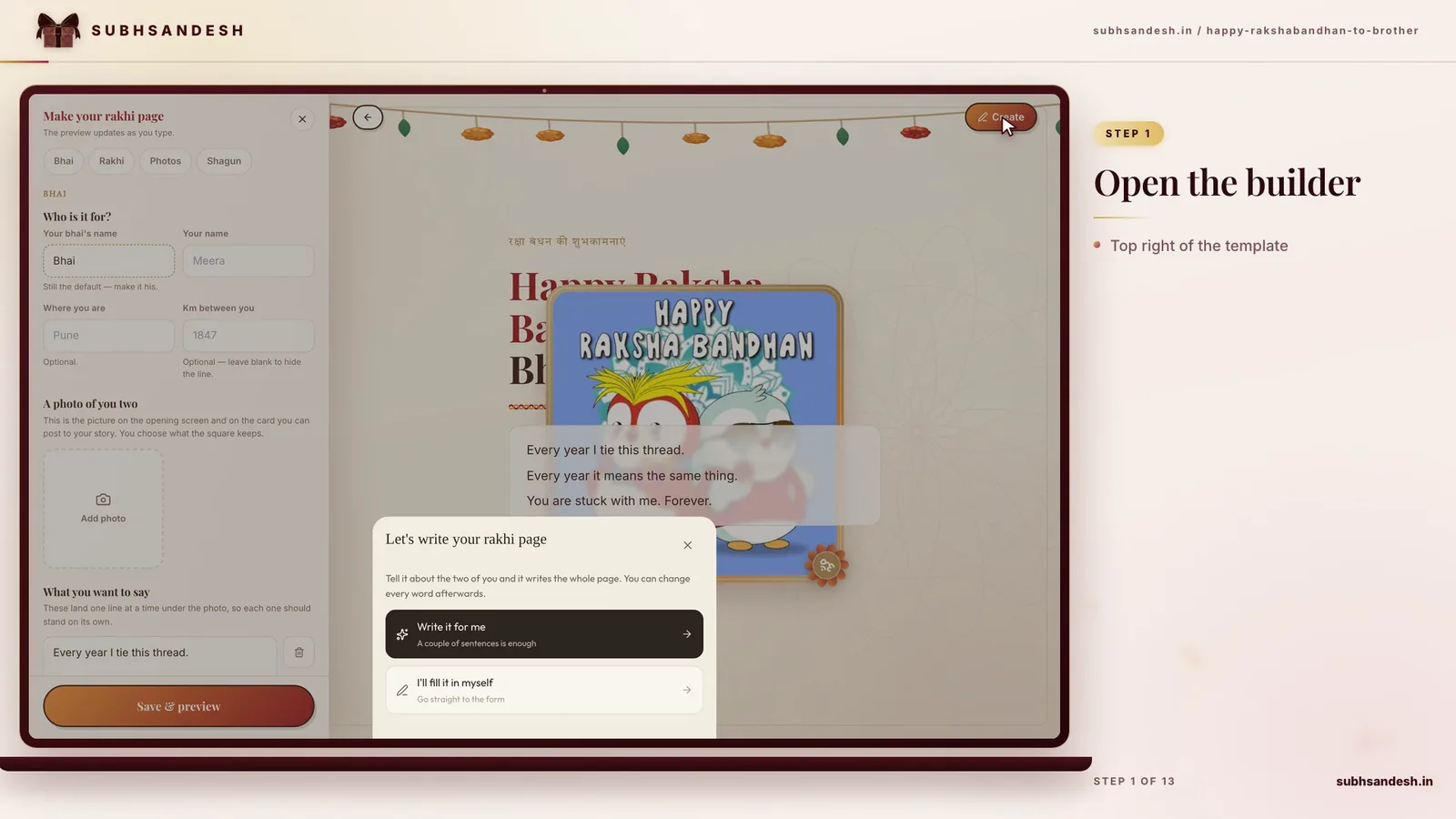
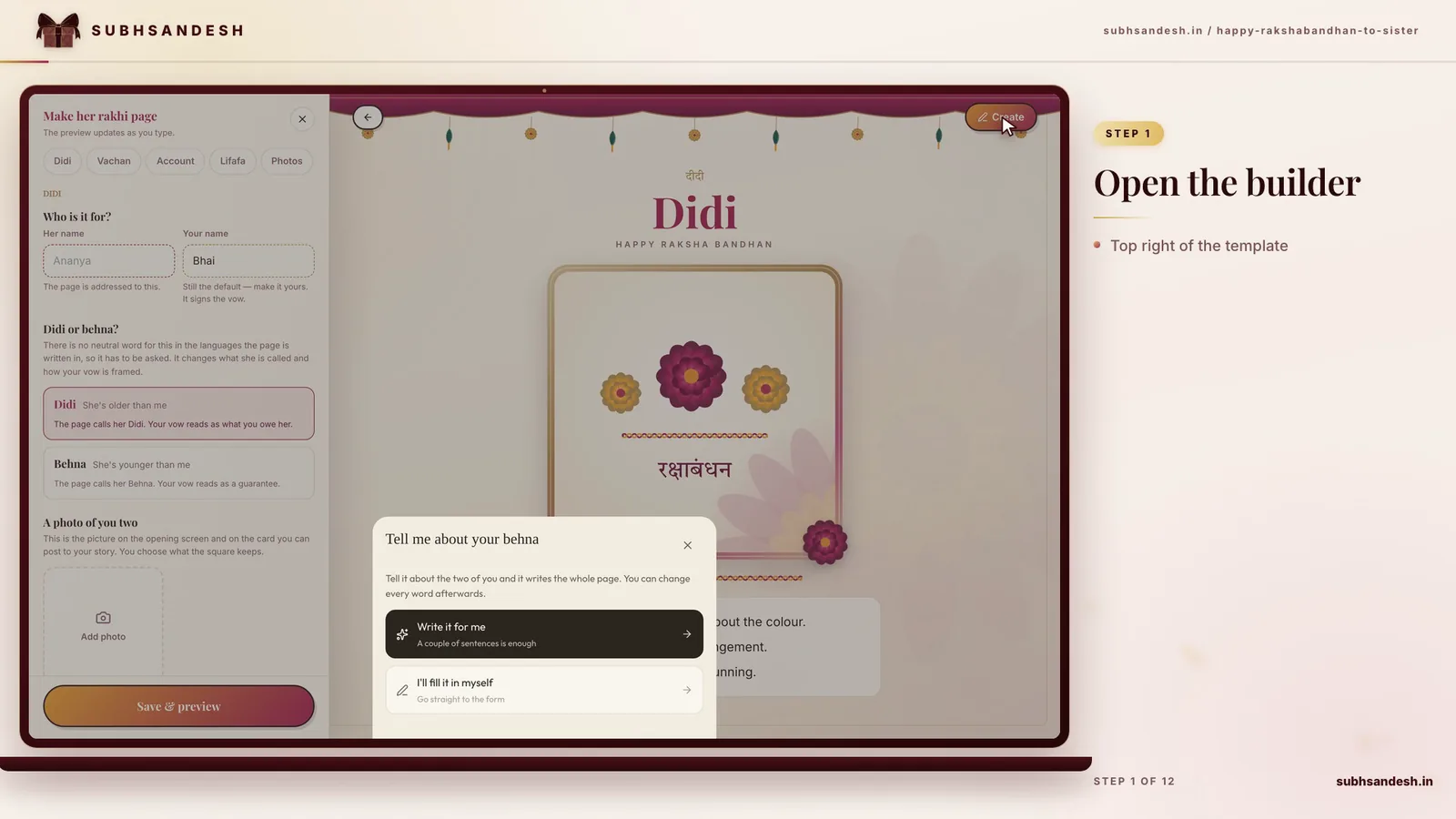
See it built, step by step
Keep reading
Thala Deepavali: A Couple's First Deepavali at the Bride's Home
Thala Deepavali is a Tamil couple's first Deepavali after marriage, at the bride's home. In 2027 it is Thursday 28 October, oil bath 4:40–6:01 AM in C…
 Suyash Agrahari· 9 min
Sugar-Free Diwali Sweets: Swaps, Label Warnings and the Evidence
Five original no-added-sugar Diwali sweets, why jaggery and honey do not count, the warnings FSSAI requires on a sugar-free box, and what an Indian su…
Suyash Agrahari· 9 minShort Diwali Quotes: 34 Original One-Liners Under 10 Words
34 original short Diwali quotes, each under ten words and marked with its word and character count, grouped by mood: lamps, family, friends, gratitude…
Suyash Agrahari· 9 min