Raksha Bandhan Online Wishes: Which Form to Send
"Raksha Bandhan online wishes" covers six different objects — a typed message, a forwarded image, an e-card, a personalised page, a voice note and a video call. This compares all six on time, on what arrives, and on who each one suits, using 2,973 pages built by 2,466 creators.
Make this into a page you can send
Photos, a message, music and a ready-to-share link — in a couple of minutes.
or browse all occasionsKey takeaways
- • "Raksha Bandhan online wishes" is six different objects — typed message, forwarded image, e-card, personalised page, voice note, video call — and picking the form matters more than picking the tool.
- • A personalised page gets reopened: 36,202 recorded views across 2,973 shared pages, an average of 12.2 opens each. A forwarded image gets looked at once.
- • A built page costs an evening, not minutes — the median gap between a page's first save and its last edit is 6.9 hours (n=931) — and 99.4% of started pages are still finished and shared.
- • The forwarded rakhi graphic is a real genre with an older audience, not a failure to try; a 2025 study of 2,588 motivational e-cards from WhatsApp and Pinterest found it is popular with older recipients.
- • A plain WhatsApp line is the right answer in three cases: when you already speak constantly, when you are late, and when you are not close.
On this page
Raksha Bandhan Online Wishes: Which Form to Send
Before you pick a tool, pick a form. "Raksha Bandhan online wishes" covers six different objects — a typed message, a forwarded image, a ready-made e-card, a personalised page, a voice note and a video call — and they are not interchangeable. On SubhSandesh, 2,973 personalised pages have been created across 15 page types by 2,466 registered creators, and those pages have been opened 36,202 times, an average of 12.2 opens each (measured 25 August 2026).
That is what the heaviest form buys: repeat opens. The lightest form buys speed and nothing else, which is sometimes exactly the right trade.
Every other guide to rakhi wishes has already decided the form for you. This one compares all six on time, on what actually arrives, and on who each suits — including the case for sending a plain line and stopping there.
What counts as Raksha Bandhan online wishes
There is no single object behind the phrase. There are six, and the search engines know it: on Bing en-IN, checked 26 August 2026, not one of the first six results for "raksha bandhan online wishes" is about wishes at all — Wikipedia, three panchang sites, a parenting explainer and Britannica.
That is a query with no settled meaning, which is a fair reflection of the person typing it. Most people searching this have decided to send something and nothing more.
The six forms are: a typed message in the chat; a forwarded image, the ready-made rakhi graphic; an e-card from a card site; a personalised page, a link built around one person; a voice note; and a video call. Everything else is a variant of one of those.
The six forms, compared
Values below are ours where they are ours. The "opens" column is real SubhSandesh data from 36,202 recorded views across 2,973 shared pages, measured 25 August 2026; the rest is time-on-task from building these pages.
| Form | Time to make | What arrives | Reopened later? | Best for |
|---|---|---|---|---|
| Typed message | Under 2 minutes | Your words, no image | Rarely — scrolls away in a day | Someone you already speak to weekly |
| Forwarded image | Seconds | A graphic with someone else's words | No — buried in the gallery | Older relatives, wide family groups |
| Ready-made e-card | 5–10 minutes | A picture with a caption | Occasionally | Colleagues, distant cousins |
| Personalised page | An evening; median 6.9h from first save to last edit | Their name, your photos, your message | Yes — 12.2 average opens per page | One sibling, once a year |
| Voice note | 1–3 minutes | Your actual voice | Sometimes, if it is short | A sibling who will not read a long message |
| Video call | 10–40 minutes | You, live | Not applicable | Anyone in a different time zone |
The 6.9-hour median is measured on our most-built template (n=931) — people start a page, leave, and come back to the wording. The 12.2-opens figure is why they bother.
Pick the form from the recipient, not from the tool
Tools sell you their own form. The recipient does not care which tool you used; they care whether the thing that arrived was meant for them.
Three questions settle it. Do they read long messages, or do they scroll past? Will anyone else be shown this — a spouse, a parent, a family group? And do you speak to them often enough that a big gesture would read as strange rather than warm?
That last question is the one people skip. If you speak to your brother twice a week, a fifteen-screen page can land as overcompensation. A voice note lands better.
If the answer to the second question is "they will show their spouse", the form should be one that survives being handed to someone else — a page or an image, not a voice note. Worth noting that 44.2% of our creators put a password on their page before sharing it (1,315 of 2,973), which is the opposite instinct: they are building something for exactly one person and locking everyone else out.
If that is your instinct too, the Raksha Bandhan page for a brother and the Raksha Bandhan page for a sister both take a password before you share the link.
Why a ready-made e-card is mostly a picture
The e-card is the form people most often mistake for a personal message. It is not one, and there is research on exactly why.
A 2025 study in Neophilology analysed 110 electronic greeting cards sampled from open-access card sites plus 49 cards that respondents sent to the author on a single holiday, 12 June 2023, alongside interviews with those respondents. Its central finding about the form is "the dominance of the visual component over the verbal" — in an e-card, the picture does the work and the words are a caption.
That is not a flaw. It is what the form is for. But it means an e-card cannot carry a message that needs more than a line, and if the thing you want to say needs a paragraph, you have picked the wrong object.
The forwarded image is not lazy — it has an audience
People apologise for forwarding a ready-made rakhi graphic. Often they should not.
A 2025 study in Nauchnyi dialog analysed 1,788 Russian-language and 800 Yakut-language motivational e-cards collected from WhatsApp and Pinterest between November 2023 and November 2024. It describes the genre plainly as one that has "gained popularity among the older demographic" — a real, studied form with a real audience, not a failure to try.
So the practical rule is a split. The forwarded image is the right form for an aunt, an older cousin, a family group of forty people. It is the wrong form for the one sibling the day is actually about, because everyone in that group received the identical file.
What a built page actually costs you
Honest numbers, since nobody selling you a page will give them.
It takes an evening, not five minutes. Our median gap between a page's first save and its last edit is 6.9 hours (sampled on our most-built template, n=931) — that is people leaving the tab open, thinking, and coming back to change the wording. Anyone promising a personalised page in ninety seconds is describing a template with a name field.
People do finish: 99.4% of started pages are published and shared — 2,956 of 2,973. Seventeen were abandoned. So the effort is not the barrier. The barrier is deciding it is worth an evening, which for most relationships, most years, it is not.
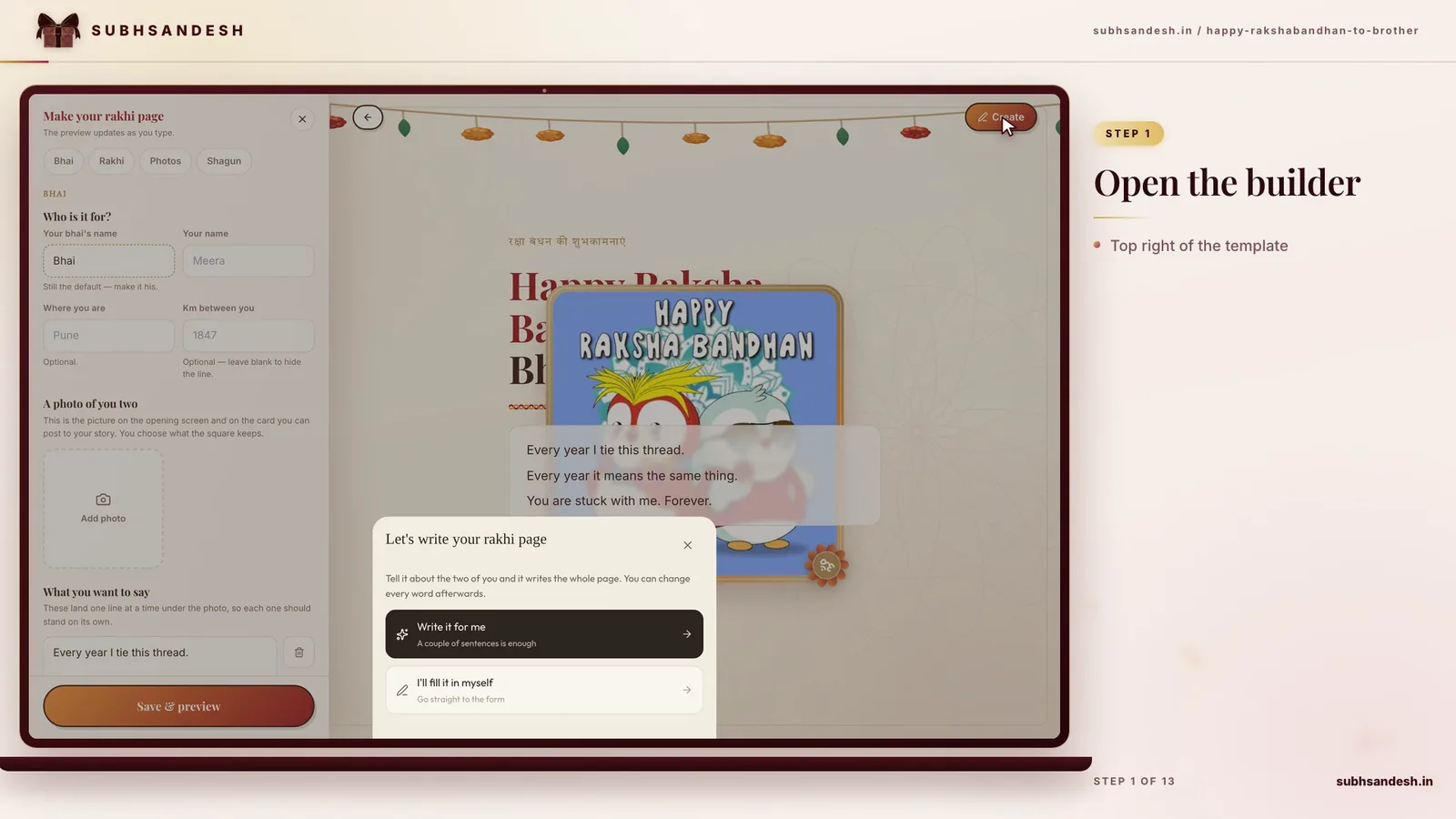
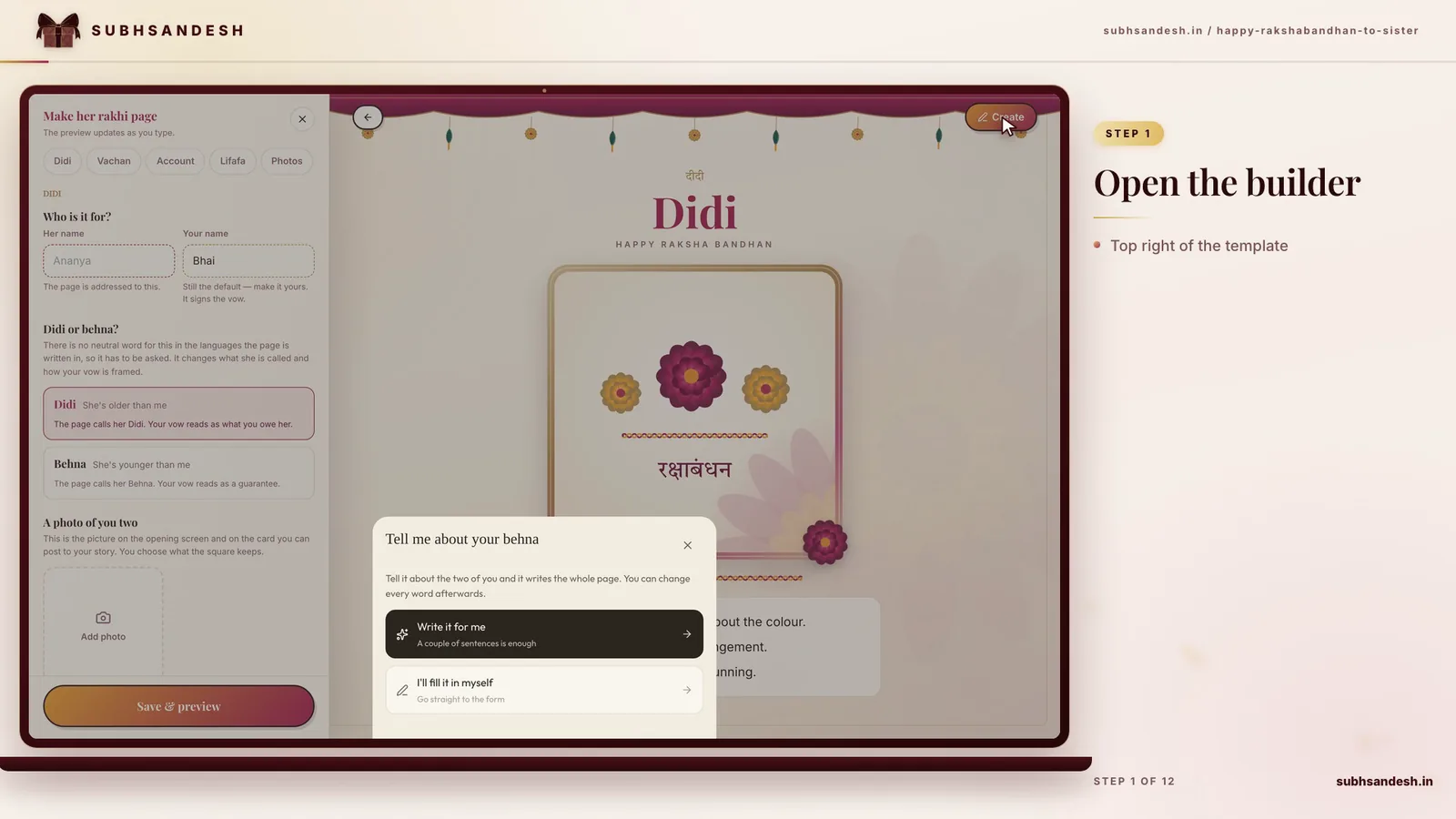
Note also that 51.1% of shared pages are opened on a phone (18,497 of 36,202 views). If the form you choose does not work on a small screen held one-handed, half your audience gets the broken version. You can see what the built form looks like across the full SubhSandesh template range before committing an evening to one.
The one thing no online form does
A physical card does something none of the six can reproduce, and it is worth naming rather than pretending otherwise.
A 2021 UF/IFAS Extension publication on card-sending describes receiving one as a sequence: pulling it out of the mailbox, reading the outside of the envelope, breaking the seal, pulling out the card, reading the note, "and then placing it somewhere special." Six physical actions, ending in an object that occupies space in a room.
No link does that. A page gets 12.2 opens and then lives in a chat thread. If your sibling is the kind of person who keeps things on a shelf, post a card and send the link as well — the two forms are not competing for the same job.
When a plain WhatsApp message is the right answer
Three cases, and they are more common than the tool pages admit.
When you speak constantly. If you and your sister text every other day, a built page is a strange formality. Type the thing you would say out loud.
When you are late. A rushed page is worse than a sincere line at 11pm. The form does not rescue the timing.
When you are not close. Only some sibling relationships are warm enough to carry a big gesture, and an elaborate personalised page sent into a distant one reads as a demand rather than a gift. A short, specific, non-forwarded message — one sentence that could only have been written about them — is the correct form there, and it is the hardest of the six to fake.
The test for any of them is the same: could this have been sent to anyone else? If yes, it is a forward, whatever it cost you to make.
Sources
- Savelyeva, T. V. (2025). "The transformation of sociocultural celebration practices: the electronic greeting card as a polycode text." Neophilology, 11(3), 705–720. Published 16 October 2025. neophilology.elpub.ru
- Melnichuk, O. A. & Alekseeva, V. F. (2025). "Axiology of Motivational E-Card Genre: Concept of Comfort in Russian and Yakut Linguocultures." Nauchnyi dialog, 14(6), 73–91. Published 19 August 2025. nauka-dialog.ru
- Janney, H. (2021). "Life Skills in a Minute: Sending a Card." EDIS 4H416, UF/IFAS Extension. Published 5 August 2021. journals.flvc.org
SubhSandesh figures are from our own database, measured 25 August 2026. The two e-card studies were read in their published English abstracts; the full texts are in Russian.
Frequently Asked Questions
Turn this inspiration into an unforgettable surprise
Build a page with photos, a heartfelt message, music and a ready-to-share link.
- Photos, message & music
- Ready-to-share link

Written by
Suyash Agrahari
Founder
Suyash Agrahari is a Software Engineer at HireQuotient and the founder of SubhSandesh and DrawFlow (drawflow.in). He builds AI agents and full-stack products with Next.js, Node.js, and the OpenAI and LangChain ecosystems, having shipped autonomous multi-agent systems, AI copilots, and large-scale outreach platforms — and scaled side projects from a few hundred to millions of users. He writes about AI engineering, web development, and building products that grow through SEO and organic reach.
Stay Connected
Follow SubhSandesh
New templates, festival ideas and step-by-step walkthrough videos — first on our socials.
Product guide
See it built, step by step
Keep reading
Thala Deepavali: A Couple's First Deepavali at the Bride's Home
Thala Deepavali is a Tamil couple's first Deepavali after marriage, at the bride's home. In 2027 it is Thursday 28 October, oil bath 4:40–6:01 AM in C…
 Suyash Agrahari· 9 min
Sugar-Free Diwali Sweets: Swaps, Label Warnings and the Evidence
Five original no-added-sugar Diwali sweets, why jaggery and honey do not count, the warnings FSSAI requires on a sugar-free box, and what an Indian su…
Suyash Agrahari· 9 minShort Diwali Quotes: 34 Original One-Liners Under 10 Words
34 original short Diwali quotes, each under ten words and marked with its word and character count, grouped by mood: lamps, family, friends, gratitude…
Suyash Agrahari· 9 min