
Raksha Bandhan Quotes in Marathi, With Meaning and Register
Seven Raksha Bandhan quotes in Marathi, each with transliteration and English meaning — plus the तू or तुम्ही decision that comes before the words, and the script faults that break Devanagari on a phone.
Make this into a page you can send
Photos, a message, music and a ready-to-share link — in a couple of minutes.
or browse all occasionsKey takeaways
- • Choose the register before the words: तू for a sibling you are close to, तुम्ही for one you address respectfully — Marathi marks it inside the verb.
- • Marathi also marks the speaker's gender, so a line written for a sister announces the wrong sender when her brother pastes it unchanged.
- • Devanagari can render correctly on your phone and wrongly on hers: the Unicode FAQ says the display engine decides "based on the availability of glyphs in the font".
- • The Marathi eyelash ऱ (RA + halant + ZWJ) is a Marathi-specific form a Hindi-built font may show as a box.
- • Pair Devanagari with plain Roman transliteration — 51.9% of 32,683 shared-page views are on a phone (measured 2026-08-18).
On this page
Raksha Bandhan Quotes in Marathi, With Meaning and Register
The raksha bandhan quotes in Marathi worth sending are written in Marathi rather than translated into it, and the decision that matters comes before the words: whether you address your sibling as तू or तुम्ही. Get that wrong with an elder sister and an affectionate line lands as rude or oddly stiff. Every line below is given three ways — Devanagari, a plain Roman transliteration, and an English meaning — because 51.9% of the 32,683 views on pages shared through SubhSandesh happen on a phone (16,952 of them, measured 2026-08-18), where the line must survive a small screen and whatever font the handset shipped with. Across the 2,718 pages created since 12 March 2026, what breaks is consistent: conjunct letters, the Marathi eyelash ऱ, and lines lifted from Hindi.
What counts as a Marathi Raksha Bandhan quote
A Marathi Raksha Bandhan quote is a short line built from Marathi grammar and kinship words, sent on Shravan Purnima — 28 August in 2026 — to a sibling or the family group. It is not a Hindi line typed in Devanagari, and the giveaway is in the endings rather than the vocabulary.
Marathi marks the person addressed inside the verb, and marks the speaker's gender in the present tense. The University of Chicago's grammar Marathi in Context prints both: मी जातो mi jato for a male speaker, मी जाते mi jate for a female one. So a brother writing "I'll be waiting" says मी वाट पाहतो; a sister says मी वाट पाहते.
So copying off a list is riskier in Marathi than in English: a line written for a sister, pasted by her brother, announces the wrong sender in its second word.
Nor does Marathi need to borrow: the Grindmill Songs Project transcribed more than 110,000 Maharashtrian folk songs over two decades, in the ovi couplet form sung by women at the grindmill. That is not a language short of domestic verse.
Pick the register first: तू, तुम्ही and आपण
Marathi in Context sets out three levels of address: तू (familiar), तुम्ही (middle, and the form it calls most frequently used), and आपण (honorific) — the last "expressing a greater degree of deference than तुम्ही" and "gradually falling out of use".
Register also leaks through imperatives, where wishes live. The familiar imperative is the bare verb base — तू बस — and the respectful adds आ: तुम्ही बसा. A wish built on a command form has already picked a register.
Which to use with an elder sister is family habit, not grammar. Most households use तू to a ताई and keep तुम्ही for elders outside the family; some older families still give an elder sibling तुम्ही. Send what your family speaks — an unexpected तुम्ही to a sister you have argued with all your life reads as sarcasm.
आपण does a second job in group messages: the grammar notes it is the same word as the inclusive "we". A 2025 paper in the Proceedings of SALT 34 is devoted to how that inclusive आपण behaves differently from singular मी in reports of thought. Open a family greeting with आपल्या घरात and everyone reading it is included.
Seven Raksha Bandhan quotes in Marathi, with transliteration and meaning
Each gives the Devanagari, a transliteration, the English meaning, and who it fits.
1. For an elder sister, addressed respectfully
ताई, तुम्ही आहात म्हणून घर आहे. रक्षाबंधनाच्या हार्दिक शुभेच्छा! Tai, tumhi aahat mhanun ghar aahe. Rakshabandhanachya hardik shubhechha! "Tai, the house is a home because you are in it. Warm Raksha Bandhan wishes." For a much older sister in a family that uses तुम्ही upward. आहात is the respectful form; आहेस makes it familiar.
2. For an elder sister, in the familiar register
ताई, तू रागावतेस तेव्हाही माझ्या भल्याचंच सांगतेस. रक्षाबंधनाच्या शुभेच्छा! Tai, tu raagaavtes tevhaahi maajhya bhalyaachanch saangtes. Rakshabandhanachya shubhechha! "Tai, even when you are angry with me you only ever say what is good for me." The ordinary case. Both verbs are second-person feminine singular, so it only works to a sister.
3. For a younger sister
लहान आहेस म्हणून काय झालं, समजूतदार तूच आहेस ग. रक्षाबंधनाच्या खूप शुभेच्छा! Lahaan aahes mhanun kaay jhaalan, samjutdaar tuch aahes ga. Rakshabandhanachya khup shubhechha! "So what if you are the younger one — you are the sensible one." The particle ग is the affectionate tag for a female listener; रे is its male counterpart (ordinary usage, not from the cited grammar). Using रे to a sister is the commonest tell that a line was copied.
4. For a sister who has moved to her husband's home
तू सासरी गेल्यावर घर शांत झालं, आणि ती शांतता आवडत नाही. यंदा राखी पोस्टानं आली तरी चालेल, ताई — मी वाट पाहतो. Tu saasari gelyaavar ghar shaant jhaalan, aani ti shaantata aavadat naahi. Yanda raakhi postaanan aali tari chaalel, Tai — mi vaat paahato. "The house went quiet after you left for your in-laws', and I do not like the quiet. Even if the rakhi comes by post this year, that is fine, Tai — I will be waiting." By a brother: पाहतो is the male-speaker form. A sister writes पाहते.
5. For the family group, not one person
आपल्या घरात राखी म्हणजे नुसता धागा नाही, तर एकत्र बसण्याचं निमित्त आहे. सर्वांना रक्षाबंधनाच्या शुभेच्छा! Aaplya gharaat raakhi mhanje nusta dhaaga naahi, tar ekatra basanyaachan nimitta aahe. Sarvaanna rakshabandhanachya shubhechha! "In our house rakhi is not just a thread, it is an excuse to sit together. Wishes to everyone." The collective greeting most lists never write; आपल्या is the inclusive possessive.
6. For an Instagram caption
भांडायचा पहिला हक्क तिचाच. Bhaandaayacha pahila hakka tichaach. "The first right to pick a fight is hers." Six words, no verb agreement to get wrong, and it reads written rather than forwarded.
7. A one-line status in the familiar imperative
राखी बांध, आणि मग भांडण चालू ठेव. Raakhi baandh, aani mag bhaandan chaalu thev. "Tie the rakhi, and then carry on with the fight." बांध and ठेव are bare bases — familiar imperative, wrong for an elder you address as तुम्ही, who needs बांधा and ठेवा.
Where each Marathi quote fits
Length and script behave differently by channel.
| Where it goes | Length that survives | Script to send | What our data shows |
|---|---|---|---|
| WhatsApp chat message | 1–2 lines, under 140 characters | Devanagari only | 51.9% of 32,683 views are on a phone |
| WhatsApp or Instagram status | 6–8 words | Devanagari, one line | 52.1% of views come from a touch device |
| A shared personalised page | 2–4 lines plus her name | Devanagari, with a gloss underneath | 99.4% of started pages get shared (2,701 of 2,718) |
| A printed card | 2 lines, proofed in the print font | Devanagari only | 44.3% of creators lock the page instead |
The shorter the surface, the more the Devanagari carries alone.
What breaks Devanagari on a phone
Devanagari conjuncts are not separate characters. रक्षाबंधन contains क्ष — क, the virama, then ष — and per the Unicode Consortium's Indic scripts FAQ, whether that shows as one ligature or a half-form plus full letter "is the decision of an underlying software module called a display engine", which "bases this decision on the availability of glyphs in the font".
So the same message can look right on your phone and wrong on your sister's, neither device broken. That is a font problem, not a typo.
Marathi has one hazard Hindi does not: the eyelash ऱ, in everyday words such as दुसऱ्या. Microsoft's OpenType specification for Devanagari records that RA + halant + zero-width joiner "is used for the encoded representation for 'eyelash RA' used for the Marathi language" — a form a Hindi-built font may render as a plain र्य or an empty box.
Two checks take a minute. Send the line to yourself and open it in WhatsApp, not the keyboard preview. And if you are setting it in a design tool or card, use a font with full Devanagari coverage — the Unicode FAQ points to Google's Noto family.
Writing Marathi in Latin letters
Plenty of people speak Marathi fluently and read only Latin script — anyone schooled in English, most cousins raised outside Maharashtra. For them Devanagari alone is a picture, not a message.
So pair them: the Devanagari first, the Roman transliteration under it, as the Marathi in Context lessons do with every sentence.
Use plain typable Roman, not the academic scheme: scholarly transliteration writes नमस्ते as nəməste and माझं as majhə: — precise and unsendable, since nobody has ə on a phone keyboard. Keep Roman lines short; a long one makes a reader decode rather than feel.
When a Marathi quote is the wrong choice
If English or Hindi is what your family jokes in, a Marathi quote is a performance and reads like one. Language signals intimacy only when it matches the household.
If she is on an older handset showing boxes, stop fighting it — send a voice note or photograph the handwritten line. Marathi read aloud has no font dependency.
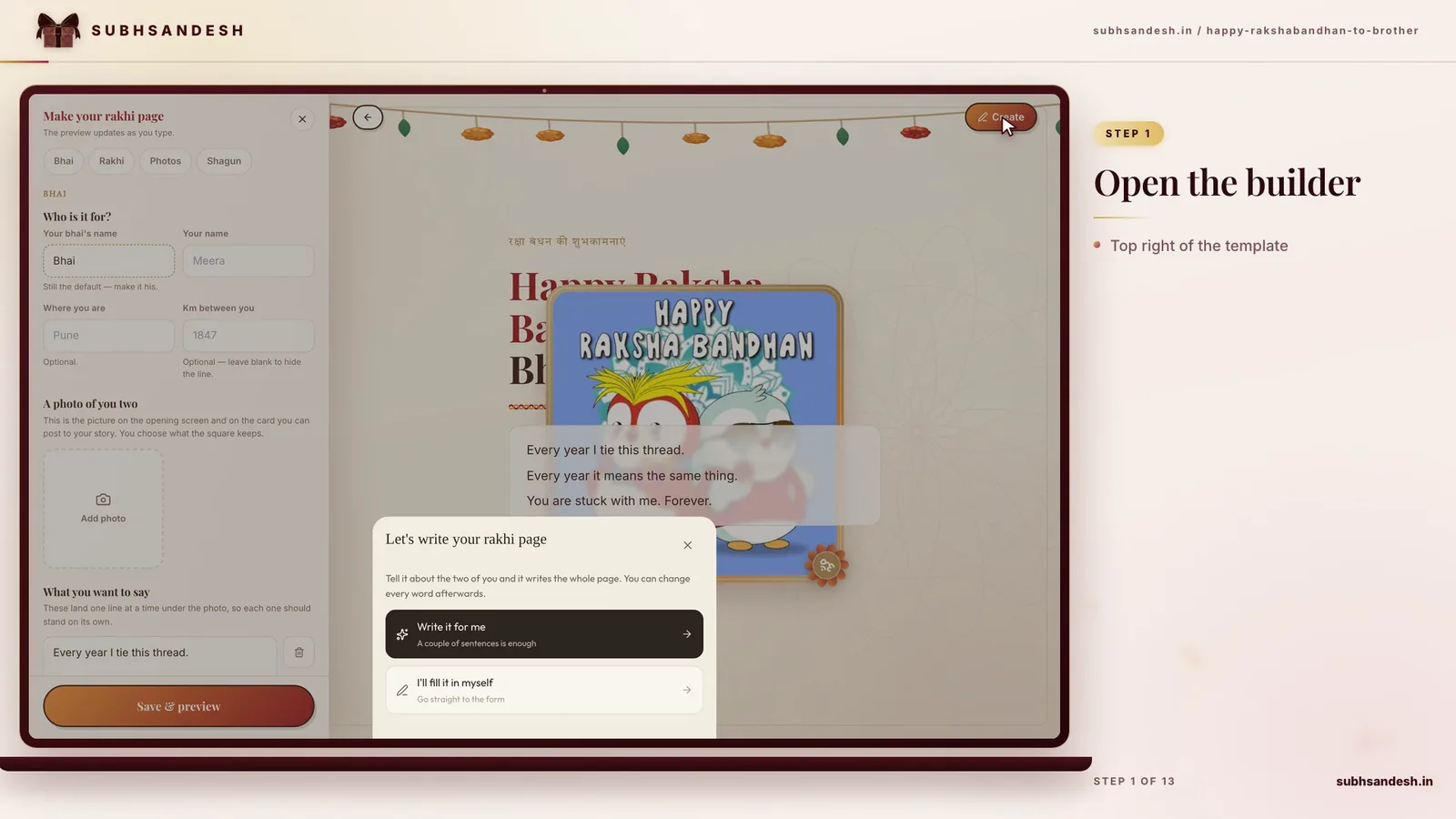
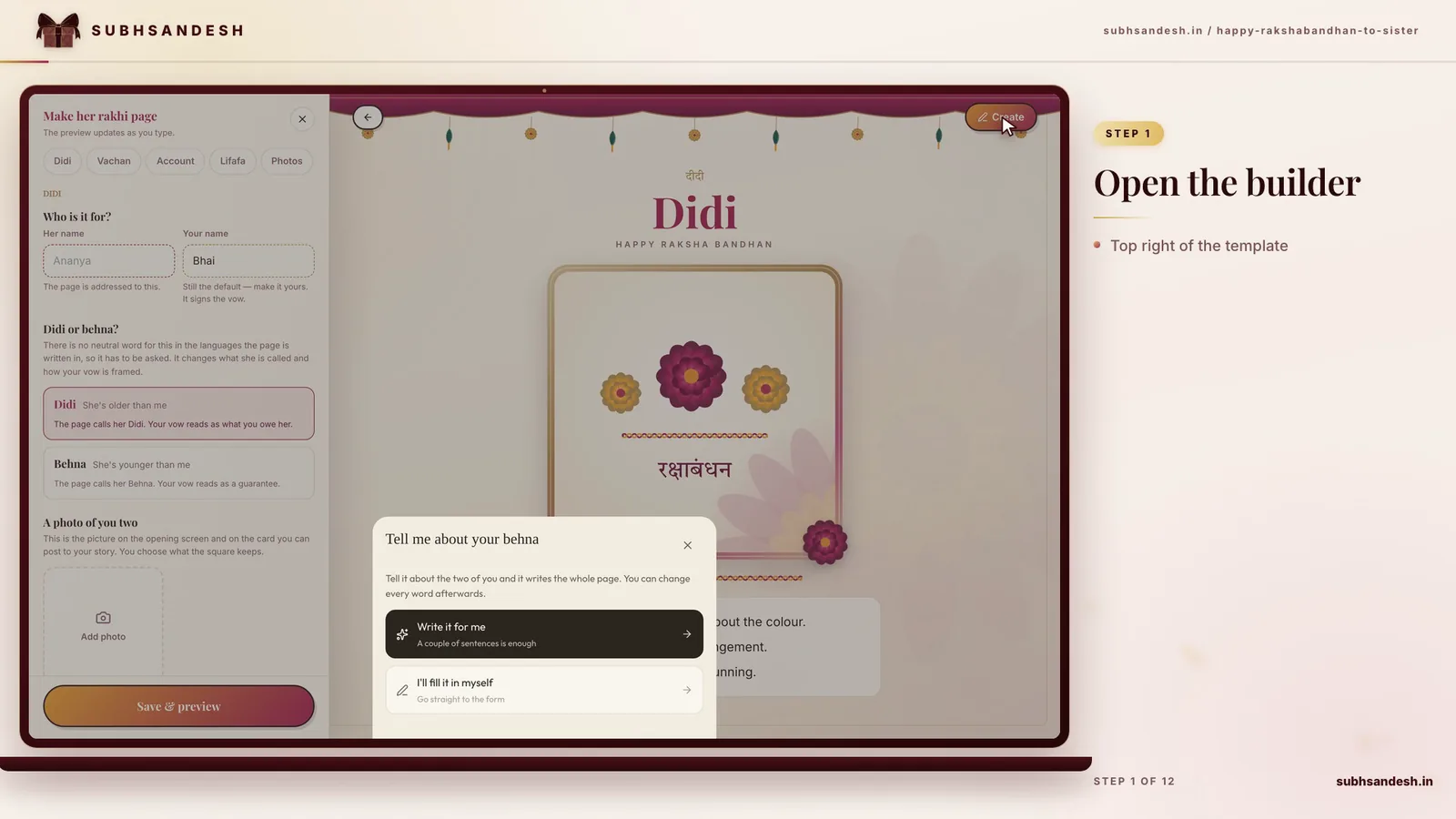
And SubhSandesh is the wrong tool twice over. Our only rakhi template, the Raksha Bandhan page for a brother, is written brother-first, so a sister-directed page means adapting it or starting from a different celebration template — there is no sister-specific rakhi design today. And if she wants something in her hands, a link is not that; post the card.
Getting it right before you send
Give yourself time: the median gap between a page's first save and its last edit on our most-used template is 6.9 hours across 913 pages. People come back and change the wording, and a second-language line is worth rereading before Shravan Purnima.
One caution before locking it — 44.3% of creators password-protect the page (1,205 of 2,718), and a separate password is one more step for someone not fluent with links. For an older sibling, leaving it open is kinder.
Sources
- Marathi in Context, University of Chicago Digital South Asia Library — three levels of address, आपण "gradually falling out of use", and the speaker-gender forms मी जातो / जाते. No publication date printed.
- Shweta Akolkar, "Interpreting the shifty first person inclusive pronoun in Marathi" — Proceedings of SALT 34, 11 March 2025.
- Indic Scripts and Languages FAQ, Unicode Consortium — conjunct encoding, display-engine dependence on font glyphs, Noto fonts.
- "Developing OpenType Fonts for Devanagari Script", Microsoft — RA + halant + ZWJ for the Marathi eyelash RA.
- "Grindmill Songs", Scroll.in — 110,000+ Maharashtrian folk songs transcribed over two decades by Hema Rairkar and Guy Poitevin, CCRSS Pune.
Frequently Asked Questions
Turn this inspiration into an unforgettable surprise
Build a page with photos, a heartfelt message, music and a ready-to-share link.
- Photos, message & music
- Ready-to-share link

Written by
Suyash Agrahari
Founder
Suyash Agrahari is a Software Engineer at HireQuotient and the founder of SubhSandesh and DrawFlow (drawflow.in). He builds AI agents and full-stack products with Next.js, Node.js, and the OpenAI and LangChain ecosystems, having shipped autonomous multi-agent systems, AI copilots, and large-scale outreach platforms — and scaled side projects from a few hundred to millions of users. He writes about AI engineering, web development, and building products that grow through SEO and organic reach.
Stay Connected
Follow SubhSandesh
New templates, festival ideas and step-by-step walkthrough videos — first on our socials.
Product guide
See it built, step by step
Keep reading
Thala Deepavali: A Couple's First Deepavali at the Bride's Home
Thala Deepavali is a Tamil couple's first Deepavali after marriage, at the bride's home. In 2027 it is Thursday 28 October, oil bath 4:40–6:01 AM in C…
 Suyash Agrahari· 9 min
Sugar-Free Diwali Sweets: Swaps, Label Warnings and the Evidence
Five original no-added-sugar Diwali sweets, why jaggery and honey do not count, the warnings FSSAI requires on a sugar-free box, and what an Indian su…
Suyash Agrahari· 9 minShort Diwali Quotes: 34 Original One-Liners Under 10 Words
34 original short Diwali quotes, each under ten words and marked with its word and character count, grouped by mood: lamps, family, friends, gratitude…
Suyash Agrahari· 9 min