
Raksha Bandhan WhatsApp Status With Name: The 24-Hour Rules
A WhatsApp status with your brother's name is a broadcast, not a message: every contact sees it and it expires in 24 hours. Who actually sees it, the posting window for Friday 28 August 2026, six named formats ranked, and what 32,683 recorded page views show about feedback.
Make this into a page you can send
Photos, a message, music and a ready-to-share link — in a couple of minutes.
or browse all occasionsKey takeaways
- • A WhatsApp status is a broadcast, not a message: by default every contact who has your number sees it, and it disappears 24 hours after posting.
- • Post between 8 pm and 11 pm on Thursday 27 August 2026 so the status is still live through Raksha Bandhan on Friday 28 August.
- • Set status privacy to 'Only share with…' first — a diary study of 1,270 users found people posting to a disappearing channel picture a smaller, closer audience than the one that can actually see it.
- • A status view is visible only to you and dies with the status; SubhSandesh's shared pages carry 32,683 recorded views, 12.0 per page, and 51.9% of those opens are on a phone.
- • 44.3% of creators password-protect their page before sharing it (1,205 of 2,718), which is the clearest sign a broadcast is the wrong surface for anything private.
On this page
- 1. Text-only status with his name in the first three words
- 2. A photo of this year's rakhi with his name typed over it
- 3. A 30-second video with a name overlay
- 4. A voice status that says his name out loud
- 5. A Hindi or Marathi status carrying his name
- 6. A link to a personalised page built around his name
Raksha Bandhan WhatsApp Status With Name: The 24-Hour Rules
A Raksha Bandhan WhatsApp status with your brother's name in it is a broadcast, not a message. By default every contact who has your number sees it, it disappears 24 hours after posting, and only you can see who watched. Across SubhSandesh's shared pages we have 32,683 recorded views at an average of 12.0 views per page, and 51.9% of those views happen on a phone — the same screen the status feed lives on. A status view is a number only you see and it dies with the status; a shared page keeps counting. Below: who actually sees your status, when to post so the 24-hour window lands on the festival, six formats ranked by how much of a name survives each, and when a status is the wrong place for the wish.
What a Raksha Bandhan WhatsApp status with a name actually is
A WhatsApp status is a photo, video, voice clip or text card posted to a separate broadcast surface inside WhatsApp. It stays visible for 24 hours to the contacts you allow, then disappears from everyone's feed, including yours. Nothing lands in your brother's chat thread, nothing shows a delivery tick, and nothing survives to be scrolled back to next August.
Putting a name into one overrides that plural audience on purpose. The status goes out to everybody; the name aims it at one person while everybody else watches — the same move as saying "this one's for Aryan" into a crowded room.
Two constraints shape the format. Video and voice statuses run to roughly 30 seconds per clip, so longer footage is split across consecutive statuses and the name has to be in the first one. And Raksha Bandhan 2026 falls on Friday 28 August, so the 24-hour clock needs starting deliberately.
Who actually sees your status, and who you think sees it
WhatsApp gives status three audience settings: all your contacts, your contacts except a list you pick, or only a list you pick. The default is all contacts — in a typical Indian phonebook, several hundred people, most of them not family.
That gap between the audience you picture and the audience you have is measurable. In a retrospective diary study of 1,270 Instagram users, Yao, Taylor and Ransom (Social Media + Society, 2024) found channel ephemerality predicted a less diverse and less close imagined audience: when a post is going to vanish, people picture a smaller, warmer crowd than the one that can actually see it. Imagined closeness also tracked how intimate the disclosure was.
The fix takes ninety seconds. Set status privacy to "Only share with…" and pick the 15 to 20 family contacts who should see a rakhi status. It changes what you can write: a childhood nickname reads well in front of 18 people and strangely in front of 400.
When to post it, so the 24 hours land on the festival
A status expires 24 hours after posting, which makes the arithmetic simple and unforgiving. Post at 6 am on Friday 28 August and it is gone by 6 am on the 29th. Post at 9 pm on Thursday 27 August and it runs until 9 pm on the 28th, covering the thread-tying in the morning, the family calls at lunch and the evening messages.
So the window worth aiming for is 8 pm to 11 pm on 27 August 2026. He sees it the moment he unlocks his phone on the day, and it is still live when relatives open WhatsApp after dinner.
Start earlier than you think you need to. On SubhSandesh the median gap between a creator's first save of a page and their last edit is 6.9 hours, sampled across 913 pages — people do not finish a personal message in one sitting.
Six ways to put his name in a Raksha Bandhan status
Ordered from the fastest to post to the longest-lasting. A name spoken aloud or written into an image reads as chosen; a name typed onto the end of a copied paragraph reads as a mail merge. Each entry gives what it is, who it suits, how long it takes, and what the name does.
1. Text-only status with his name in the first three words
A plain status card, no image, name at the front: "Aryan, thirteen rakhis and you still hide the sweets." Suits anyone in a hurry or on a weak connection. Under a minute. A name in the opening words is what a scrolling reader registers before deciding whether this is about them.
2. A photo of this year's rakhi with his name typed over it
Photograph the actual thread before you tie it, then add his name as text over the image. Suits sisters who are with their brother on the day. Two to three minutes. A name plus a photograph nobody else could have taken is the one combination that cannot be forwarded onward and still make sense.
3. A 30-second video with a name overlay
A clip of the tilak, the aarti thali, or the two of you arguing over sweets, with his name burnt into the first frame. Suits families celebrating in person. Five minutes including trimming. Because the clip is capped near 30 seconds, the name must appear in the first two seconds or tap-through viewers never see it.
4. A voice status that says his name out loud
WhatsApp allows a voice status of up to about 30 seconds. Suits long-distance siblings and anyone who writes stiffly but talks warmly. Two minutes, usually two takes. Spoken names carry further than typed ones: the own-name attention research behind the cocktail-party effect is auditory, and the capture was strongest for unhurried speech.
5. A Hindi or Marathi status carrying his name
The same content in Devanagari, with the name in script rather than transliterated. Suits families whose everyday register is not English. Three minutes with the keyboard set up. Script choice is itself a message about who the status is for, and it narrows who reads it closely.
6. A link to a personalised page built around his name
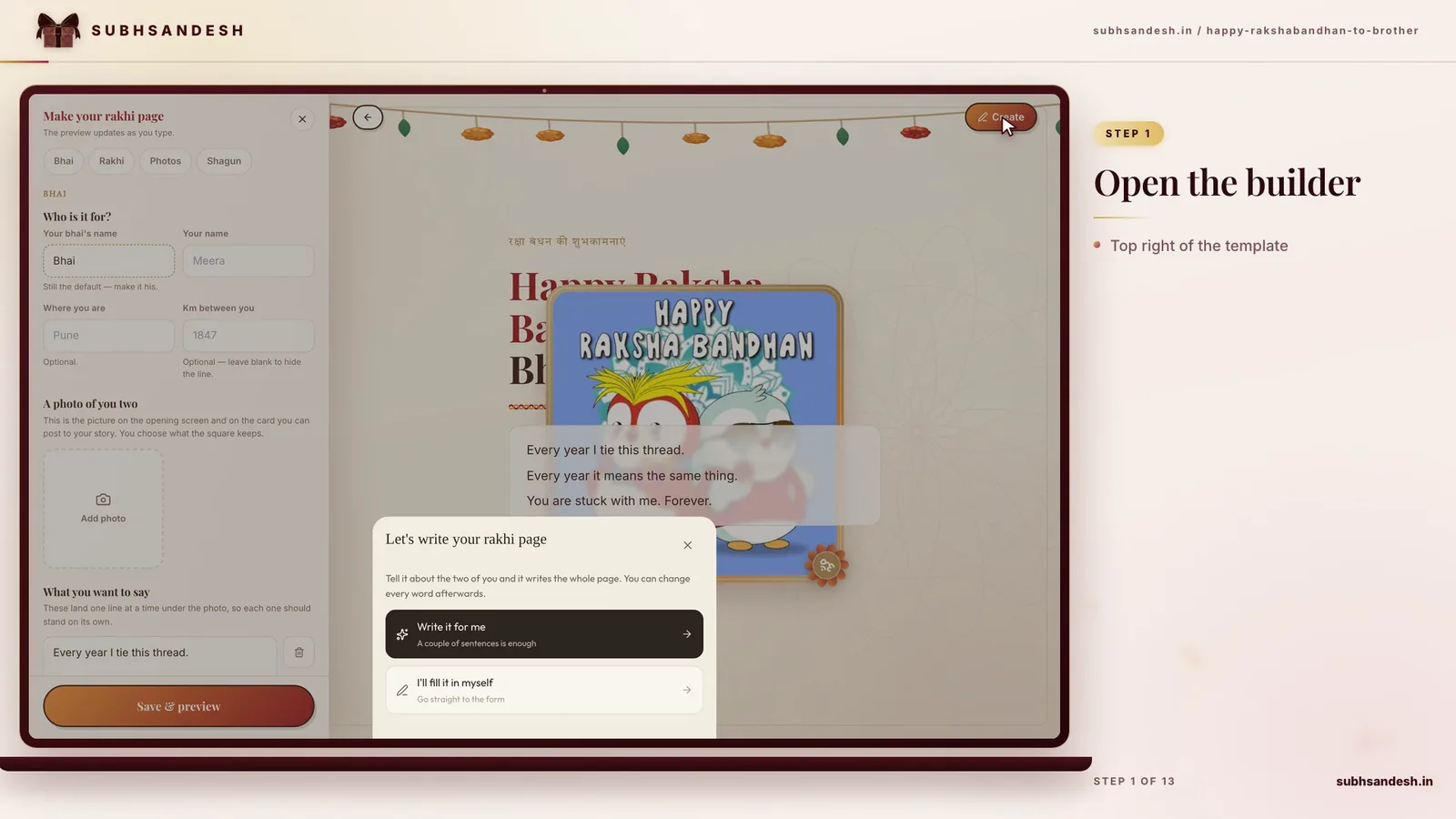
Build a page with his name, your photos and a message, then post the link as your status with one line of text. Suits the sibling who wants the wish to outlive the 24 hours. Ten to fifteen minutes on the Raksha Bandhan page for a brother, which carries tilak, aarti and rakhi-tying scenes around his name and photo. Every open is recorded, and it is still there next year.
Which format to pick, by audience, lifespan and feedback
These five surfaces differ less in effort than in what they leave behind. The feedback column for the page row is measured, not estimated.
| Format | Who can see it | How long it lasts | What you learn afterwards | Minutes to make |
|---|---|---|---|---|
| Text-only status | All contacts, or your chosen list | 24 hours | A viewer list only you see, deleted with the status | 1 |
| Photo of the rakhi with his name | All contacts, or your chosen list | 24 hours | Same viewer list, plus any replies to status | 3 |
| 30-second video status | All contacts, or your chosen list | 24 hours | Viewer list; no per-viewer watch time | 5 |
| Voice status | All contacts, or your chosen list | 24 hours | Viewer list only | 2 |
| Link to a personalised page | Only whoever you send the link to | Indefinite | Recorded views: 12.0 per page on average, 51.9% opened on a phone | 10–15 |
The takeaway is not that one wins. A status reaches the family group in one action and asks nothing of anyone; a page reaches one person and keeps working. The sisters who get both right post the status for the room and send the link to him.
What a name inside a broadcast can and cannot do
A name captures attention. The clearest evidence is auditory: in a 2024 study of 39 participants, hearing their own name among distractor names measurably slowed a visual word-categorisation task, and they detected their own name faster than others. That is the mechanism a named status borrows — and nobody has run the equivalent experiment on a name in a status feed.
What a name cannot do is make a broadcast feel like a message. In an opt-in panel study of 1,910 Facebook users linked to server logs, Burke and Kraut found receiving targeted, composed communication from strong ties was associated with improvements in well-being, while viewing friends' wide-audience broadcasts and receiving one-click feedback were not. Effort spread across an audience is effort divided.
Ephemeral posting has its own trade-off. Bayer and colleagues sampled 154 students over two weeks and interviewed 28: Snapchat exchanges were rated more enjoyable and produced more positive mood than calling, texting, email or Facebook, but were perceived as less supportive. If you want your brother to feel held rather than entertained, the status is not the part that does it.
When a WhatsApp status is the wrong place for the wish
Four cases, and we lose two of them. If what you want to say is private — a family matter, a thank-you nobody else knows about — a broadcast is structurally wrong, and the numbers agree: 44.3% of SubhSandesh creators password-protect their page before sharing it, 1,205 of 2,718 pages.
If your brother has no smartphone, the status never reaches him and neither does a link; a phone call and a posted rakhi are better. If he has muted your updates — which you cannot detect — the status reaches everyone except its intended reader. And if he is in the same room, a status about him while he sits there is worse than looking up.
Where a status wins is reach: one action, the whole extended family, no group etiquette to negotiate. Where it loses is permanence and privacy. The full template gallery covers the durable half.
Sources
- Yao, Taylor & Leiser Ransom, Who's Viewing My Post? Social Media + Society, January 2024.
- Burke & Kraut, Facebook Use and Well-Being Depends on Communication Type and Tie Strength, Journal of Computer-Mediated Communication 21(4), 1 July 2016 (author manuscript).
- Bayer, Ellison, Schoenebeck & Falk, Sharing the Small Moments, Information, Communication & Society 19(7), 2 July 2016.
- Li, Lee, Chiu, Loeb & Sanderson, Attention capture by own name decreases with speech compression, Cognitive Research: Principles and Implications, 12 May 2024.
- First-party data: SubhSandesh platform database, measured 18 August 2026.
Frequently Asked Questions
Turn this inspiration into an unforgettable surprise
Build a page with photos, a heartfelt message, music and a ready-to-share link.
- Photos, message & music
- Ready-to-share link

Written by
Suyash Agrahari
Founder
Suyash Agrahari is a Software Engineer at HireQuotient and the founder of SubhSandesh and DrawFlow (drawflow.in). He builds AI agents and full-stack products with Next.js, Node.js, and the OpenAI and LangChain ecosystems, having shipped autonomous multi-agent systems, AI copilots, and large-scale outreach platforms — and scaled side projects from a few hundred to millions of users. He writes about AI engineering, web development, and building products that grow through SEO and organic reach.
Stay Connected
Follow SubhSandesh
New templates, festival ideas and step-by-step walkthrough videos — first on our socials.
Product guide
See it built, step by step
Keep reading
Thala Deepavali: A Couple's First Deepavali at the Bride's Home
Thala Deepavali is a Tamil couple's first Deepavali after marriage, at the bride's home. In 2027 it is Thursday 28 October, oil bath 4:40–6:01 AM in C…
 Suyash Agrahari· 9 min
Sugar-Free Diwali Sweets: Swaps, Label Warnings and the Evidence
Five original no-added-sugar Diwali sweets, why jaggery and honey do not count, the warnings FSSAI requires on a sugar-free box, and what an Indian su…
Suyash Agrahari· 9 minShort Diwali Quotes: 34 Original One-Liners Under 10 Words
34 original short Diwali quotes, each under ten words and marked with its word and character count, grouped by mood: lamps, family, friends, gratitude…
Suyash Agrahari· 9 min