
Raksha Bandhan Wishes for Bhaiya Bhabhi: One Message, Two People
Raksha Bandhan wishes for bhaiya bhabhi are one message with two recipients. Six Hindi lines with transliteration and English glosses, grouped by how long bhabhi has been in the family and by who you are actually closer to — including the strained case.
Make this into a page you can send
Photos, a message, music and a ready-to-share link — in a couple of minutes.
or browse all occasionsKey takeaways
- • A bhaiya bhabhi wish is one message with two recipients: give bhabhi a line that still makes sense if your brother's name is deleted.
- • Group the wording by tenure, not sentiment — aap in year one, tum by year ten, and a separate short note when the relationship is strained.
- • Adult sibling ties run on words: in 1,259 sibling dyads in the Netherlands Kinship Panel Study, 33% had received practical help from a sibling but 93% gave emotional support.
- • Whether bhabhi gets a rakhi is regional — the lumba is standard in Marwari and Rajasthani families and unknown in much of eastern and southern India.
- • Write for a phone: 51.9% of the 32,683 views on SubhSandesh's shared pages open on one, and 44.3% of creators add a password before sharing.
On this page
Raksha Bandhan Wishes for Bhaiya Bhabhi: One Message, Two People
Raksha Bandhan wishes for bhaiya bhabhi are one message with two recipients and, usually, a family group watching. The good ones give bhabhi a line that still makes sense if your brother's name is deleted.
Send one joint message when they read things together, two when you are close to one and formal with the other. The wishes below are grouped by how long bhabhi has been in the family and by who you are closer to.
The constraint is the screen. 51.9% of the 32,683 views on SubhSandesh's shared pages happen on a phone (16,952 of them, measured 2026-08-18), and 44.3% of creators put a password on the page before sending it (1,205 of 2,718). Keep both names in the first two lines.
What a Raksha Bandhan wish for bhaiya bhabhi actually is
It is a greeting addressed jointly to your brother and the woman he married. The thread goes on his wrist; she is greeted in the same breath, and in many families receives a lumba — a tasselled rakhi tied to her bangle rather than her wrist.
Raksha Bandhan 2026 falls on Friday 28 August. Because it is a working Friday, most families do the ritual in the morning and the messages land the night before. "Bhabhi" carries a register of address with it, so pick the register before the words.
Why one message, and when to send two
A joint wish is not a shortcut. It says they are one household now, which is the thing that actually changed, and spares bhabhi a forwarded copy of a message written for someone else.
It matters more than it looks. In the Netherlands Kinship Panel Study, across 1,259 sibling dyads, Voorpostel and Blieszner found that 33% of adult siblings had received practical help from a sibling and 35% had given it — while emotional support ran at 93% and 94%. Adult sibling ties run almost entirely on words: the message is not decoration on the relationship, it is the relationship.
Send two instead when you are warm with one and merely polite with the other, since one register cannot serve both; when the note carries something private, such as money or a family argument; or when what you want to say to bhabhi is hers alone.
Three wishes by how long bhabhi has been in the family
Tenure changes the wording more than sentiment does. Each line: Devanagari, transliteration, English gloss.
1. The first Raksha Bandhan after the wedding
भैया, राखी आपकी कलाई पर, और भाभी, इस घर में आपका पहला रक्षाबंधन — दोनों को बहुत बहुत बधाई। Bhaiya, rakhi aapki kalai par, aur bhabhi, is ghar mein aapka pehla Raksha Bandhan — dono ko bahut bahut badhai. "Bhaiya, the rakhi goes on your wrist; and bhabhi, this is your first Raksha Bandhan in this house — many congratulations to you both."
Use aap for her in year one even if you use tu for him. It marks the day as new for her, and claims no closeness you have not built.
2. Years two to five, when she runs the house you visit
भाभी, अब आप मेहमान नहीं हैं — इस बार मिठाई आप ही की पसंद की है। भैया-भाभी, रक्षाबंधन की शुभकामनाएँ। Bhabhi, ab aap mehmaan nahin hain — is baar mithai aap hi ki pasand ki hai. Bhaiya-bhabhi, Raksha Bandhan ki shubhkamnayein. "Bhabhi, you are not a guest any more — this time the sweets are the ones you like. Bhaiya-bhabhi, Raksha Bandhan wishes."
This is the window in which the relationship settles. One concrete detail about her — her sweet, her tea, her name for you — beats any adjective.
3. Ten years in, when she is the one who remembers the date
भैया, तारीख़ आपको भाभी ही याद दिलाती हैं — इस बार शुक्रिया उन्हें भी। दोनों को रक्षाबंधन की शुभकामनाएँ। Bhaiya, tareekh aapko bhabhi hi yaad dilati hain — is baar shukriya unhein bhi. Dono ko Raksha Bandhan ki shubhkamnayein. "Bhaiya, it is bhabhi who reminds you of the date — so this time, thank you to her as well. Raksha Bandhan wishes to you both."
By year ten she is usually the household's calendar: she buys the sweets, calls before the festival, puts your name in the group. Thanking her for that is more accurate than praise.
Three wishes by who you are actually closer to
Closeness rarely splits along blood lines. Across 2,718 personalised pages on SubhSandesh, spread over 13 page types, the average page collects 12.0 views — and the ones reread are addressed to a person, not a category.
4. When you are closer to bhabhi than to bhaiya
भाभी, सच कहूँ तो भैया से ज़्यादा बात आपसे होती है। राखी उनकी कलाई पर, पर यह संदेश पहले आपके लिए है। Bhabhi, sach kahoon to bhaiya se zyada baat aapse hoti hai. Rakhi unki kalai par, par yeh sandesh pehle aapke liye hai. "Bhabhi, honestly, I talk to you more than I talk to bhaiya. The rakhi goes on his wrist, but this message is for you first."
Send it to her, not the family group. Naming the imbalance in front of him turns a compliment into a comparison.
5. When you are close to him and courteous with her
भैया, राखी हमेशा की तरह — और भाभी, आपको भी मेरी तरफ़ से रक्षाबंधन की शुभकामनाएँ। इस बार मिलना ज़रूर हो। Bhaiya, rakhi hamesha ki tarah — aur bhabhi, aapko bhi meri taraf se Raksha Bandhan ki shubhkamnayein. Is baar milna zaroor ho. "Bhaiya, the rakhi as always — and bhabhi, my Raksha Bandhan wishes to you too. Let us be sure to meet this time."
This is the honest version of most first-decade relationships, and a courteous line plus a real invitation beats warmth you do not feel.
6. When the relationship is strained
भैया, राखी भेज रही हूँ। भाभी, आपको भी नमस्ते और शुभकामनाएँ। Bhaiya, rakhi bhej rahi hoon. Bhabhi, aapko bhi namaste aur shubhkamnayein. "Bhaiya, I am sending the rakhi. Bhabhi, my greetings and good wishes to you too."
Short, correct and deliberately unloaded. A strained bhabhi relationship is common enough to name; the mistake is an effusive line both of you know is false, which reads as sarcasm on a phone.
Which version fits: tenure, register and format
What changes across the four:
| Situation | Years in the family | Register for bhabhi | What bhabhi gets | Sending it as a page |
|---|---|---|---|---|
| First rakhi after the wedding | 0–1 | aap | Her own two-line greeting in your message | Both names in the title; 51.9% of views are on a phone |
| Settled in | 2–5 | aap, or tum if she uses it | One line of her own, with a concrete detail | 44.3% of creators add a password before sharing |
| Long-established | 10+ | tum | Equal billing in the opening line | One page for both, plus a voice note to her |
| Strained | Any | aap, short | A separate three-line message | Plain text; skip the page |
The pattern: the longer she has been in the family, the earlier her name appears and the shorter the message needs to be.
Does bhabhi get a rakhi too?
Families genuinely differ and there is no pan-Indian rule. Among Marwari and wider Rajasthani families the lumba rakhi for bhabhi is standard; in much of eastern and southern India it is unknown and the thread goes on the brother's wrist alone.
Regional and caste variation in who observes what is the norm. In Ann Grodzins Gold's Rajasthan fieldwork, published in Oral Tradition in 2015, she was told in Ghatiyali that the Tij fast was kept "only by those high status castes in which remarriage was forbidden" — one village, one festival, already a rule about who it covers.
Ask rather than guess: does your family tie a lumba, and did hers? If nobody knows, greeting her without a thread is not an omission.
Your bhabhi is somebody's nanad too
On 28 August your bhabhi is also a nanad — a husband's sister — in the house she grew up in, and she may want to be there rather than here.
The asymmetry is measurable.
In two Tamil villages surveyed in September 2017, Power and Ready found that among people who had ever married, 87% of men still lived in their natal village against 30% of women. Residents who had married in were also likelier than locally born ones to name close in-laws among those they turn to for support. The person with fewest of her own relatives nearby leans hardest on yours.
Nor is a visit home automatic. Shruti Chaudhry's ethnography of rural Uttar Pradesh in Modern Asian Studies (September 2019) concludes that natal kin support is conditional and finite, and that distance cuts married women off from it.
Her social world may also be smaller than you assume. In a 2018 survey of married women aged 18–30 in Jaunpur, Uttar Pradesh, Anukriti and colleagues reported that the average woman named 1.6 people in the district besides her husband and mother-in-law that she discusses important matters with, and 36% named no close confidante there at all. A message addressed to her by name is not a nicety in that setting.
When a joint wish is the wrong choice
If the two of them are fighting, a cheerful joint greeting arrives as a comment on the fight; send him the rakhi and her a separate two-line note. If the relationship needs a repair rather than a greeting, an apology page for a family member is the honest tool. And if you are in the same house that morning, put the phone down; a page is for distance.
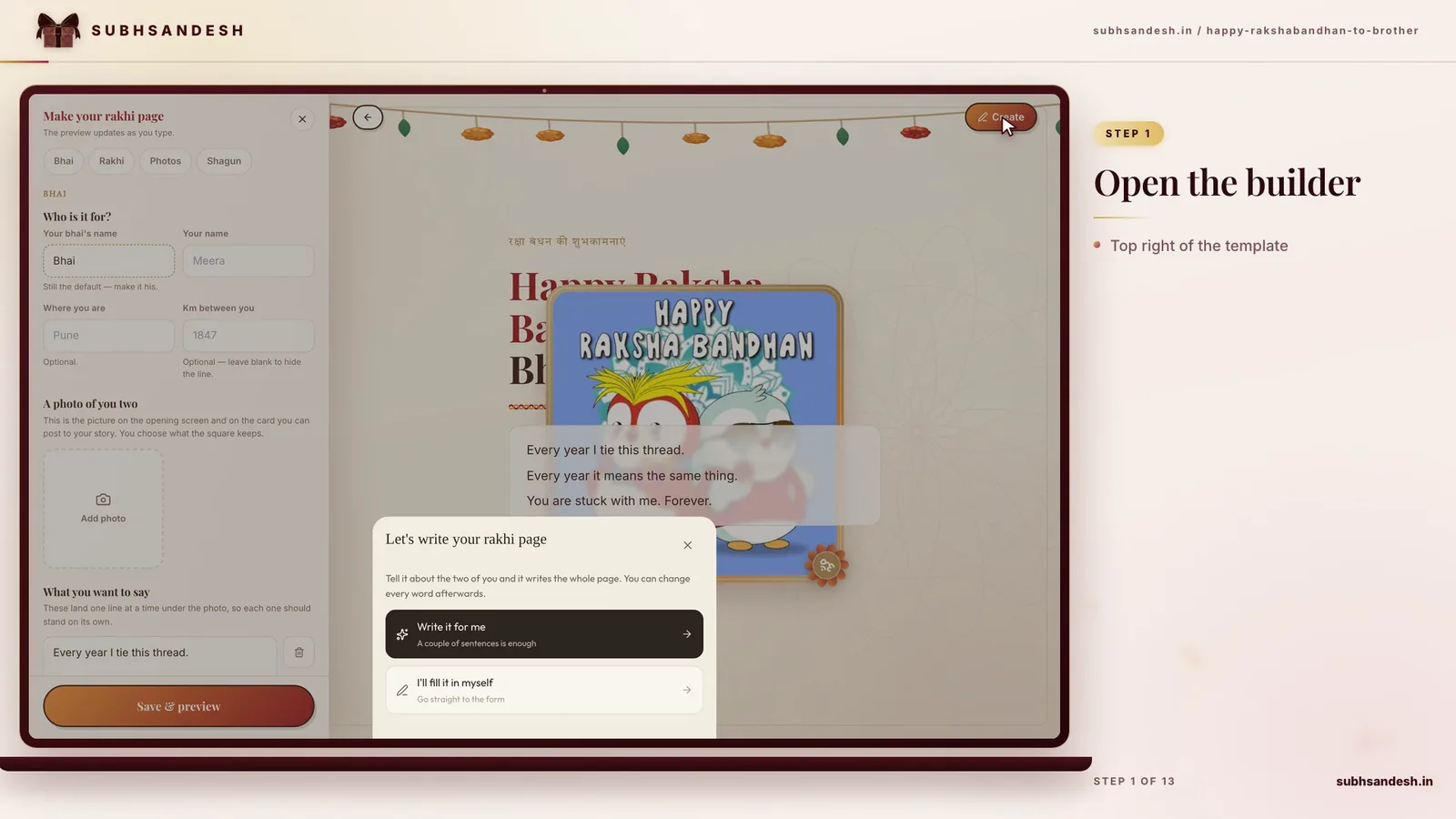
One more limit. Of SubhSandesh's 13 page types exactly one is a rakhi page, and it is written brother-first: the animation ties a thread on a wrist.
It carries both names, but bhabhi reads as a guest in its wording, and it has no lumba equivalent yet. If you want her at the centre, a general template from the SubhSandesh library with both names is more honest.
Sources
- Voorpostel and Blieszner, "Intergenerational Solidarity and Support Between Adult Siblings," Journal of Marriage and Family 70(1), 2008.
- Power and Ready, "Cooperation beyond consanguinity," Philosophical Transactions of the Royal Society B 374(1780), 15 July 2019.
- Chaudhry, "'For how long can your pīharwāle intervene?'," Modern Asian Studies 53(5), September 2019 (abstract only).
- Anukriti, Herrera-Almanza, Karra and Pathak, "Curse of the Mummy-ji," American Journal of Agricultural Economics 102(5), 2020.
- Gold, "Waiting for Moonrise," Oral Tradition 29(2), 2015.
Frequently Asked Questions
Turn this inspiration into an unforgettable surprise
Build a page with photos, a heartfelt message, music and a ready-to-share link.
- Photos, message & music
- Ready-to-share link

Written by
Suyash Agrahari
Founder
Suyash Agrahari is a Software Engineer at HireQuotient and the founder of SubhSandesh and DrawFlow (drawflow.in). He builds AI agents and full-stack products with Next.js, Node.js, and the OpenAI and LangChain ecosystems, having shipped autonomous multi-agent systems, AI copilots, and large-scale outreach platforms — and scaled side projects from a few hundred to millions of users. He writes about AI engineering, web development, and building products that grow through SEO and organic reach.
Stay Connected
Follow SubhSandesh
New templates, festival ideas and step-by-step walkthrough videos — first on our socials.
Product guide
See it built, step by step
Keep reading
Thala Deepavali: A Couple's First Deepavali at the Bride's Home
Thala Deepavali is a Tamil couple's first Deepavali after marriage, at the bride's home. In 2027 it is Thursday 28 October, oil bath 4:40–6:01 AM in C…
 Suyash Agrahari· 9 min
Sugar-Free Diwali Sweets: Swaps, Label Warnings and the Evidence
Five original no-added-sugar Diwali sweets, why jaggery and honey do not count, the warnings FSSAI requires on a sugar-free box, and what an Indian su…
Suyash Agrahari· 9 minShort Diwali Quotes: 34 Original One-Liners Under 10 Words
34 original short Diwali quotes, each under ten words and marked with its word and character count, grouped by mood: lamps, family, friends, gratitude…
Suyash Agrahari· 9 min