
Raksha Bandhan Wishes for Sister From Sister, No Brother Needed
Every page ranking for wishes for a sister assumes a brother wrote them. Six sister-to-sister scripts instead — elder, younger, twin, cousin, chosen, and the year a brother is gone — plus the lines to delete and how two sisters actually tie.
Make this into a page you can send
Photos, a message, music and a ready-to-share link — in a couple of minutes.
or browse all occasionsKey takeaways
- • Sister-to-sister rakhi needs a two-way promise: lines about protecting her always, or about the thread on your own wrist, describe a relationship neither of you is in.
- • All six pages ranking for this phrase on 19 August 2026 assumed a brother wrote the wish, and three gendered the sender outright.
- • In a study of 382 students, same-gender sibling pairs reported more positive attitudes to the relationship than mixed-gender pairs, and girls with a sister reported lower loneliness.
- • If she is in another city, a page gets reopened where a chat message does not: 12.0 views per page on average and 51.9% of 32,683 views on a phone, measured 2026-08-18.
- • SubhSandesh's only rakhi template is written brother-first, so there is no sister-to-sister design today — the words can be replaced, the frame cannot.
On this page
Raksha Bandhan Wishes for Sister From Sister, No Brother Needed
Raksha Bandhan wishes for a sister from a sister work when the promise runs both ways. You are not standing in for a brother, so a line about the thread on your wrist, or about protecting her always, describes a relationship you are not in. Name one specific thing she did this year, then say what you owe each other — not what you will do for her. When I checked this search on 19 August 2026, all six pages ranking for it assumed the sender was a brother, and three of them gendered him outright. Put the words somewhere she can reopen: across the 2,718 personalised pages created on SubhSandesh since 2026-03-12, the average page is viewed 12.0 times, and 51.9% of the 32,683 recorded views happen on a phone. Below are six wishes sorted by who she is to you, the lines to delete first, and how the tying works with two women's wrists on Friday 28 August 2026.
What sister-to-sister rakhi actually is
Sister-to-sister rakhi is two sisters tying a rakhi on each other's wrist, or one sister tying for another, instead of the thread going from a sister to a brother. Nothing in the tying itself requires a man: a thread, a tilak, something sweet, and a promise.
What changes is the direction of the promise. The traditional frame is asymmetric on purpose — the sister gives the thread, the brother gives protection and a gift back. Two sisters have no such division, which is why borrowed lines land badly. One honest limit up front: rakhi is not among the 13 page types SubhSandesh measures, so nobody, us included, has a number for how common this is.
Why sisters tie rakhi to each other
Three situations account for most of it. The first is simply having no brother, which the wishes-listicle genre quietly assumes away. The second is a brother who is absent — posted far away, estranged, or dead — where the day still arrives and the thread still exists. The third is a deliberate reframing by sisters who do have brothers and tie for each other as well, because the person who actually shows up is a sister.
The sibling-closeness research makes the third case look less like a novelty. In a study of 382 high-school students in İzmir, including 134 female sibling dyads against 124 male and 124 mixed-gender ones, students with a same-gender sibling reported more positive attitudes to the relationship than students with an opposite-gender sibling, and girls with a sister reported lower loneliness. Its review of earlier work reports sister–sister pairs showing the highest warmth and closeness of any sibling combination. That closeness is not self-sustaining: across 125 adolescents and 125 adults, girls outscored boys on intimacy, love and emotional support, and the adult sample scored lower than the adolescent one. An annual thread is maintenance.
Three lines to delete before you write anything
Delete anything about your own wrist. In a brother's wish the sender wears the rakhi; in yours, both of you might, or neither, and "the thread you tied on me" quietly reinstalls the brother.
Delete the one-way protection promise. "I will always protect you" is the brother's half of a bargain that ran in one direction as a kinship rule, not a sentiment: in the Uttar Pradesh village of Pahansu, the anthropologist Gloria Goodwin Raheja found she could not pay for her own food once she had been placed as a sister of the household, because one never takes anything from a sister or daughter. Two sisters are not inside that rule, and pretending otherwise makes one of you the brother.
Delete "you are like my brother." It reads as a compliment and lands as a demotion.
Six Raksha Bandhan wishes from one sister to another
Each states the wish, who it suits, what it does, and the trap to avoid.
1. For an elder sister
"You were the first person who told me the truth about anything. I am not tying this so you keep looking after me. You have done that since you were nine; it is my turn to check on you. Happy Raksha Bandhan, di."
Suits an elder sister who took on adult work early. It retires her role instead of thanking her for it. Avoid "you are my second mother" — it hands her the job again for another year.
2. For a younger sister
"You get away with everything and I have decided to stop minding. This thread is me admitting you are the one who calls first, remembers first, and forgives first. Tie mine before the tea goes cold."
Suits a younger sister who has become the family's actual kin-keeper. It works by naming a reversal she has probably noticed and nobody has said out loud. Avoid the "my little sister forever" register; she is an adult with a rent agreement.
3. For your twin
"Same birthday, same face on bad days, and about forty seconds between us. Nobody protects anybody here. We just refuse to let the other one be alone in a room. Happy Raksha Bandhan to the person who was there before I could talk."
Suits twins, where hierarchy is the one thing that never applied. It works because it replaces protection with company, which is the accurate word. Avoid any birth-order joke you have both heard four hundred times.
4. For a cousin sister
"Six houses, one summer holiday, and one person I could tell everything to at 2 a.m. Cousins by paperwork, sisters by every actual test. Wearing your rakhi this year with the same pride."
Suits a cousin who functions as a sister — the case the SERP handles only as a brother's cousin. It names the evidence instead of asserting the bond. Avoid apologising for the word cousin.
5. For a chosen sister who is not related to you
"Twelve years, three cities, one friendship that outlasted both our worst decisions. You are not family by blood, which is precisely why I am tying this on purpose. Happy Raksha Bandhan, sister I picked."
Suits a friend, a roommate, or a sister-in-law you actually like. Rakhi has always allowed a thread outside the family — this is that, without the borrowed brother. It works because "on purpose" is the whole point. If she lives elsewhere, a miss-you page for a best friend carries this better than a chat message does.
6. When you are tying for a sister because your brother is gone
"I know whose wrist this thread was meant for. I am tying it on you because he would have hated the two of us sitting apart today. No promises this year — just this, and you, and his name said out loud once."
Suits the first few Raksha Bandhans after a brother's death, or a permanent estrangement. It says the absence instead of covering it. Avoid "he would want us to be happy", avoid exclamation marks, and send nothing animated — a plain message or a phone call fits that day.
How the tying works when there is no brother's wrist
There is no separate ritual to learn. Both sisters put a tilak on the other, tie the thread, feed the other something sweet, and the younger one usually goes first — the same sequence, run twice, which takes about five minutes. Some families use a lumba, the rakhi normally tied to a bhabhi's bangle, because it is the one form already made for a woman's wrist.
If the older generation objects, precedent helps more than argument. Women's festivals in the region are routinely re-aimed by the women performing them: Teej is framed mythically as a wife's devotion to her husband, yet in practice is a reunion of women with their parents, brothers and sisters at the maternal home, where the singing is about what the in-laws' house costs them. The stated script points at a man; the day belongs to the women in the room.
Where a sister-to-sister wish actually survives
Format matters more here, because no gift ritual is carrying the message for you. The right-hand column is SubhSandesh's own usage data from 2,718 pages, measured 2026-08-18.
| How you send it | Time to prepare | Best when she is | What our own data shows |
|---|---|---|---|
| Said out loud while tying | 0 minutes | In the same room | Not measurable, still the best version |
| WhatsApp text | 1 minute | Reachable but busy | Nothing to reopen; no view count either |
| A shared page with her name and photo | 10 minutes | In another city or country | Average 12.0 views per page; 51.9% of 32,683 views on a phone |
| Public Instagram post | 5 minutes | Fine with an audience | 44.3% of creators pick a password instead (1,205 of 2,718) |
All four are free, so time and audience are the trade-offs. Note the last row: given the option, close to half of the people making a page for one person lock it. A wish that names a brother's death or a family argument is not status material, and the password exists for that.
When this is the wrong thing to send
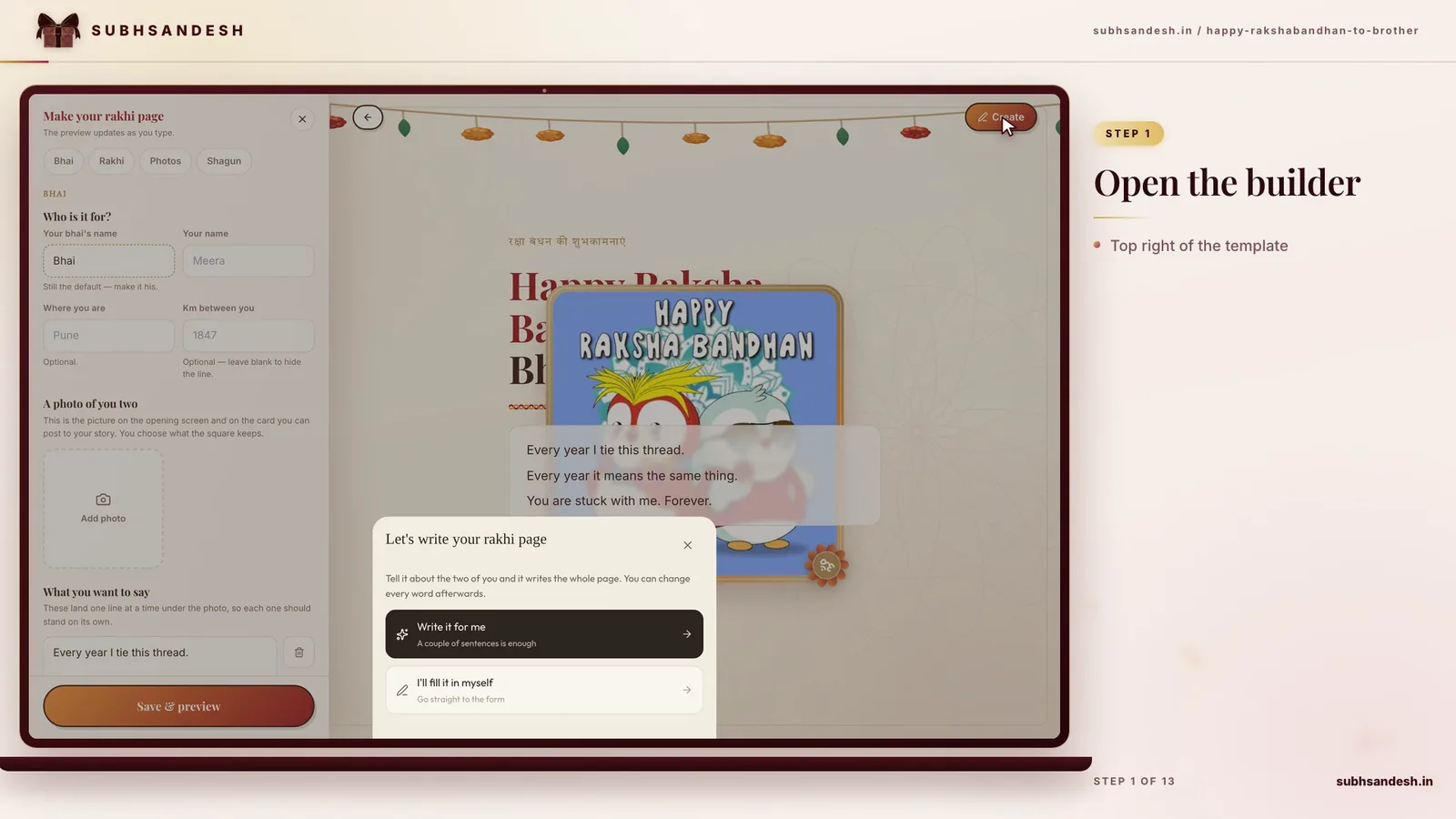
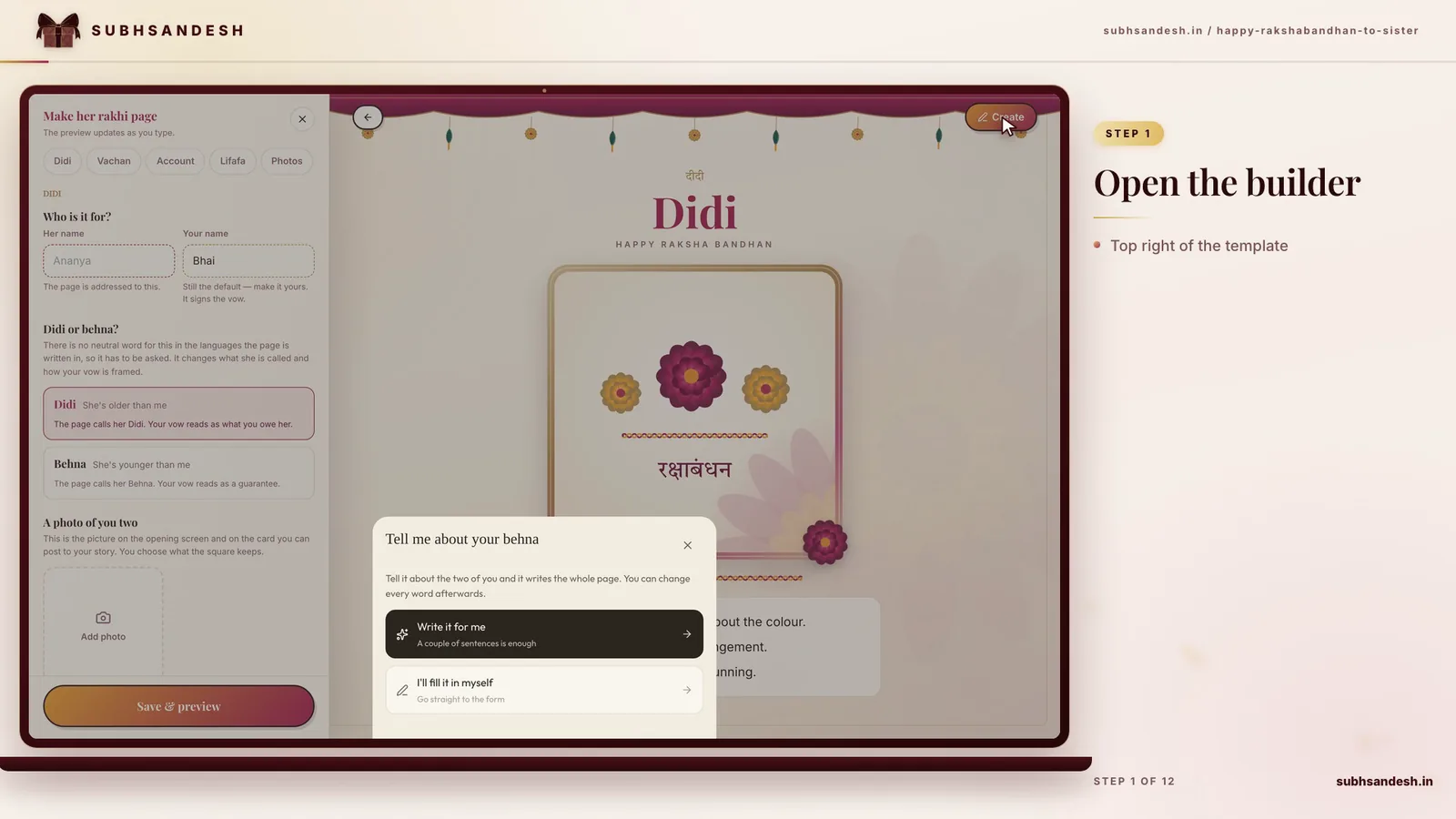
Be straight about the tooling: SubhSandesh's Raksha Bandhan template is written brother-first, with copy and tying scenes addressed to a brother. There is no sister-to-sister rakhi design today. You can replace the words with your own, but the frame still assumes his wrist, and if that will annoy you, a plainer page from the full SubhSandesh template list is the honest choice.
Two more cases where a link loses. If you are both in the same house on 28 August, send nothing and say it while tying — a page competes with a person who is standing in front of you. And in a first year of grief the animation is the problem, not the words — send the plain message and call her.
Sources
- Öz Soysal, F. S. (2016). A Study on Sibling Relationships, Life Satisfaction and Loneliness Level of Adolescents. Journal of Education and Training Studies. Full text
- Raheja, G. G., & Gold, A. G. (1994). Listen to the Heron's Words: Reimagining Gender and Kinship in North India. University of California Press. Open-access text
- Dahal, K. (2020). Celebrating Teej as a Festival of (Re)union and Enjoyment. Molung Educational Frontier. Full text
- Minić, J., Keljanović, A., & Pavlović, D. (2025). The Quality of Relationships with Siblings in Adolescence and Adulthood. Zbornik radova Filozofskog fakulteta u Prištini. PDF (Serbian, with English summary)
Frequently Asked Questions
Turn this inspiration into an unforgettable surprise
Build a page with photos, a heartfelt message, music and a ready-to-share link.
- Photos, message & music
- Ready-to-share link

Written by
Suyash Agrahari
Founder
Suyash Agrahari is a Software Engineer at HireQuotient and the founder of SubhSandesh and DrawFlow (drawflow.in). He builds AI agents and full-stack products with Next.js, Node.js, and the OpenAI and LangChain ecosystems, having shipped autonomous multi-agent systems, AI copilots, and large-scale outreach platforms — and scaled side projects from a few hundred to millions of users. He writes about AI engineering, web development, and building products that grow through SEO and organic reach.
Stay Connected
Follow SubhSandesh
New templates, festival ideas and step-by-step walkthrough videos — first on our socials.
Product guide
See it built, step by step
Keep reading
Thala Deepavali: A Couple's First Deepavali at the Bride's Home
Thala Deepavali is a Tamil couple's first Deepavali after marriage, at the bride's home. In 2027 it is Thursday 28 October, oil bath 4:40–6:01 AM in C…
 Suyash Agrahari· 9 min
Sugar-Free Diwali Sweets: Swaps, Label Warnings and the Evidence
Five original no-added-sugar Diwali sweets, why jaggery and honey do not count, the warnings FSSAI requires on a sugar-free box, and what an Indian su…
Suyash Agrahari· 9 minShort Diwali Quotes: 34 Original One-Liners Under 10 Words
34 original short Diwali quotes, each under ten words and marked with its word and character count, grouped by mood: lamps, family, friends, gratitude…
Suyash Agrahari· 9 min