
Raksha Bandhan Wishes for Soldiers Who Cannot Write Back
Raksha Bandhan wishes for soldiers, written for a message that gets no reply: six sender situations from a sister to a total stranger, four channels compared on what actually arrives, what not to write, and the state fund to use if you want the gesture to be more than words.
Make this into a page you can send
Photos, a message, music and a ready-to-share link — in a couple of minutes.
or browse all occasionsKey takeaways
- • Write closed, not open: a message to a soldier has to still work if no reply ever comes, and 51.1% of the 36,202 page views SubhSandesh has recorded were phone opens, so keep it under about 60 words.
- • Two different people run this search — someone with a soldier in their life, and a civilian with none. The second case, a rakhi with no name attached to it, is the one no ranking page writes for.
- • Send words before a link: a text needs one bar of signal, while a password-protected page needs two messages to arrive in order, and 44.2% of our creators password-protect before sharing (1,315 of 2,973).
- • A 2023 meta-analysis of 23 randomised studies and 6,745 participants put the benefit of expressed gratitude at Hedges' g = 0.22 for the writer, and had to code separately for whether the thanks ever reached the recipient.
- • For a material gesture rather than a verbal one, the Armed Forces Flag Day Fund — instituted 13 April 1993, run by the Kendriya Sainik Board — is the state route; SubhSandesh has no relationship with it.
On this page
- 1. Your brother is serving and can read but not reply
- 2. A friend or cousin in uniform, with no shared house to refer to
- 3. A soldier you have never met, writing in public
- 4. A woman in uniform, and you are her brother
- 5. A rakhi you cannot address to anyone in particular
- 6. A soldier who is not coming home, and the family who is
Raksha Bandhan Wishes for Soldiers Who Cannot Write Back
Raksha Bandhan wishes for soldiers should be written for a message that gets read once, on a phone, with no reply coming. Of the 36,202 page views SubhSandesh has recorded, 51.1% happened on a phone — 18,497 of them — and a shared page averages 12.2 views, both measured 2026-08-25. A soldier posted away from home is the hardest version of that pattern: no delivery address you can count on, no fixed hour when he is free, often no way for him to answer at all. So the message has to be complete on its own, and short enough to read on one bar of signal.
Below: six sender situations with lines written for each, four channels compared on what each needs to arrive, how to post an actual letter, and what not to write. Raksha Bandhan 2027 falls on Tuesday 17 August 2027.
What "Raksha Bandhan wishes for soldiers" actually covers
Two different people run this search. One has a specific soldier in their life — a brother, a cousin, a school friend, a husband's sister. The other has nobody in uniform and still wants to mark the day, which is the older practice of tying a rakhi on someone who is not a blood sibling.
The second case is the harder one and the one every wishes list skips: no shared history, usually no name, and no expectation of a reply, so warmth has to come from something other than memory. Judge it by whether it still reads well if nothing comes back.
Six situations, and what to write in each
Each situation below states who is sending and gives a line you can send as it stands. Keep every one under about 60 words — long messages get scrolled past, and 51.1% of opens on our platform are phone opens.
1. Your brother is serving and can read but not reply
He may see your message hours or days late, in a batch, with no chance to answer. Write it closed rather than open: no questions, no "call me when you can", nothing that makes him owe you a reply he cannot send.
"Tied your rakhi to your photo at home today. Nothing here needs an answer — Ma is fine, I am fine, and the thread is waiting for your wrist whenever you are back."
If you want him to see the ceremony rather than read about it, a Raksha Bandhan page for a brother carries the photo and the date in one link, and 99.4% of pages started on SubhSandesh are finished and shared — 2,956 of 2,973, measured 2026-08-25.
2. A friend or cousin in uniform, with no shared house to refer to
Here the risk is sounding formal. Use one specific memory instead of a general tribute, because specificity is the whole difference between a message and a forward.
"Rakhi today. I still tell people about the 2019 trek where you carried both bags. Thread posted to your parents' address, since I have no idea where you are and am not asking."
That last clause matters: asking where somebody is posted puts them in the position of refusing you.
3. A soldier you have never met, writing in public
A 2023 meta-analysis of 23 randomised studies covering 6,745 participants found expressed-gratitude exercises produce a small but real improvement in the writer's wellbeing — Hedges' g = 0.22 against neutral comparison conditions — and the reviewers had to code separately for whether the thanks ever reached the recipient at all. Read honestly, that is a finding about you, not about him.
"To whoever reads this: happy Raksha Bandhan. No claim on your time, no photo needed. Just a note from a stranger in Pune who thought about your rakhi today."
4. A woman in uniform, and you are her brother
Roughly nobody writes this version, and it is where the standard template breaks: the rakhi comes to her from you, and the protective language of the usual wishes runs backwards.
"Happy Raksha Bandhan, Captain. You have never once needed protecting, so take the sweets instead. Sending the page — open it when you have signal."
The Raksha Bandhan page addressed to a sister is the right template here; the brother version has the tilak and thread the wrong way round.
5. A rakhi you cannot address to anyone in particular
Civilian rakhi drives collect threads for units rather than individuals, so your message is read by someone whose name you will never learn. Write it as a note to a room, not a person, and skip anything that assumes a shared religion or region.
"For whoever this reaches — one rakhi from a family in Nagpur, sent for the day rather than for anyone in particular. Keep it or pass it on."
6. A soldier who is not coming home, and the family who is
For a bereaved family, Raksha Bandhan is the anniversary of an absence rather than a festival. Send the message the day before, not on the day, and name the person.
"Thinking of Vikram tomorrow, and of you. Not expecting a reply — just did not want the day to pass without saying his name."
What actually reaches him, and what it costs
The realistic channels, compared on arrival time, on what he needs at his end, and on where we have a measured number rather than an opinion.
| Channel | Typical arrival | Needs at his end | SubhSandesh measurement |
|---|---|---|---|
| Plain text or WhatsApp message | Seconds to send, read when signal returns | One bar of signal, almost no data | — not our platform |
| Shareable page link | Seconds to send, opened whenever he can | Mobile data and a browser | 51.1% of 36,202 opens were on a phone; 12.2 views per page |
| Password-protected page | As above, plus a second message carrying the password | Two messages arriving in order | 44.2% of 2,973 creators set a password before sharing |
| Posted rakhi or letter | Days to weeks, on the unit's own mail cycle | Nothing — it waits for him | — |
| Contribution to the Armed Forces Flag Day Fund | Same day, online | Nothing at all | — |
Send words first and a link second: a text costs him nothing to open, a link costs data he may be rationing.
If you are posting a letter rather than sending a message
A letter is not a longer wish. It may be opened weeks after you sealed it, with no way to answer, so date it at the top and write nothing that needs an update — no questions, no plans, no "reply when you can". Put the thing you actually meant to say in the first two lines.
The address is the part not to improvise. This post prints no address format on purpose: a serving soldier's postal address is not something you can look up, so ask him or his family for the line in writing and copy it exactly — a format lifted off any blog, including this one, is a letter that does not arrive. Post weeks before 17 August 2027, because unit mail moves on its own cycle rather than a courier's estimate.
The gesture that is not a message at all
If you want the day to produce something other than a caption, the state-run route is the Armed Forces Flag Day Fund administered by the Kendriya Sainik Board, created by Gazette notification No 5(1)/92/US(WE)/D(Res) dated 13 April 1993 by amalgamating four earlier welfare funds. It pays for ex-servicemen, war widows and dependents rather than for serving personnel.
The board's own page notes that about 60,000 defence personnel are released every year, most between 35 and 40. SubhSandesh has no relationship with the fund; it is named because it is the honest answer to "what else can I do".
What not to write
Skip the sacrifice register. "You give your life so we can sleep" is written for the sender's audience, not the recipient, and there is no version of it that a person on duty needs to read on their phone.
Four more to cut: any request for his location or posting; any request for a photo of him wearing the rakhi; "we can never repay you", which asks him to accept a debt; and anything that needs a reply to feel complete.
Also skip the assumption that his family is nearby and coping. A 2012 Smith College study of family and close friends of unmarried service members — 33 participants recruited through military forums — found that people supporting an unmarried soldier are routinely shut out of military resources because they do not meet the forces' own definition of family. Siblings and friends are exactly the people writing rakhi messages, and exactly the people that support structure does not see.
When a shareable page is the wrong choice
A link is the wrong send in three cases. If his unit restricts personal devices, nothing digital arrives at all and a posted letter is the only thing that will wait for him. If he is rationing mobile data, a page costs him more than a text does for the same words.
And if you password-protect the page — as 44.2% of our creators do — he now needs two messages to arrive in the right order, which is a bad bet on an intermittent connection. A 2022 international scoping review of social media and internet-based communication in military families during separation reports real benefits for connectedness alongside distinct practical barriers, and finds very little research on Service families specifically. Only the abstract was readable, so that is all it is cited for.
Where a page does earn its place: it holds a photograph, a date and a name in one link that survives being opened three weeks late, and you can browse the full template list if neither rakhi page fits.
Sources
- Biltz, M., Resiliency on the home front: addressing the needs of family and friends of unmarried military members during deployment, Smith College School for Social Work, 2012 — scholarworks.smith.edu
- Kirca, A., Malouff, J. M., & Meynadier, J., The Effect of Expressed Gratitude Interventions on Psychological Wellbeing, International Journal of Applied Positive Psychology, 28 January 2023 — link.springer.com
- Wood, A., et al., Social media and Internet-based communication in military families during separation: an international scoping review, New Media & Society, 17 August 2022 — journals.sagepub.com (abstract only)
- Kendriya Sainik Board, Armed Forces Flag Day Fund — ksb.gov.in
Frequently Asked Questions
Turn this inspiration into an unforgettable surprise
Build a page with photos, a heartfelt message, music and a ready-to-share link.
- Photos, message & music
- Ready-to-share link

Written by
Suyash Agrahari
Founder
Suyash Agrahari is a Software Engineer at HireQuotient and the founder of SubhSandesh and DrawFlow (drawflow.in). He builds AI agents and full-stack products with Next.js, Node.js, and the OpenAI and LangChain ecosystems, having shipped autonomous multi-agent systems, AI copilots, and large-scale outreach platforms — and scaled side projects from a few hundred to millions of users. He writes about AI engineering, web development, and building products that grow through SEO and organic reach.
Stay Connected
Follow SubhSandesh
New templates, festival ideas and step-by-step walkthrough videos — first on our socials.
Product guide
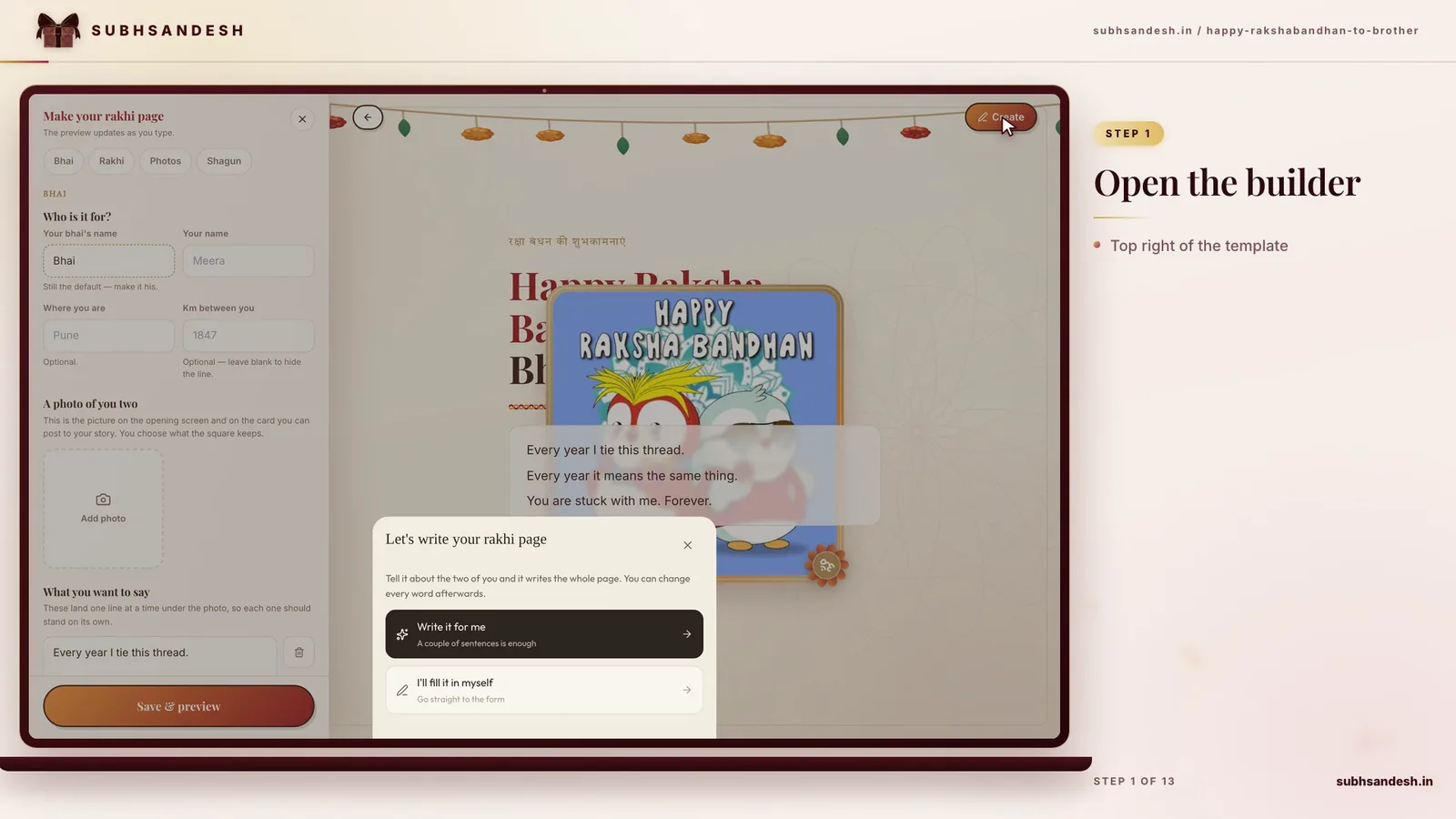
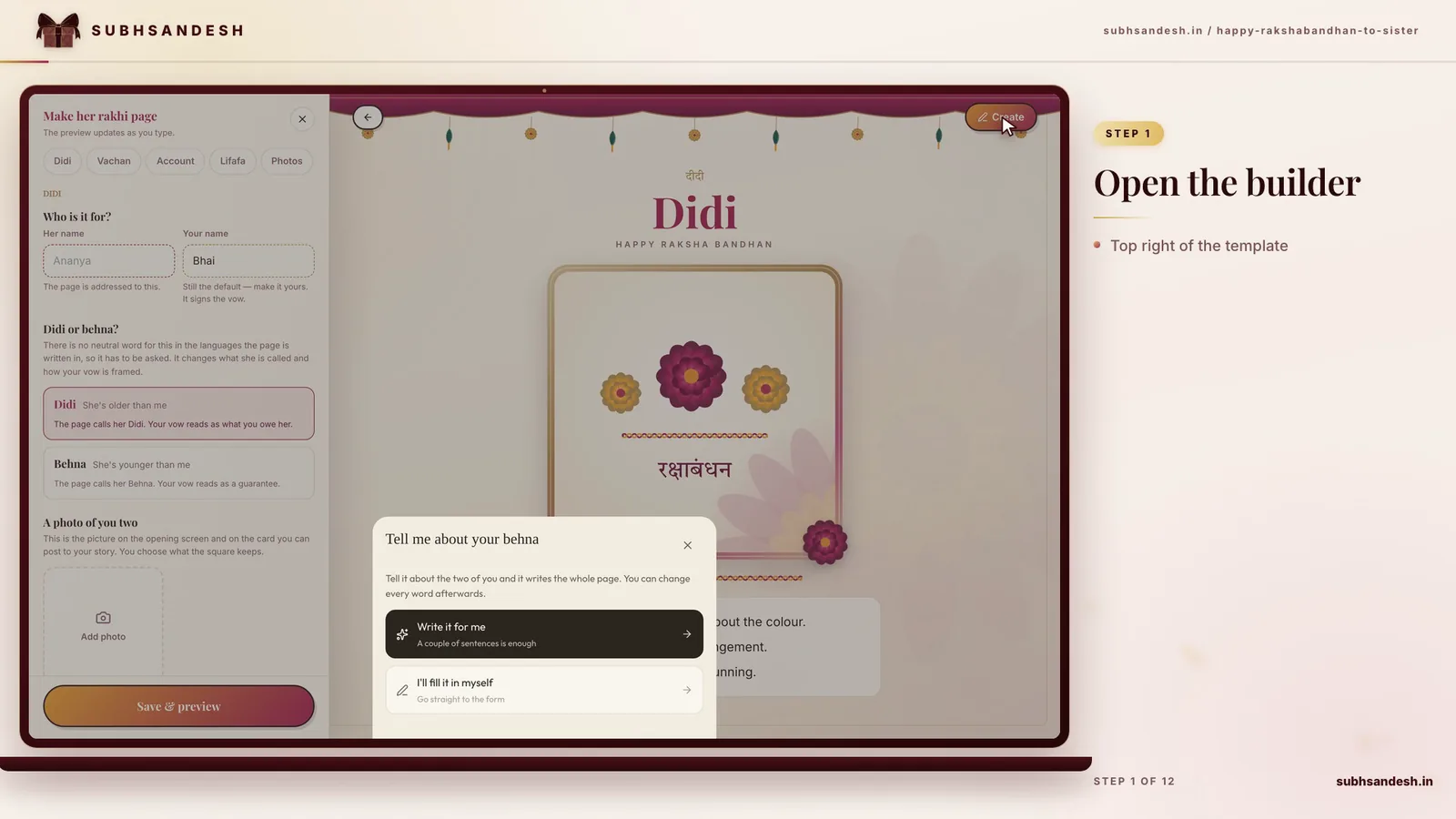
See it built, step by step
Keep reading
Thala Deepavali: A Couple's First Deepavali at the Bride's Home
Thala Deepavali is a Tamil couple's first Deepavali after marriage, at the bride's home. In 2027 it is Thursday 28 October, oil bath 4:40–6:01 AM in C…
 Suyash Agrahari· 9 min
Sugar-Free Diwali Sweets: Swaps, Label Warnings and the Evidence
Five original no-added-sugar Diwali sweets, why jaggery and honey do not count, the warnings FSSAI requires on a sugar-free box, and what an Indian su…
Suyash Agrahari· 9 minShort Diwali Quotes: 34 Original One-Liners Under 10 Words
34 original short Diwali quotes, each under ten words and marked with its word and character count, grouped by mood: lamps, family, friends, gratitude…
Suyash Agrahari· 9 min