
Raksha Bandhan Wishes in Bengali, and the Register to Use
In Bengal the day is রাখী পূর্ণিমা, Jhulan ends on it, and Tagore tied rakhi across the Hindu–Muslim line in 1905. Six Bengali wishes with transliteration, gloss and the আপনি/তুমি/তুই register each one commits you to.
Make this into a page you can send
Photos, a message, music and a ready-to-share link — in a couple of minutes.
or browse all occasionsKey takeaways
- • In Bengal the festival is রাখী পূর্ণিমা (Rakhi Purnima), and it closes Jhulan — the Vaishnav Radha–Krishna swing festival that runs five days to the Shravan full moon.
- • Rabindranath Tagore made rakhi political: an assembly on 27 September 1905 proposed a Rakhi Bandhan festival, and on 16 October 1905 Bengalis tied rakhi "irrespective of caste and religion" against the partition of Bengal.
- • Pick the pronoun before the line. Bengali has three second-person forms, and a peer-reviewed study classes তুই as the form elders use downward — so তুই sent up to a দাদা reads as a demotion.
- • Write for a phone: 51.9% of the 32,683 recorded views of shared SubhSandesh pages are on one, and 52.1% come from a touch device.
- • Bengali conjuncts and the ya-phalā are font-dependent, so the same message can be correct on your phone and broken on your দিদি's — a font problem, not a typo.
On this page
Raksha Bandhan Wishes in Bengali, and the Register to Use
Most Raksha Bandhan wishes in Bengali get the words right and the frame wrong. In Bengal the day is রাখী পূর্ণিমা, Rakhi Purnima — the Shravan full moon that closes the Radha–Krishna swing festival Jhulan — and in 1905 Rabindranath Tagore turned the same thread into a protest against the partition of Bengal. Before the line comes the pronoun: Bengali has three second-person forms, আপনি, তুমি and তুই, and তুই aimed upward at an elder brother reads as a demotion. Below are six wishes, each in Bengali script with a Roman transliteration and an English gloss, tagged with the register it carries. All six are written to be read on a phone, because 51.9% of the 32,683 recorded views of pages shared on SubhSandesh are on one, across 2,718 pages created since 2026-03-12.
What a Bengali Raksha Bandhan wish is actually called
A Bengali Raksha Bandhan wish is a greeting for রাখী পূর্ণিমা (Rakhi Purnima) or রাখী বন্ধন (Rakhi Bandhan), the Shravan full-moon day on which a thread is tied on the wrist. "Raksha Bandhan" is the pan-Indian name; in Bengali households the day is far more often just রাখী.
That matters for what you write. Open with শুভ রাখী পূর্ণিমা (shubho Rakhi Purnima) and you sound like family. Open with a transliterated "Happy Raksha Bandhan" and you sound like a greeting-card app.
The Bengali-language pages ranking for this query in August 2026 are still headed 2024 and 2025, and every one of them uses রাখী পূর্ণিমা in the body while keeping "Raksha Bandhan" in the headline.
Why Rakhi Purnima shares its date with Jhulan
The Bengali festival stacked on the same full moon is Jhulan, and it is a Vaishnav festival, not a sibling one. Banglapedia, the Asiatic Society of Bangladesh's national encyclopedia, records that Jhulan is a Vaishnava festival of Radha and Krishna which "continues for five days, from the eleventh of the first bright fortnight of the Bangla month of Shravan to the day of the full moon" — that final day is Rakhi Purnima.
So in Bengal the thread arrives at the end of five days of swinging Radha–Krishna images, and idols are placed on a decorated swing while the household celebrates. A wish that gestures at ঝুলন rather than only at ভাই-বোন is doing something no wishes list on the first page of results does.
The 1905 rakhi: Tagore's thread across a communal line
Rakhi in Bengal has a documented political history. Writing in the Journal of Research in Humanities and Social Science, Priyanka Mitra of Rabindra Bharati University records that an assembly convened at Tagore's initiation on 27 September 1905 at the Sabitri Library proposed the Rakhi Bandhan festival, and that the song "Banglar Mati, Banglar Jol" was written on that occasion.
Then on 16 October 1905, the day the partition of Bengal took effect, the protest peaked. Mitra's account has shops shuttered, vehicles halted, people walking barefoot chanting "Vande Mataram", bathing in the Ganga and then, "irrespective of caste and religion", tying rakhi on each other's hands as a symbol of unity. Tagore posted cards and rakhis to his acquaintances himself; rakhi strings were sold from the Bhandar office on Cornwallis Street.
That is a rakhi between adults of different faiths, with no sibling in it. It is the strongest thing a Bengali rakhi message can carry, and none of the wishes lists ranking for this keyword uses it.
Pick the register first: আপনি, তুমি, তুই
Bengali does not have one word for "you". A peer-reviewed study of Bengali person deixis in the International Journal of English Linguistics (30 December 2019) sets out three separate morphemes for the singular second person — আপনি apni, তুমি tumi, তুই tui — classed respectively as formal/polite/hierarchical, familiar/polite/intimate, and intimate/impolite/neglecting.
The paper is explicit that this is not the two-way European T/V split: আপনি sits on the V axis, তুই on the T axis, and তুমি "does not fall into any of these categories". তুই marks a friendly, jovial, informal "or even hostile" relationship, and it is what elders in a family use downward, to address the younger members.
That is the whole trap. তুই to a younger brother is warm.
তুই from a younger sibling to a দাদা or দিদি inverts the direction the pronoun normally travels, and a copied line carries whichever pronoun the stranger who wrote it had in mind. Read the pronoun before you press send.
Six Raksha Bandhan wishes in Bengali, with transliteration and meaning
Six lines across three registers. Each gives the Bengali, a plain Roman transliteration, an English gloss, and the register it commits you to.
1. To an elder brother (তুমি)
শুভ রাখী পূর্ণিমা, দাদা। তোমার হাতে রাখী বাঁধতে পারলাম না, কিন্তু মনটা সারাদিন তোমার কাছেই ছিল।
Shubho Rakhi Purnima, dada. Tomar haate rakhi bandhte parlam na, kintu monta saradin tomar kachhei chhilo.
"Happy Rakhi Purnima, dada. I couldn't tie the rakhi on your wrist, but my mind stayed near you all day." Register: তুমি. Use it when you are in another city and the tying did not happen.
2. To an elder sister who has moved away (তুমি)
দিদি, তুমি ছাড়া বাড়িটা এখনও ঠিক বাড়ি মনে হয় না। শুভ রাখী।
Didi, tumi chhara barita ekhono thik bari mone hoy na. Shubho Rakhi.
"Didi, without you the house still doesn't quite feel like a house. Happy Rakhi." Register: তুমি. Sisters tie rakhi to sisters too; this is written for that, not for a brother.
3. To a younger sibling (তুই)
রাখীর সুতোটা ছোট, কিন্তু যা বেঁধে রাখে তা তুই ভাবতেও পারবি না। ভালো থাকিস।
Rakhir sutota chhoto, kintu ja bedhe rakhe ta tui bhabteo parbi na. Bhalo thakis.
"The rakhi thread is small, but you cannot imagine what it holds together. Stay well." Register: তুই, with the তুই imperative thakis. Only downward, to someone younger.
4. To an elder relative or a jamaibabu (আপনি)
রাখী পূর্ণিমার আন্তরিক শুভেচ্ছা রইল। আপনি ও আপনার পরিবারের সকলে ভালো থাকুন।
Rakhi Purnimar antorik shubhechchha roilo. Apni o apnar parivarer sokole bhalo thakun.
"Sincere Rakhi Purnima greetings. May you and everyone in your family be well." Register: আপনি, with the honorific imperative thakun. The safe default for anyone senior or not close.
5. The Jhulan line (no pronoun)
আজ ঝুলনের দোলা থামে, আর শ্রাবণী পূর্ণিমার সকালে হাতে বাঁধা পড়ে রাখী।
Aaj jhuloner dola thame, ar Shrabani Purnimar sokale haate bandha pore rakhi.
"Today the Jhulan swing comes to rest, and on the morning of the Shravan full moon the rakhi is tied on the wrist." No second person at all, so it carries no register risk — the reason it works as a status line.
6. The 1905 line, for a rakhi that is not between siblings (তুমি)
রাখী শুধু ভাই-বোনের নয় — ১৯০৫ সালে এই সুতোই বাঙালিকে ভাগ করতে দেয়নি। তাই এই রাখী তোমার জন্যও।
Rakhi shudhu bhai-boner noy — 1905 sale ei sutoi Bangalike bhag korte deyni. Tai ei rakhi tomar jonnyo-o.
"Rakhi is not only for brothers and sisters — in 1905 this same thread refused to let Bengalis be divided. So this rakhi is for you too." Register: তুমি. Send it to a friend, a colleague, a neighbour. It is the one line here that needs the history above to land.
Which register goes to whom, and how it gets read
The pronoun decides the line; the surface decides the length.
| Who you are writing to | Pronoun | Line above | What our own numbers say |
|---|---|---|---|
| Elder brother or didi | তুমি (tumi) | 1 and 2 | 51.9% of 32,683 views open on a phone — keep it to two lines |
| Younger sibling | তুই (tui) | 3 | 52.1% of views come from a touch device, so thumb-length |
| A senior, a jamaibabu, a colleague | আপনি (apni) | 4 | 44.3% of creators lock the page before sending (1,205 of 2,718) |
| A friend, no sibling tie | তুমি (tumi) | 5 and 6 | 2,718 pages across 13 page types, none rakhi-specific |
The last row is the honest limit: we have platform-wide data and no rakhi-specific data at all.
What breaks Bengali script on someone else's phone
Bengali is an abugida, and its conjuncts are not single characters. The W3C's Bengali Script Resources note of 20 March 2026 records that clusters are indicated with a virama (hasant), producing "a large number of conjunct forms expressed using stacked consonants, conjoined consonants, and ligated glyphs", and that RA takes special forms both cluster-initial and post-base.
The specific hazard is the ya-phalā. Per the Unicode Consortium's Bengali FAQ, when U+09AF য occurs last in a cluster it takes that special shape, and if য follows র the font "will normally produce the reph over the full form of ya, as in পর্যন্ত" — keeping the ya-phalā shape there needs U+200D ZERO WIDTH JOINER before the hasant.
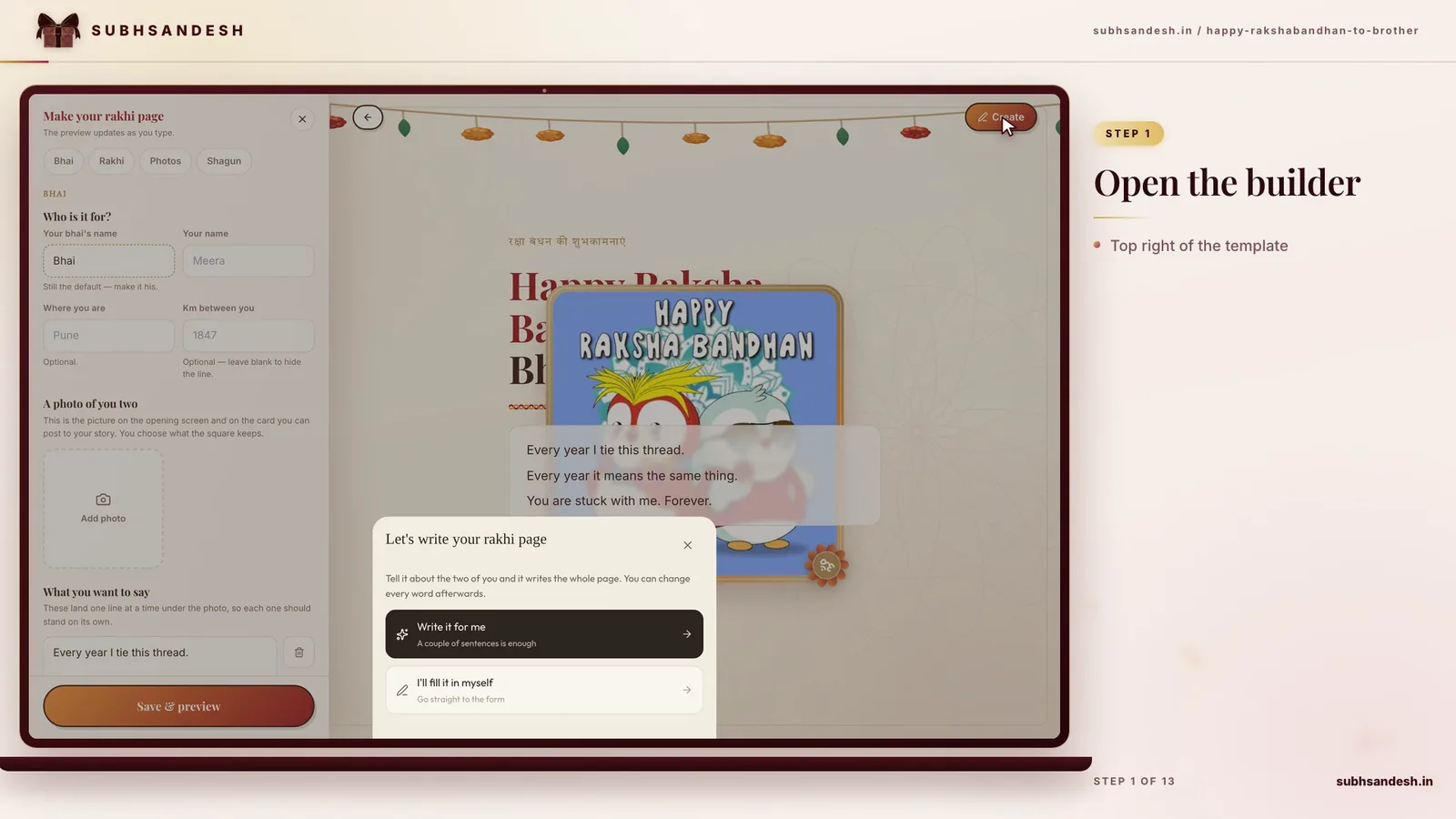
So the same message can be correct on your phone and wrong on your দিদি's, with neither device broken. It is a font problem, not a typo. A page that ships its own web font sidesteps it; the Raksha Bandhan page for a brother does that, though note it is written brother-first, so a sister-to-sister wish needs the wider template gallery instead.
When a Bengali wish is the wrong choice
If your দাদা reads Bengali fluently but does not type it, a Bengali-script message is a small tax on him: he can read it and cannot reply in kind. Send the Bengali line plus a Roman transliteration, exactly as laid out above.
Skip Bengali entirely in three cases. A recipient outside Bengal whose Bengali is spoken-only will read the transliteration and skip the script.
A print job needs the conjuncts proofed in the actual print font before it goes to press, and none of our 2,718 pages is a print product, so we have no print data to offer you. And if you are in the same room, tie the thread and say it — a link is worse than a wrist.
Sources
- Jhulan — Banglapedia, Asiatic Society of Bangladesh (no publication date stated)
- Priyanka Mitra, "Partition of Bengal, Swadeshi Movement and the Role of Rabindranath Tagore", Journal of Research in Humanities and Social Science 7(1), 2019, pp. 37–42
- Md. Afaz Uddin, "Second Person Pronouns as Person Deixis in Bengali and English", International Journal of English Linguistics 10(1), published 30 December 2019
- Bengali Script Resources, W3C Group Note Draft, 20 March 2026
- Bengali (Bangla) FAQ, Unicode Consortium (living document, no publication date stated)
Frequently Asked Questions
Turn this inspiration into an unforgettable surprise
Build a page with photos, a heartfelt message, music and a ready-to-share link.
- Photos, message & music
- Ready-to-share link

Written by
Suyash Agrahari
Founder
Suyash Agrahari is a Software Engineer at HireQuotient and the founder of SubhSandesh and DrawFlow (drawflow.in). He builds AI agents and full-stack products with Next.js, Node.js, and the OpenAI and LangChain ecosystems, having shipped autonomous multi-agent systems, AI copilots, and large-scale outreach platforms — and scaled side projects from a few hundred to millions of users. He writes about AI engineering, web development, and building products that grow through SEO and organic reach.
Stay Connected
Follow SubhSandesh
New templates, festival ideas and step-by-step walkthrough videos — first on our socials.
Product guide
See it built, step by step
Keep reading
Thala Deepavali: A Couple's First Deepavali at the Bride's Home
Thala Deepavali is a Tamil couple's first Deepavali after marriage, at the bride's home. In 2027 it is Thursday 28 October, oil bath 4:40–6:01 AM in C…
 Suyash Agrahari· 9 min
Sugar-Free Diwali Sweets: Swaps, Label Warnings and the Evidence
Five original no-added-sugar Diwali sweets, why jaggery and honey do not count, the warnings FSSAI requires on a sugar-free box, and what an Indian su…
Suyash Agrahari· 9 minShort Diwali Quotes: 34 Original One-Liners Under 10 Words
34 original short Diwali quotes, each under ten words and marked with its word and character count, grouped by mood: lamps, family, friends, gratitude…
Suyash Agrahari· 9 min