
Raksha Bandhan Wishes in Gujarati, With Roman Transliteration
Every Gujarati wish here is given twice — real ગુજરાતી script and a Roman transliteration you can paste into any chat — with the તું/તમે respect rule, keyboard and font notes, and the 51.1% of 36,202 shared page views that open on a phone.
Make this into a page you can send
Photos, a message, music and a ready-to-share link — in a couple of minutes.
or browse all occasionsKey takeaways
- • Send the wish twice: Gujarati script for readers of the script, Roman transliteration for the sibling or cousin who speaks Gujarati but never learned the letters.
- • 51.1% of the shared pages SubhSandesh has measured are opened on a phone (18,497 of 36,202 views), which is exactly where a missing Gujarati font turns a wish into empty boxes.
- • તું is intimate and તમે is respectful, and the rule flips by relationship: તમે to a bhabhi whatever her age, but for a sister it goes by age — તમે to a મોટી બહેન, તું to a નાની બહેન, where it reads warm rather than rude.
- • Rakhi falls on Friday 28 August 2026 and Tuesday 17 August 2027; in Gujarat the same full-moon day is widely called બળેવ.
- • Each shared page is opened 12.2 times on average, and 44.2% of creators password-protect it before sending the link.
On this page
Raksha Bandhan Wishes in Gujarati, With Roman Transliteration
Send a Raksha Bandhan wish in Gujarati twice over: once in the ગુજરાતી script for whoever can read it, and once in Roman letters for the cousin, nephew or sibling abroad who speaks Gujarati fluently and never learned the alphabet. That second reader is the one every Gujarati wishes page ignores.
It matters because of where these messages land: 51.1% of the pages SubhSandesh has measured are opened on a phone (18,497 of 36,202 recorded views), and each shared page is opened 12.2 times on average. A wish that renders as empty boxes on someone's Android is a wish nobody reads.
What "રક્ષાબંધનની શુભેચ્છા" actually means
શુભેચ્છા (shubhechha) is Gujarati for "good wish", so રક્ષાબંધનની શુભેચ્છા translates literally as "good wishes of Raksha Bandhan". It is the neutral, safe greeting for anyone — a sibling, a colleague, a family group.
Two words sit next to it. શુભકામના (shubhkamna) is a shade more formal and reads better in a message to elders. હાર્દિக (hardik, "heartfelt") is the intensifier you put in front of either.
Raksha Bandhan follows the lunar calendar, so the date moves: Friday 28 August 2026, then Tuesday 17 August 2027. In Gujarat the same full-moon day is called બળેવ (Baleva) — the name your grandparents may use instead of "Rakhi".
7 Raksha Bandhan wishes in Gujarati, script and Roman side by side
1. The safe all-purpose wish
Gujarati: રક્ષાબંધનની હાર્દિક શુભેચ્છા! આ સંબંધ હંમેશા આવો જ મજબૂત રહે.
Roman: Raksha Bandhan ni hardik shubhechha! Aa sambandh hamesha aavo j majboot rahe.
Means: "Heartfelt Raksha Bandhan wishes. May this bond stay exactly this strong."
Who it fits: anybody — sibling, cousin, family WhatsApp group, a colleague from Ahmedabad. It carries no pronoun, which is why it is safe.
2. The wish for a brother
Gujarati: વીરા, તારી બહેન તારા માટે હંમેશા પ્રાર્થના કરે છે. હેપી રક્ષાબંધન!
Roman: Vira, tari behen tara mate hamesha prarthana kare chhe. Happy Raksha Bandhan!
Means: "Brother, your sister prays for you always."
Who it fits: a younger or same-age brother. વીરા is the affectionate Kathiawadi word for brother and lands warmer than plain ભાઈ. For an elder brother your family addresses respectfully, use wish 4.
3. The long-distance wish
Gujarati: અંતર ભલે હોય, બંધન નહીં તૂટે. દૂરથી પણ રાખડી બાંધું છું.
Roman: Antar bhale hoy, bandhan nahi tute. Doorthi pan rakhdi bandhu chhu.
Means: "Let there be distance — the bond will not break. I am tying the rakhi from far away."
Who it fits: a sibling in another city or country. An overseas relative is likeliest to lack a Gujarati font.
4. The respectful wish for an elder
Gujarati: તમને અને તમારા પરિવારને રક્ષાબંધનની હાર્દિક શુભકામનાઓ.
Roman: Tamne ane tamara parivaarne Raksha Bandhan ni hardik shubhkamnao.
Means: "Heartfelt Raksha Bandhan wishes to you and your family."
Who it fits: a bhabhi, a kaka or kaki, a foi, an elder cousin or elder brother, a boss. તમને and તમારા are the respectful forms — this is the wish most people get wrong.
5. The light, teasing wish
Gujarati: રાખડી બાંધી દીધી, હવે ગિફ્ટ ક્યાં છે? હેપી રક્ષાબંધન!
Roman: Rakhdi bandhi didhi, have gift kya chhe? Happy Raksha Bandhan!
Means: "The rakhi is tied — now where's the gift?"
Who it fits: a sibling close enough to laugh. Not to an elder, and not if money is tight at home — it reads as a demand, not a joke.
6. The one-line status or caption
Gujarati: એક દોરો, હજાર આશીર્વાદ. — રક્ષાબંધન
Roman: Ek doro, hajaar ashirvad. — Raksha Bandhan
Means: "One thread, a thousand blessings."
Who it fits: a WhatsApp status, an Instagram caption, a story sticker. At roughly 30 characters it survives every status limit without truncating mid-word.
7. The wish when the rakhi will arrive late
Gujarati: રાખડી થોડી મોડી પહોંચશે, પણ પ્રેમ સમયસર છે. રક્ષાબંધનની શુભેચ્છા.
Roman: Rakhdi thodi modi pahonchshe, pan prem samaysar chhe. Raksha Bandhan ni shubhechha.
Means: "The rakhi will reach you a little late, but the love is on time."
Who it fits: anyone posting a rakhi across states or borders. Send it on the day rather than apologising later.
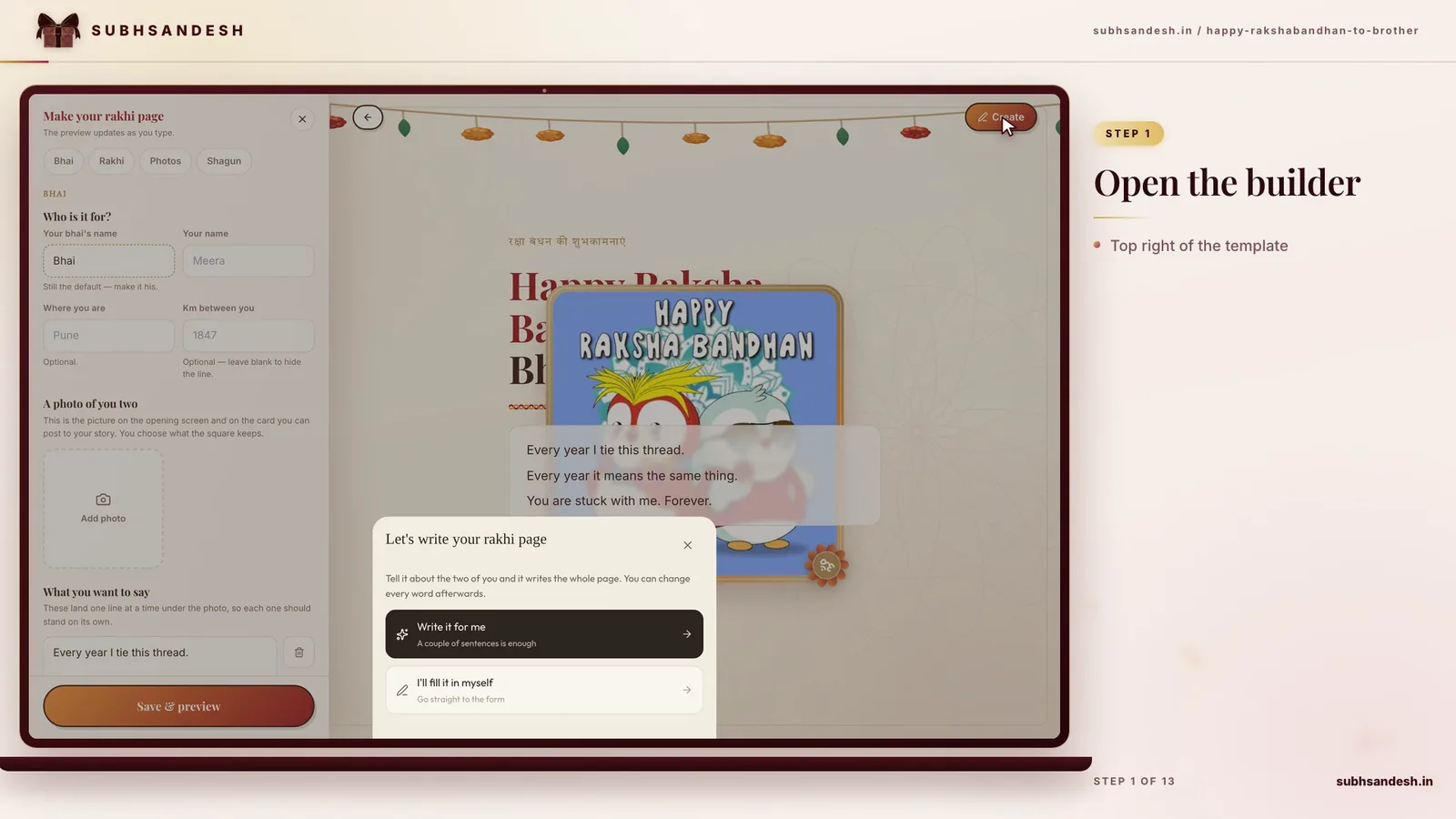
To send it as something openable, the Raksha Bandhan page for a brother holds both lines on one screen with a photo and their name.
તું or તમે — the pronoun that decides whether your wish sounds rude
Gujarati marks respect in the second person, and not one of the nine pages on Google's first page mentions it. તું (tu) is intimate singular; તમે (tame) is respectful and plural, roughly Hindi's "aap".
The possessives must agree: તું takes તારી and તારા, તમે takes તમારી and તમારા. Mixing them in one message is the tell that a wish was copied, not written.
The practical rule: તું for a younger or same-age sibling, તમે for a bhabhi, a kaka or kaki, a foi and — in most Gujarati families — an elder brother. When you cannot tell, send wish 1, which has no pronoun.
Writing to a sister: બહેન, મોટી બહેન, નાની બહેન
Raksha Bandhan's default direction is sister to brother, so a brother writing to his sister has no stock Gujarati line to copy. બહેન (behen) is the plain word for sister; મોટી બહેન (moti behen) is an elder sister, નાની બહેન (nani behen) a younger one.
The honorific runs the opposite way to the bhabhi rule above. A bhabhi takes તમે whatever her age; a sister is judged on age alone — તમે to a મોટી બહેન is normal, and તું to a નાની બહેન reads as warmth rather than rudeness. Same pronoun, opposite verdict.
For an elder sister — મોટી બહેન, in તમે
Gujarati: મોટી બહેન, તમે હંમેશા મારી ઢાલ રહ્યાં છો. તમને રક્ષાબંધનની હાર્દિક શુભકામનાઓ.
Roman: Moti behen, tame hamesha mari dhaal rahyaan chho. Tamne Raksha Bandhan ni hardik shubhkamnao.
Means: "Elder sister, you have always been my shield. Heartfelt Raksha Bandhan wishes to you."
For a younger sister — નાની બહેન, in તું
Gujarati: બહેન, તારી રાખડી મારી સૌથી મોટી તાકાત છે. તું હંમેશા ખુશ રહે.
Roman: Behen, tari rakhdi mari sauthi moti takat chhe. Tu hamesha khush rahe.
Means: "Sister, your rakhi is my greatest strength. May you always be happy." Keep it for a sister you tease, not one whose feet you touch.
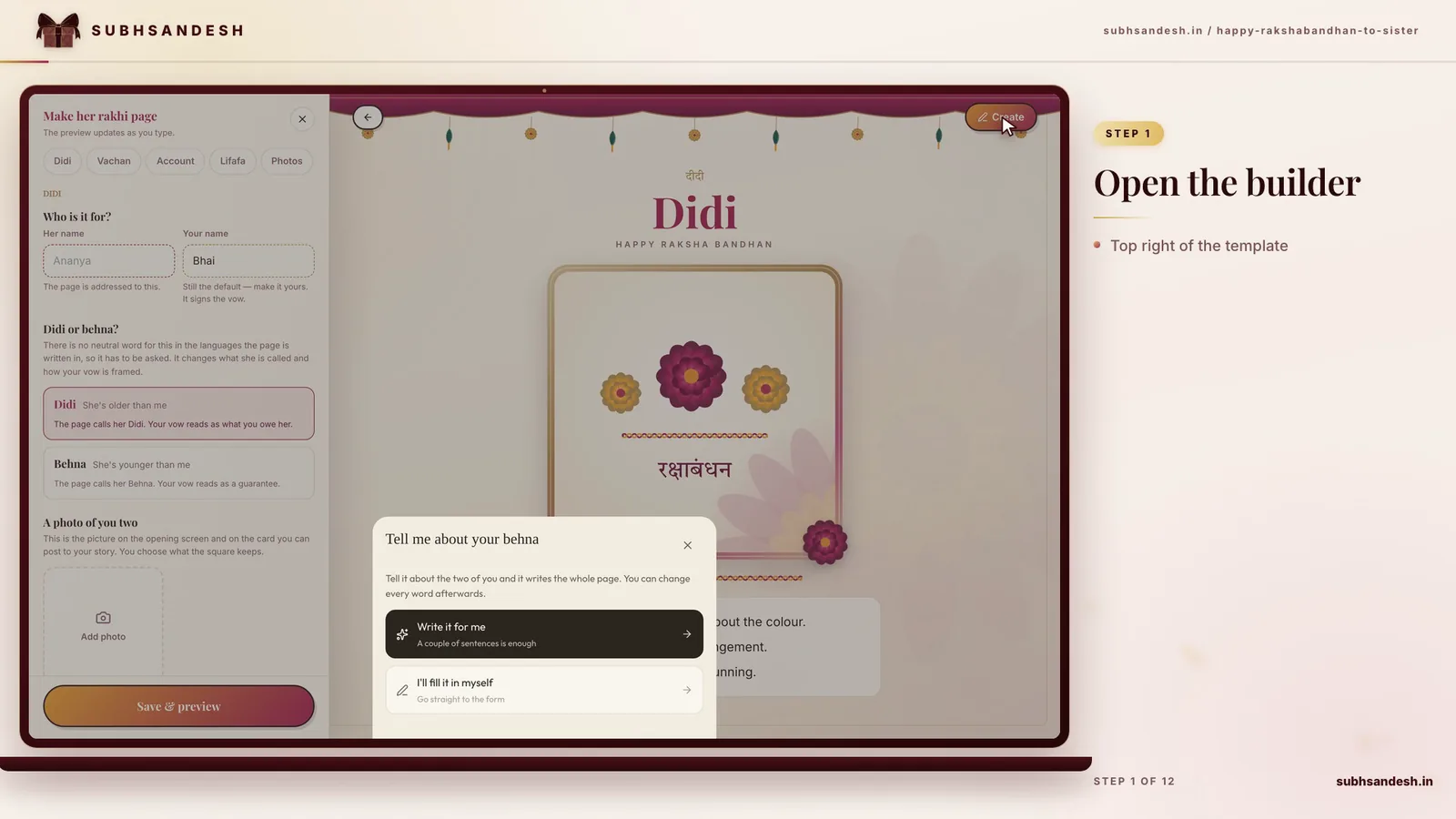
The hard part is the first line, not the sending: 99.4% of pages started on SubhSandesh are published and shared (2,956 of 2,973). The Raksha Bandhan page for a sister carries both lines with her photo and name.
How to type Gujarati script on a phone, and when to send Roman instead
You do not need the keyboard layout. Gboard and the iOS Gujarati keyboard both have a transliteration mode: type shubhechha in Roman letters and the suggestion strip offers શુભેચ્છા. Add Gujarati in language settings once and it stays.
Rendering is the real risk. Gujarati has its own Unicode block, U+0A80–U+0AFF, and a device without the font shows empty rectangles, or drops vowel marks so the words are readable but wrong. Older Android builds and in-app browsers are the usual culprits.
So send both lines. There is no single right spelling of a Gujarati word in Roman letters: in the Dakshina dataset of 12 South Asian languages, native speakers gave 4.2 attested Latin-script spellings per Gujarati word — the joint-highest in the set, more than double Hindi's 1.8.
So write the Roman line to be read aloud, not to be spelled correctly. Back-transliteration work across 13 Indian languages (LREC 2026) finds Romanized Indic text has no standardised orthography, and that even purpose-built models reproduce vowel diacritics less accurately than base letters — 81.0 against 88.0 BLEU.
Speaking a language and reading its script are separate skills, and Gujarati is thinly resourced in the second. A Sheffield PhD on text alignment for South Asian languages built its tools for Hindi first and bootstrapped the Gujarati versions from them — the two differ mainly in script and vocabulary, not structure.
Britain's Gujarati diaspora shows it from the other side. Maya Parmar's 2013 Leeds PhD on the twice-migrant Gujarati East African community found so little written literature by or about it that she read the culture through food, garba and family photographs.
Which way of sending a Gujarati wish survives the trip
| How you send it | What the recipient needs | Does the Gujarati script survive? | SubhSandesh measured behaviour |
|---|---|---|---|
| Plain text in WhatsApp | Gujarati font support on their device | Usually — older Android shows empty boxes | Not measured; we do not send chat messages |
| Roman transliteration in chat | Nothing | No — the sound survives, the script does not | Not measured |
| Screenshot or image of the wish | Only a photo viewer | Yes, but the text cannot be copied or searched | Not measured |
| A shared page link | Only the link | Yes, rendered as web text with the font supplied | 51.1% of 36,202 views open on a phone; 12.2 views per page on average; 44.2% of creators lock the page with a password first |
A link is the only route where you supply the font instead of hoping their phone has it, and the only one where you can see whether the wish was opened.
When a Gujarati wish is the wrong choice
If your sibling grew up outside Gujarat and speaks Hindi or English at home, a Gujarati wish can read as performance rather than affection. Send the language you two use, and keep Gujarati for the grandparents.
Skip it too when the recipient has no smartphone: not one of the 2,973 pages created on SubhSandesh since March 2026 is worth sending to a grandmother with a keypad phone, and a call in Gujarati beats all of them. If you will be in the same room on 17 August 2027, tie the rakhi and say the words out loud.
Browse the SubhSandesh templates, add a photo, paste both lines, send the link.
Sources
- Roark et al., "Processing South Asian Languages Written in the Latin Script: the Dakshina Dataset", LREC 2020, CC BY-NC — Gujarati counts in Table 1.
- Kumar et al., "Sentence-Level Back-Transliteration of Romanized Indian Languages", LREC 2026.
- Aswani, "Designing a General Framework for Text Alignment: Case Studies with Two South Asian Languages", PhD thesis, Sheffield, 2012.
- Parmar, "Reading the double diaspora: cultural representations of Gujarati East Africans in Britain", PhD thesis, Leeds, 2013, CC BY-NC-SA.
- The Unicode Standard 17.0, section 12.4 Gujarati — for the U+0A80–U+0AFF block.
- Wikipedia, "Raksha Bandhan" — entity reference, not a research source.
Frequently Asked Questions
Turn this inspiration into an unforgettable surprise
Build a page with photos, a heartfelt message, music and a ready-to-share link.
- Photos, message & music
- Ready-to-share link

Written by
Suyash Agrahari
Founder
Suyash Agrahari is a Software Engineer at HireQuotient and the founder of SubhSandesh and DrawFlow (drawflow.in). He builds AI agents and full-stack products with Next.js, Node.js, and the OpenAI and LangChain ecosystems, having shipped autonomous multi-agent systems, AI copilots, and large-scale outreach platforms — and scaled side projects from a few hundred to millions of users. He writes about AI engineering, web development, and building products that grow through SEO and organic reach.
Stay Connected
Follow SubhSandesh
New templates, festival ideas and step-by-step walkthrough videos — first on our socials.
Product guide
See it built, step by step
Keep reading
Thala Deepavali: A Couple's First Deepavali at the Bride's Home
Thala Deepavali is a Tamil couple's first Deepavali after marriage, at the bride's home. In 2027 it is Thursday 28 October, oil bath 4:40–6:01 AM in C…
 Suyash Agrahari· 9 min
Sugar-Free Diwali Sweets: Swaps, Label Warnings and the Evidence
Five original no-added-sugar Diwali sweets, why jaggery and honey do not count, the warnings FSSAI requires on a sugar-free box, and what an Indian su…
Suyash Agrahari· 9 minShort Diwali Quotes: 34 Original One-Liners Under 10 Words
34 original short Diwali quotes, each under ten words and marked with its word and character count, grouped by mood: lamps, family, friends, gratitude…
Suyash Agrahari· 9 min