
Raksha Bandhan Wishes in Hindi, Written in Your Own Voice
Raksha Bandhan wishes in Hindi, each labelled for a sister's or a brother's voice and for aap or tum: eight in Devanagari with Roman transliteration and English, plus the grammar rule that lets you send one without marking your gender.
Make this into a page you can send
Photos, a message, music and a ready-to-share link — in a couple of minutes.
or browse all occasionsKey takeaways
- • Hindi marks the speaker's gender on the verb — a sister writes करती हूँ, a brother करता हूँ — so roughly half of any unlabelled list of Hindi rakhi wishes is grammatically wrong for whoever copies it.
- • आप for an elder sibling, तुम for a younger one: Hindi's three-way second person (तू, तुम, आप) encodes seniority and closeness, not politeness alone.
- • All 8 wishes below appear in Devanagari, Roman transliteration and English, each labelled for voice and register; 3 of the 8 carry no first-person verb and so mark no gender at all.
- • 44.2% of SubhSandesh's 2,973 creators password-protect a page before sharing it (1,315 of 2,973), which is what a one-to-one message looks like in the data rather than a broadcast.
- • Raksha Bandhan 2027 falls on Tuesday 17 August 2027; the 2026 festival was Friday 28 August 2026.
On this page
- 1. For an elder brother, from a sister
- 2. For a younger brother, from a sister
- 3. For an elder sister, from a brother
- 4. For a younger sister, from a brother
- 5. For an elder brother when the rakhi is posted, from a sister
- 6. No name, no first-person verb: for a status
- 7. आप दोनों, for a bhabhi or an elder couple
- 8. याद हो, the copula that marks no gender
Raksha Bandhan Wishes in Hindi, Written in Your Own Voice
A Raksha Bandhan wish in Hindi is not one message but three decisions, and almost every copy-paste list makes all three for you, usually getting one wrong. The three are your voice (Hindi marks the speaker's gender on the verb: a sister writes करती हूँ, a brother करता हूँ), your register (आप for an elder sibling, तुम for a younger one), and your script (Devanagari, Roman, or both).
These are private, one-to-one messages: 44.2% of people who build a page on SubhSandesh set a password before sharing (1,315 of 2,973 creators, measured 25 August 2026), and 99.4% of started pages are published and sent (2,956 of 2,973). Below are eight wishes in Devanagari, Roman and English, each labelled for voice and register.
What "Raksha Bandhan wishes in Hindi" actually means
रक्षाबंधन की शुभकामनाएँ (Raksha Bandhan ki shubhkaamnaayein) is the standard Hindi phrase. शुभकामनाएँ is grammatically plural — literally "auspicious wishes" — so it always takes a plural verb.
Three words compete, and they are not interchangeable. शुभकामनाएँ is neutral-to-formal and safe with anyone.
बधाई is closer to "congratulations" and suits an achievement more than a festival. मुबारक is Urdu-origin, casual, best with a sibling you joke with.
A wish is also not a shayari. A wish is addressed to one person in a line or two of ordinary Hindi; a shayari is a couplet built on metre and rhyme that would be a poem even unsent.
Voice, register and script: the three choices a list gets wrong
Voice. Hindi conjugates the first person for the speaker's gender: मैं कामना करती हूँ from a sister, मैं कामना करता हूँ from a brother. Any unlabelled list mixes both, so about half of it is wrong for whoever copies it. Top-ranking Hindi rakhi pages carry करता हूँ and करती हूँ side by side, with no marker saying which is yours.
Register. Hindi has three second-person pronouns — तू, तुम, आप — and the choice is about seniority and closeness, not politeness. Bhatt's analysis of Hindi honorifics in Linguistica Brunensia (2012, pp. 49–60) describes them as reflecting family ties, familiarity, formality, closeness and social status at once, which is why no single polite default exists. आप to a बड़ा भाई or दीदी, तुम to a younger sibling. तुम to an elder brother reads as a small insult; आप to your younger sister reads as sarcasm.
Kinship nouns carry the same load. From questionnaires with 70 Hindi-speaking respondents aged 20 to 85 (Russian Journal of Linguistics, 2021), Suryanarayan and Khalil note that Hindi is unusually precise about seniority, and that kinship terms replace first names to avoid the disrespect a bare name carries. भैया and दीदी are not decoration.
Script. Writing in Devanagari rather than Roman is itself a signal, and Roman is not laziness. Poonam's Panjab University thesis on Hindi–English hybridised verbs on Twitter (completed 2020) shows the mixing follows morphological rules — English verbs take the Hindi vowel ओ to form imperatives — and tracks who writes that way, by country, gender and profession. Devanagari reads as deliberate; Roman as fast.
8 Raksha Bandhan wishes in Hindi, labelled by voice and register
Each gives Devanagari, transliteration, the English sense, and who it is for.
1. For an elder brother, from a sister
भैया, आपकी कलाई पर बंधा यह धागा मेरी हर दुआ का हिसाब है। मैं आपकी लंबी उम्र की कामना करती हूँ।
Bhaiya, aapki kalai par bandha yah dhaaga meri har dua ka hisaab hai. Main aapki lambi umr ki kaamna karti hoon.
"Brother, this thread on your wrist is the sum of every prayer I have made. I wish you a long life."
Use when you are the sister and he is older: आप throughout, करती हूँ marks you.
2. For a younger brother, from a sister
छोटू, तुम बड़े हो गए हो, लेकिन राखी वाले दिन तुम आज भी मेरे पीछे भागते वही बच्चे हो। बहुत प्यार करती हूँ।
Chhotu, tum bade ho gaye ho, lekin rakhi waale din tum aaj bhi mere peechhe bhaagte wahi bachche ho. Bahut pyaar karti hoon.
"You have grown up, but on Rakhi day you are still the kid running after me."
Use when you are the sister and he is younger: तुम, and छोटू only if you already say it.
3. For an elder sister, from a brother
दीदी, राखी आप बांधती हैं और हिम्मत मुझे मिल जाती है। आपका छोटा भाई हमेशा साथ खड़ा रहेगा, यह वादा करता हूँ।
Didi, rakhi aap baandhti hain aur himmat mujhe mil jaati hai. Aapka chhota bhai hamesha saath khada rahega, yah vaada karta hoon.
"You tie the rakhi and I am the one who ends up braver. Your younger brother will always stand by you — a promise."
Use when you are the brother and she is older: आप, करता हूँ marks you.
4. For a younger sister, from a brother
तुम्हारी लड़ाइयाँ, तुम्हारी शिकायतें, तुम्हारा गुस्सा — सब मेरा है। रक्षाबंधन मुबारक, और हाँ, तुम्हारा भाई कहीं नहीं जा रहा।
Tumhaari ladaaiyaan, tumhaari shikaayatein, tumhaara gussa — sab mera hai. Raksha Bandhan mubarak, aur haan, tumhaara bhai kaheen nahin ja raha.
"Your fights, your complaints, your temper — all of it is mine. Happy Raksha Bandhan, and no, your brother is not going anywhere."
Use when you are the brother, she is younger, and मुबारक suits you both.
5. For an elder brother when the rakhi is posted, from a sister
इस साल राखी डाक से आएगी, दुआ पहले पहुँच जाएगी। जहाँ भी हों, सुरक्षित रहें — यही मांगती हूँ।
Is saal rakhi daak se aayegi, dua pehle pahunch jaayegi. Jahaan bhi hon, surakshit rahen — yahi maangti hoon.
"This year the rakhi travels by post; the prayer arrives first. Wherever you are, stay safe."
Use when the thread will not arrive in time: रहें keeps आप-level respect, माँगती हूँ marks a sister.
6. No name, no first-person verb: for a status
एक धागा, एक वादा, एक उम्र भर का रिश्ता। शुभ रक्षाबंधन।
Ek dhaaga, ek vaada, ek umr bhar ka rishta. Shubh Raksha Bandhan.
"One thread, one promise, one relationship that lasts a lifetime."
Use when the audience is everyone: it names nobody, no first-person verb.
7. आप दोनों, for a bhabhi or an elder couple
आप दोनों को रक्षाबंधन की हार्दिक शुभकामनाएँ। यह त्योहार आपके घर में सुख और स्वास्थ्य लेकर आए।
Aap donon ko Raksha Bandhan ki haardik shubhkaamnaayein. Yah tyohaar aapke ghar mein sukh aur swaasthya lekar aaye.
"Warm Raksha Bandhan wishes to you both. May this festival bring health and happiness into your home."
Use when you need formal and plural: आप दोनों, and no first-person verb.
8. याद हो, the copula that marks no gender
बहुत साल हो गए, बहुत बातें बाकी हैं। इस राखी पर सिर्फ इतना — तुम याद हो।
Bahut saal ho gaye, bahut baatein baaki hain. Is rakhi par sirf itna — tum yaad ho.
"It has been years, and much is left unsaid. This Rakhi, only this — you are remembered."
Use when you do not want to explain yourself: याद हो is a copula, not a conjugated verb, so it reveals nothing about your gender.
To avoid marking your own gender, pick a wish built on nouns and the copula — शुभकामनाएँ, मुबारक, याद हो — not करता/करती हूँ. Entries 6, 7 and 8 are neutral by construction.
Which send channel keeps the Devanagari as text
Where you paste it decides whether the Hindi stays selectable text or becomes a picture.
| Way you send it | Hindi stays selectable text | Who can see it | SubhSandesh first-party number |
|---|---|---|---|
| Direct WhatsApp message | Yes | 1 person | 51.1% of 36,202 page views are on a phone |
| WhatsApp Status or story | No — flattened to an image | Every contact | 12.2 average views per shared page |
| Forwarded wish image | No — flattened to an image | 1 person | 6.9 h median between first save and last edit (n=931) |
| A personalised page link | Yes | 1 person, password optional | 44.2% of 2,973 creators set a password |
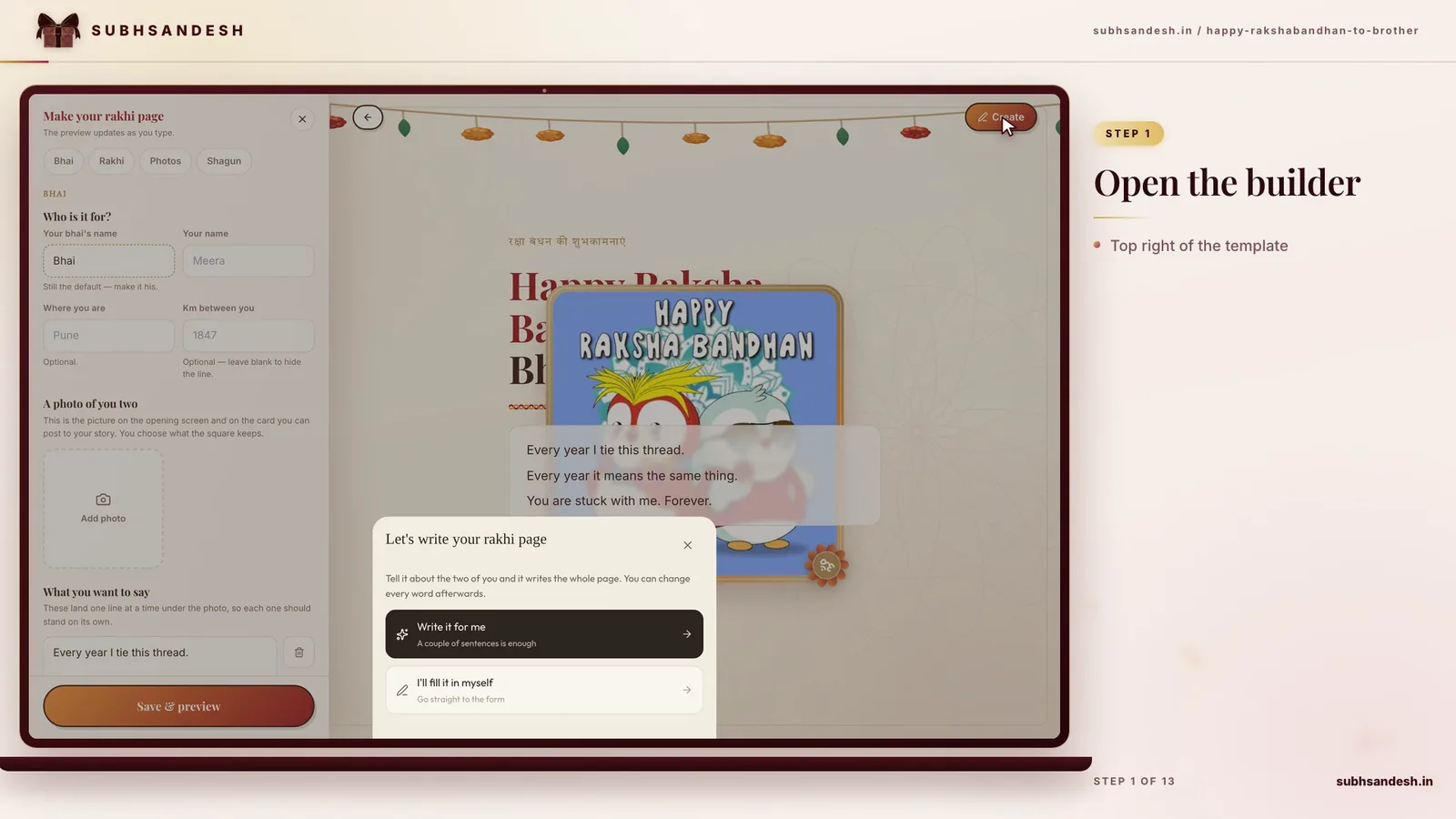
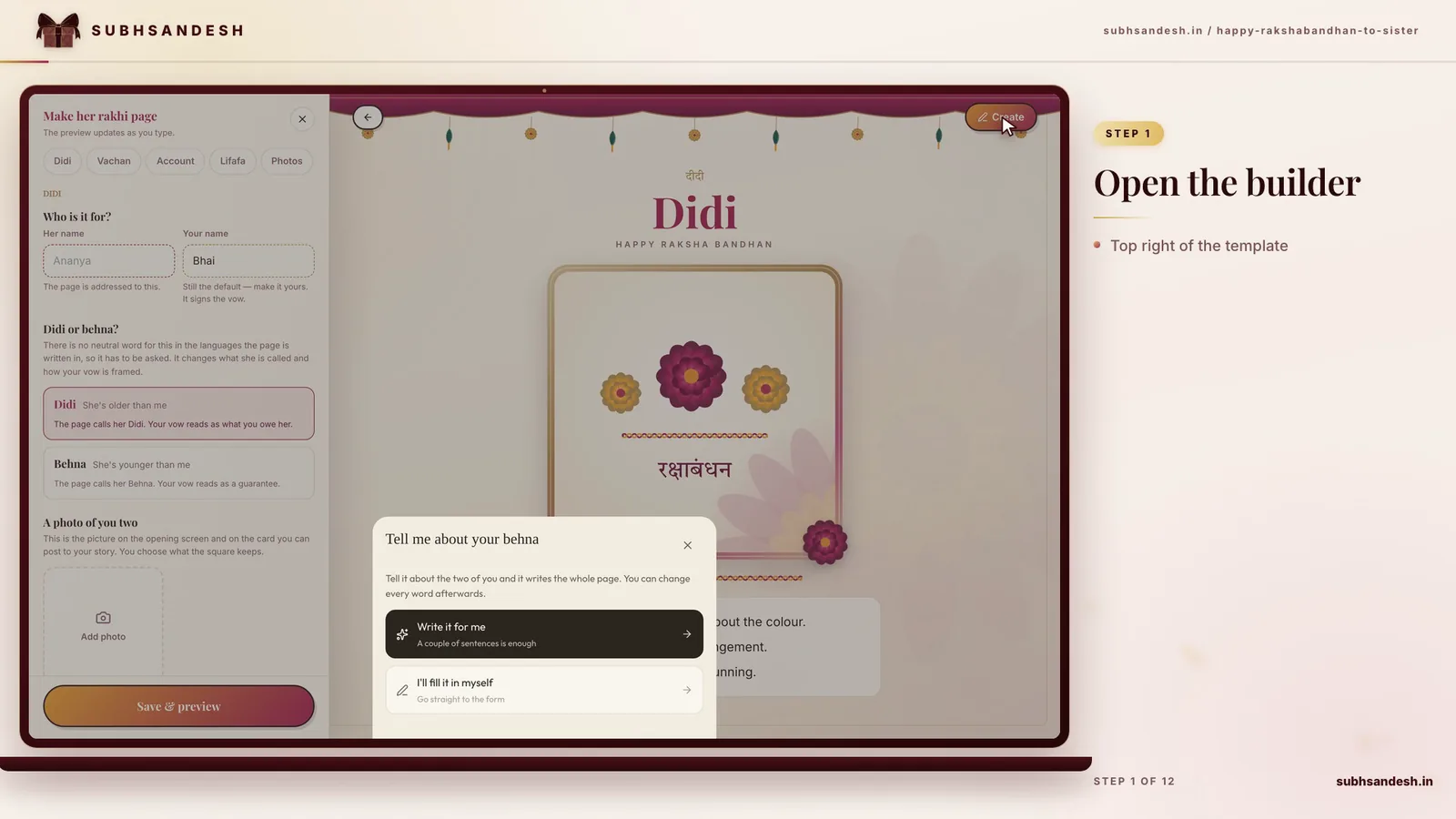
An image cannot be searched, read by a screen reader, or replied to line by line — which is why pages whose Hindi lives only inside JPGs fail when you want to send the words. The Raksha Bandhan page for a brother keeps the Devanagari as real text beside the tilak and rakhi-tying animation, and its password toggle is the one 1,315 creators have used; the page for a sister runs the other way, for entries 3 and 4.
Three ways a Hindi wish goes wrong
First, script overload. If your sibling did not go to a Hindi-medium school and reads Devanagari slowly, a long Hindi paragraph is homework, not affection. Send entry 6, or use Roman.
Second, mismatched politeness. There is no single polite Hindi. From survey data with near-native Hindi speakers whose first languages are Eastern Indic languages, Kumar and Dharurkar report in Bhasha (1 July 2025) that politeness judgements shift with the speaker's own first language: those already used to explicit honorific marking often rate modal forms as more polite than the passives Hindi speakers elsewhere reach for. The register that reads respectful to you may not read respectful to your sibling.
Third, a machine-written honorific. Kodali's 2025 IIIT Hyderabad thesis on code-mixed text built CLINE, a dataset of English–Hindi code-mixed sentences rated by humans for acceptability, and reports that the standard automatic metrics often cannot tell acceptable mixing from unacceptable. That judgement is human. A tool can hand you a grammatical Hindi line and still pick the pronoun your family never uses.
And if your brother is in the next room, put the phone down.
Raksha Bandhan 2027: Tuesday 17 August
Raksha Bandhan 2027 falls on Tuesday 17 August 2027. The 2026 festival was Friday 28 August 2026, which is why a wish carrying last year's date reads stale even when the words are fine.
Tuesday is a working day across most of India, so 8am lands better than 3pm. If the rakhi goes by post, thread and words no longer arrive together — the case entry 5 is written for. The digital half takes minutes from the SubhSandesh templates.
Sources
- Bhatt, "Honorifics in Hindi", Linguistica Brunensia 60(1–2), 2012
- Suryanarayan & Khalil, "Kinship terms, identity and social reality", Russian Journal of Linguistics 25(1), 2021
- Poonam, "Hindi–English hybridized verbs on Twitter", PhD thesis, Panjab University, 2020
- Kumar & Dharurkar, "Passivity and Politeness in Selected Indic Languages", Bhasha 4(1), 1 July 2025
- Kodali, "Computationally Code-Mixing Bahut Challenging Hai", PhD thesis, IIIT Hyderabad, 2025
Frequently Asked Questions
Turn this inspiration into an unforgettable surprise
Build a page with photos, a heartfelt message, music and a ready-to-share link.
- Photos, message & music
- Ready-to-share link

Written by
Suyash Agrahari
Founder
Suyash Agrahari is a Software Engineer at HireQuotient and the founder of SubhSandesh and DrawFlow (drawflow.in). He builds AI agents and full-stack products with Next.js, Node.js, and the OpenAI and LangChain ecosystems, having shipped autonomous multi-agent systems, AI copilots, and large-scale outreach platforms — and scaled side projects from a few hundred to millions of users. He writes about AI engineering, web development, and building products that grow through SEO and organic reach.
Stay Connected
Follow SubhSandesh
New templates, festival ideas and step-by-step walkthrough videos — first on our socials.
Product guide
See it built, step by step
Keep reading
Thala Deepavali: A Couple's First Deepavali at the Bride's Home
Thala Deepavali is a Tamil couple's first Deepavali after marriage, at the bride's home. In 2027 it is Thursday 28 October, oil bath 4:40–6:01 AM in C…
 Suyash Agrahari· 9 min
Sugar-Free Diwali Sweets: Swaps, Label Warnings and the Evidence
Five original no-added-sugar Diwali sweets, why jaggery and honey do not count, the warnings FSSAI requires on a sugar-free box, and what an Indian su…
Suyash Agrahari· 9 minShort Diwali Quotes: 34 Original One-Liners Under 10 Words
34 original short Diwali quotes, each under ten words and marked with its word and character count, grouped by mood: lamps, family, friends, gratitude…
Suyash Agrahari· 9 min