Raksha Bandhan Wishes With Emoji: Which Ones Actually Say Rakhi
There is no rakhi emoji: none of the 148,853 named characters in Unicode carries RAKSHA or BANDHAN. Here are the six that actually carry the meaning, what each one is officially called, and which ones get misread on a different phone.
Make this into a page you can send
Photos, a message, music and a ready-to-share link — in a couple of minutes.
or browse all occasionsKey takeaways
- • There is no rakhi emoji: zero of the 148,853 named characters in the Unicode Character Database version 16.0.0 contain RAKSHA or BANDHAN.
- • The closest character that exists is the knot, the only one in Unicode whose name is that single word; the spool of thread and the ribbon are the next nearest.
- • The same character is drawn separately by each vendor, and two people rating the identical rendering disagreed on its sentiment 25% of the time in a 304-person study.
- • Keep the word rakhi in the text and let the emoji do rhythm: 51.1% of shared SubhSandesh pages are opened on a phone, where the vendor's artwork is the phone's, not yours.
On this page
Raksha Bandhan Wishes With Emoji: Which Ones Actually Say Rakhi
There is no rakhi emoji. We checked all 148,853 named characters in the Unicode Character Database (version 16.0.0) one at a time: zero contain RAKSHA or BANDHAN in their name, and the only eight containing the letters RAKHI are Znamenny chant marks from Russian liturgical notation. The nearest real candidates are the knot, the spool of thread and the ribbon — craft objects, not a festival.
That gap lands on a phone, which is where an emoji gets picked. 51.1% of shared SubhSandesh pages are opened on a phone (18,497 of 36,202 recorded views), at 12.2 average views per created page. This page names the six characters that carry rakhi meaning, what each one is officially called, which ones get misread, and why the same character can look different on your brother's handset.
Is there a rakhi emoji?
No. Unicode encodes characters, not pictures, and across the 148,853 named characters of version 16.0.0 it has never encoded one for Raksha Bandhan or for the thread itself. Anything you send is a borrowed character doing a job it was not named for.
What Unicode does carry makes the absence sharper. There is a diya lamp, a Hindu temple, a sari, a coconut, prayer beads, a nazar amulet, a red gift envelope for the Chinese hongbao and a moon cake for the Mid-Autumn Festival. Diwali has a character; the second-biggest household festival in North India has none.
So the practical question is not "what is the rakhi emoji" but "which borrowed characters read as rakhi to the person opening the message".
The six emoji that carry rakhi meaning
The page ranking first for this query is an emoji database listing 370 distinct characters with no explanation attached to any of them; the emoji-combo page at position three carries 342, most of them Braille block characters used as fill. Volume is not the problem; choice is. These six are ranked by how much rakhi meaning they actually carry.
1. 🪢 Knot
Official Unicode name: KNOT. It is the only character among 148,853 whose name is that single word, and a rakhi is a thread tied in a knot, so it is the closest literal match that exists. It does not appear in the ten most-used characters on the first-ranking emoji page, so most recipients will not have seen it in this context — use it once, next to the word rakhi, rather than alone.
2. 🧵 Spool of thread
Official name: SPOOL OF THREAD. It reads as sewing rather than ceremony, because that is what it depicts — a bobbin, not a wrist thread. It works when the sentence already says rakhi and the emoji is doing rhythm rather than meaning; on its own it reads as a craft project.
3. 🎀 Ribbon
Official name: RIBBON. A tied loop, closer in shape to a rakhi than the spool is, and the single most common non-heart character on the rakhi emoji pages we examined. Its weakness is that it also serves birthdays, gifts and awareness campaigns, so it carries no festival specificity at all.
4. 🙏 Person with folded hands
Official name: PERSON WITH FOLDED HANDS. This is the one to be careful with. It is widely read as prayer and equally widely read as thanks, please, or a high five, and Miller and colleagues found in 2016 that the closely related person-raising-both-hands character was among the three most differently interpreted renderings on four of the five platforms they tested.
5. 🧿 📿 Nazar amulet and prayer beads
Official names: NAZAR AMULET and PRAYER BEADS. Both appear on the first-ranking rakhi emoji page — the nazar 16 times, the beads 14. They are protective and devotional objects, which is the right register for a thread tied for protection, but neither is Indian in origin and neither names the festival.
6. ❤️ Heavy black heart
Official name: HEAVY BLACK HEART, despite rendering red almost everywhere. It was the most-used character on the first-ranking rakhi page, appearing 51 times. It carries affection reliably and rakhi not at all, which is exactly why it is safe: nobody misreads it, and nobody learns anything from it either.
Why the same emoji looks different on your brother's phone
Unicode assigns the code; each vendor draws its own picture for it, the way a font decides how the letter A looks. Miller and colleagues surveyed 304 participants across renderings from Apple, Google, Microsoft, Samsung and LG and found real disagreement even before platforms enter the picture.
When two people rated the exact same rendering, they disagreed on whether the sentiment was positive, neutral or negative 25% of the time. Forty-four of 110 renderings — 40% — had an average sentiment disagreement of two points or more on an eleven-point scale.
Across platforms it widens: 9 of the 22 characters they analysed varied by more than a full sentiment unit depending on which vendor drew them. Note the date, though. That study is from 2016, and every vendor has redrawn its set since, so treat the mechanism as established and the specific per-vendor numbers as historical.
Emoji, sticker, word or page: what actually survives the trip
Four different things get called "adding a rakhi" to a message, and they behave differently once sent.
| What you send | What it actually is | Same for every recipient? | Misread risk | SubhSandesh measure |
|---|---|---|---|---|
| Emoji character | A Unicode codepoint drawn by the recipient's vendor | No — five vendor sets in the 2016 study | Sentiment disagreement 25% of the time on identical renderings | Chosen on a phone in 51.1% of 36,202 views |
| Sticker or image | A bitmap file | Yes | Low; nothing to interpret | Not measured on our platform |
| The written word "rakhi" | Plain text | Yes | None | Works across all 2,973 pages created |
| A personalised page | One web page, one rendering | Yes | None | 12.2 average views per shared page; 44.2% locked first |
The pattern is that ambiguity travels with the emoji and nothing else. If the meaning must arrive intact, put it in words and let the emoji do rhythm.
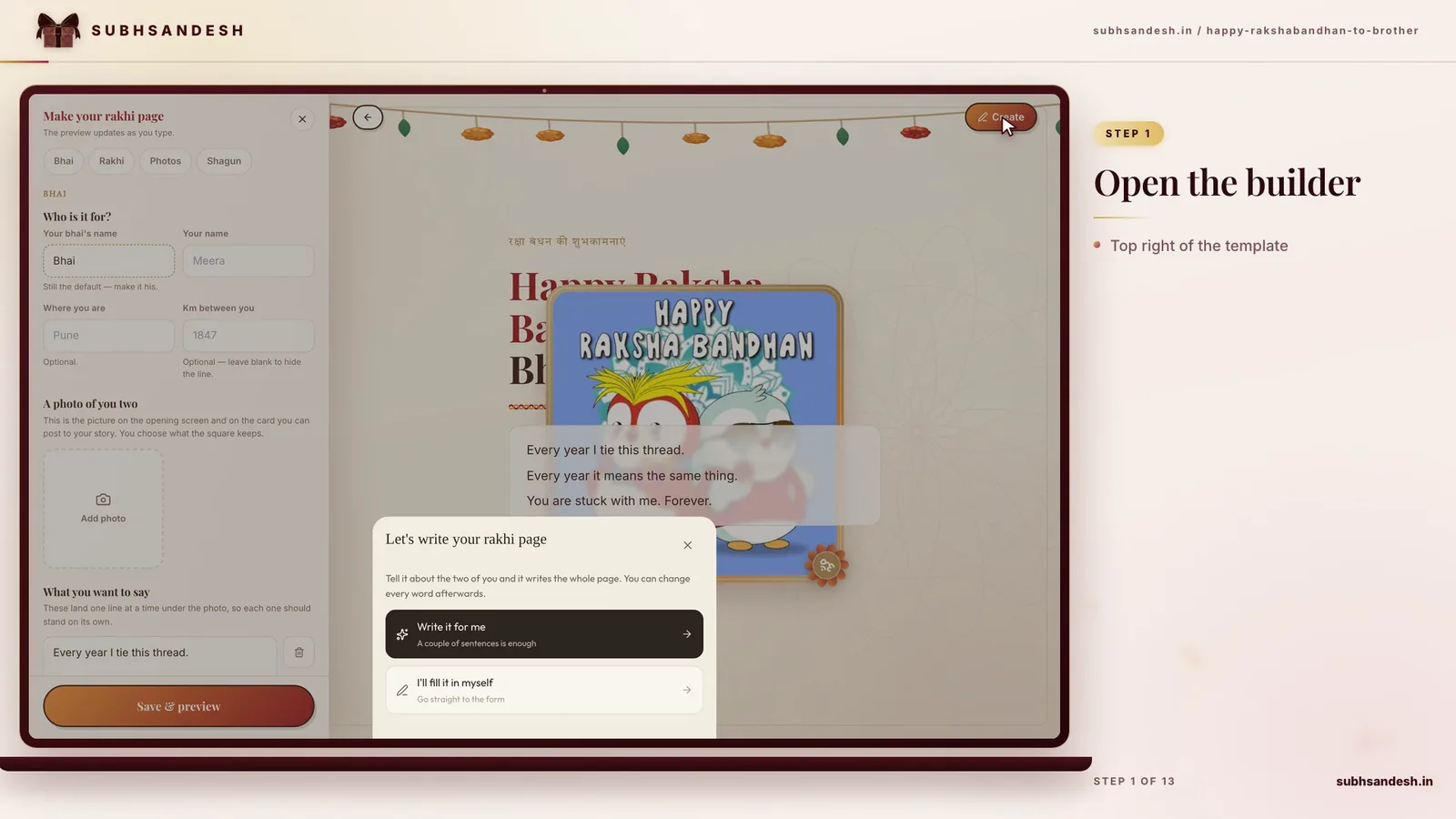
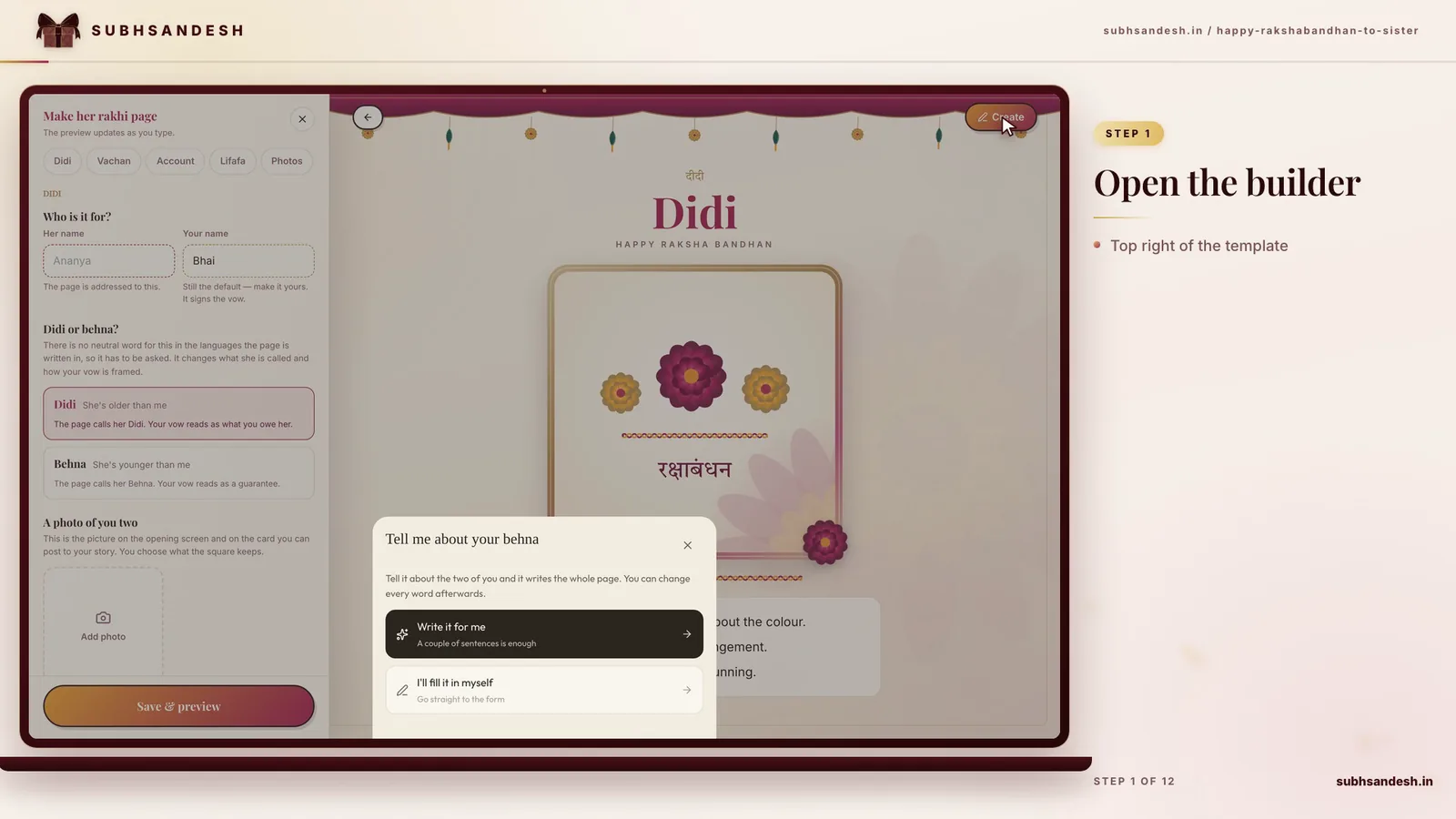
That is also the argument for sending a page rather than a paragraph: it renders once, the same way, for everyone who opens the link. Our Raksha Bandhan page for a brother and the Raksha Bandhan page for a sister both carry the name and photo inside the page instead of inside a character set.
How many emoji belong in a rakhi wish
More than you would put in a sentence, and fewer than the combo pages suggest. McCulloch and Gawne examined a corpus of over a billion emoji uses and found that 53%, 52% and 39.5% of the ten most common two-, three- and four-emoji sequences were the same character repeated, where the equivalent word sequences in a large English corpus showed zero repetition.
Their argument is that emoji work like beat gestures — the rhythmic hand movement that accompanies speech — rather than like words. Three hearts in a row is not a typo; it is emphasis, and it is the single most normal thing people do with emoji.
Four lines with the emoji doing rhythm rather than meaning:
- Happy Raksha Bandhan, bhai. The thread is already on its way. 🪢
- Rakhi bandhwane ka time aa gaya, and I miss you today. 🎀❤️
- Tied yours from three time zones away. Happy Rakhi, didi. 🧵✨
- Thank you for the rakhi. Wearing it all day. 🙏❤️
The same work reports that around 85% of emoji use sits alongside words rather than replacing them. An emoji-only rakhi message is the unusual case, not the safe one.
Which emoji suit an elder brother, a younger brother, or a sister
Register decides this before taste does. In a 2024 study of 92 students, 69.2% said they used emoji to show appreciation and 56% to convey excitement — but 34.1% used them for irony and sarcasm and 14.3% for fear, concern or anger. The same small vocabulary does sincerity and mockery, which is why a teasing character next to an earnest line reads wrong.
For an elder brother, or anyone you address with aap, one emoji at the end of the sentence is the whole budget. The line carries the respect; the emoji only marks that you are warm rather than formal.
For a younger brother or a sister you tease, the ceiling is much higher, and repetition is on your side. Herring and Dainas found that across 523 survey responses, readers agreed with the researchers' own reading of what an emoji was doing only 60.4% of the time, and only 50.9% among men — so the safer assumption is that your emoji will be read as tone, not as content.
When to send the wish with no emoji at all
Skip them for a first rakhi after a bereavement, for a sibling you are not currently on speaking terms with, and for anything you would call an apology rather than a greeting. A character that reads as cheerful on one platform and neutral on another is a bad thing to gamble a hard message on.
Skip them too when roughly 48.9% of your audience is not on a phone, which is what our own view data implies for shared pages, and older desktop mail clients handle newer characters worst.
We should also state our own limit. Our rakhi templates are new and lightly used, so we have no rakhi-specific open rate and will not invent one; the numbers on this page are platform-wide across 2,973 pages and 15 page types. If you want to see how a page renders before trusting it with a message, browse all SubhSandesh templates and open one on your own phone first.
Sources
- Miller, Thebault-Spieker, Chang, Johnson, Terveen and Hecht, "Blissfully happy" or "ready to fight": Varying Interpretations of Emoji, ICWSM, 2016 — grouplens.org
- McCulloch and Gawne, Emoji Grammar as Beat Gestures, Emoji2018 workshop at ICWSM, published 6 July 2018 — ceur-ws.org
- Herring and Dainas, Receiver Interpretations of Emoji Functions: A Gender Perspective, Emoji2018 workshop at ICWSM, published 6 July 2018 — ceur-ws.org
- Micle and Mudure-Iacob, Creating Communicative Context Through the Use of Emoji and Politeness in Online Academic Written Interactions, Studia UBB Philologia LXIX(3), 30 September 2024 — studia.reviste.ubbcluj.ro
- Character names and the absence of a rakhi character were checked directly against the Unicode Character Database, version 16.0.0.
Frequently Asked Questions
Turn this inspiration into an unforgettable surprise
Build a page with photos, a heartfelt message, music and a ready-to-share link.
- Photos, message & music
- Ready-to-share link

Written by
Suyash Agrahari
Founder
Suyash Agrahari is a Software Engineer at HireQuotient and the founder of SubhSandesh and DrawFlow (drawflow.in). He builds AI agents and full-stack products with Next.js, Node.js, and the OpenAI and LangChain ecosystems, having shipped autonomous multi-agent systems, AI copilots, and large-scale outreach platforms — and scaled side projects from a few hundred to millions of users. He writes about AI engineering, web development, and building products that grow through SEO and organic reach.
Stay Connected
Follow SubhSandesh
New templates, festival ideas and step-by-step walkthrough videos — first on our socials.
Product guide
See it built, step by step
Keep reading
Thala Deepavali: A Couple's First Deepavali at the Bride's Home
Thala Deepavali is a Tamil couple's first Deepavali after marriage, at the bride's home. In 2027 it is Thursday 28 October, oil bath 4:40–6:01 AM in C…
 Suyash Agrahari· 9 min
Sugar-Free Diwali Sweets: Swaps, Label Warnings and the Evidence
Five original no-added-sugar Diwali sweets, why jaggery and honey do not count, the warnings FSSAI requires on a sugar-free box, and what an Indian su…
Suyash Agrahari· 9 minShort Diwali Quotes: 34 Original One-Liners Under 10 Words
34 original short Diwali quotes, each under ten words and marked with its word and character count, grouped by mood: lamps, family, friends, gratitude…
Suyash Agrahari· 9 min