
Raksha Bandhan Wishes With Name and Photo: What to Send, and How
Two ways to send a Raksha Bandhan wish with a name and photo: a rendered JPG or a shareable page. Compares steps, cost and what actually reaches the recipient, with SubhSandesh's own open data and the research on the name effect.
Make this into a page you can send
Photos, a message, music and a ready-to-share link — in a couple of minutes.
or browse all occasionsKey takeaways
- • A name-on-image JPG and a named shareable page are different products: the JPG renders inline in a group chat, while a link has to be tapped — and 51.9% of the 32,683 views SubhSandesh has recorded happen on a phone.
- • Adding the recipient's name measurably lifts response: 60% versus 52% questionnaire return in a 618-person randomised trial, and a 20% higher email open rate across Stanford's field experiments.
- • The name effect is small and not guaranteed — a 2024 replication with 100 caregivers found 78% versus 68%, with a confidence interval spanning -10.2% to 24.4%.
- • 44.3% of the 2,718 people who built a SubhSandesh page password-protected it before sending, which a downloaded JPG cannot do.
- • Sharing is not opening: 2.8 million shared links produced 75 billion potential views but only 9.6 million clicks, which is why a group-chat wish still wants an image alongside the link.
On this page
Raksha Bandhan Wishes With Name and Photo: What to Send, and How
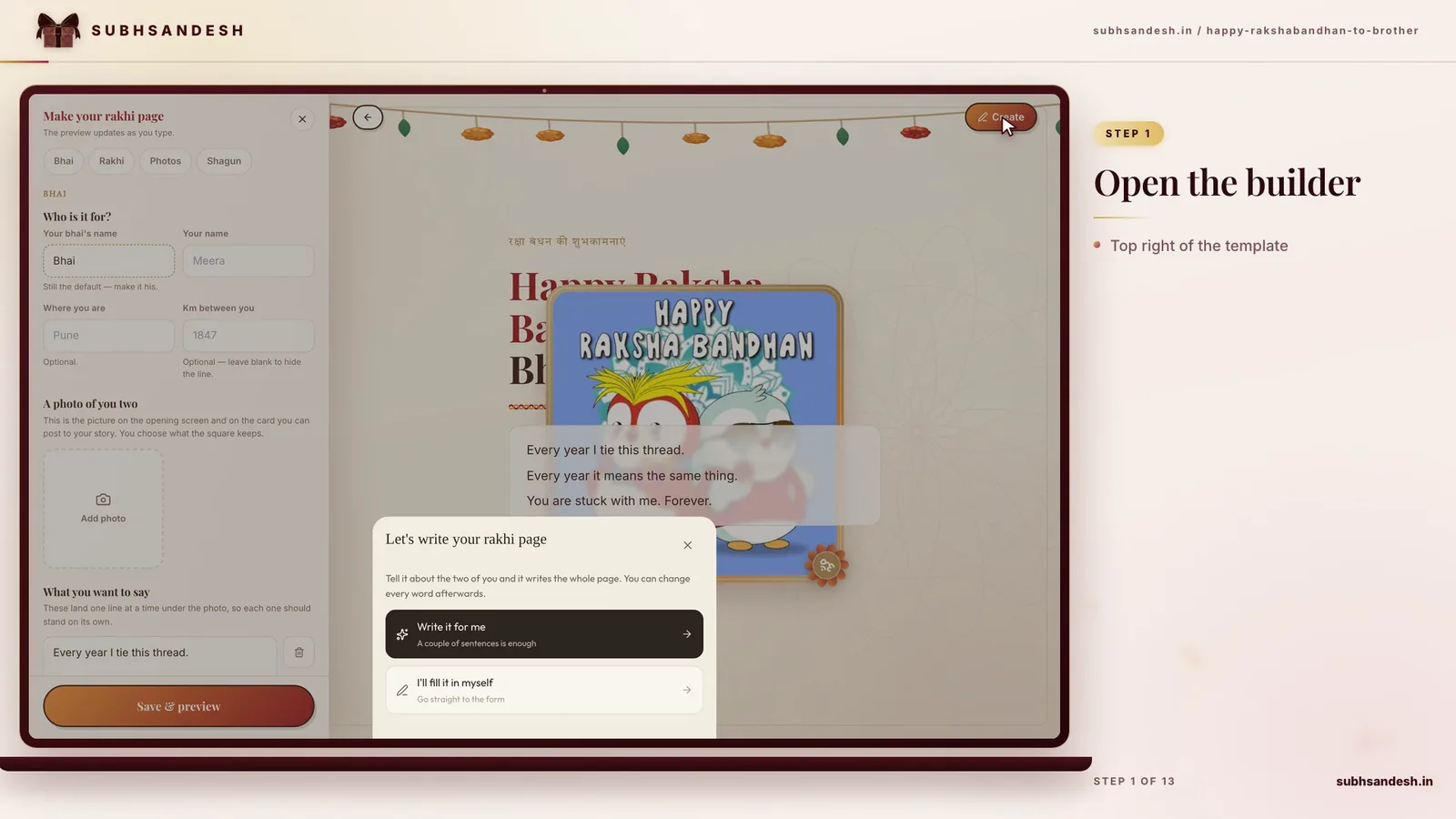
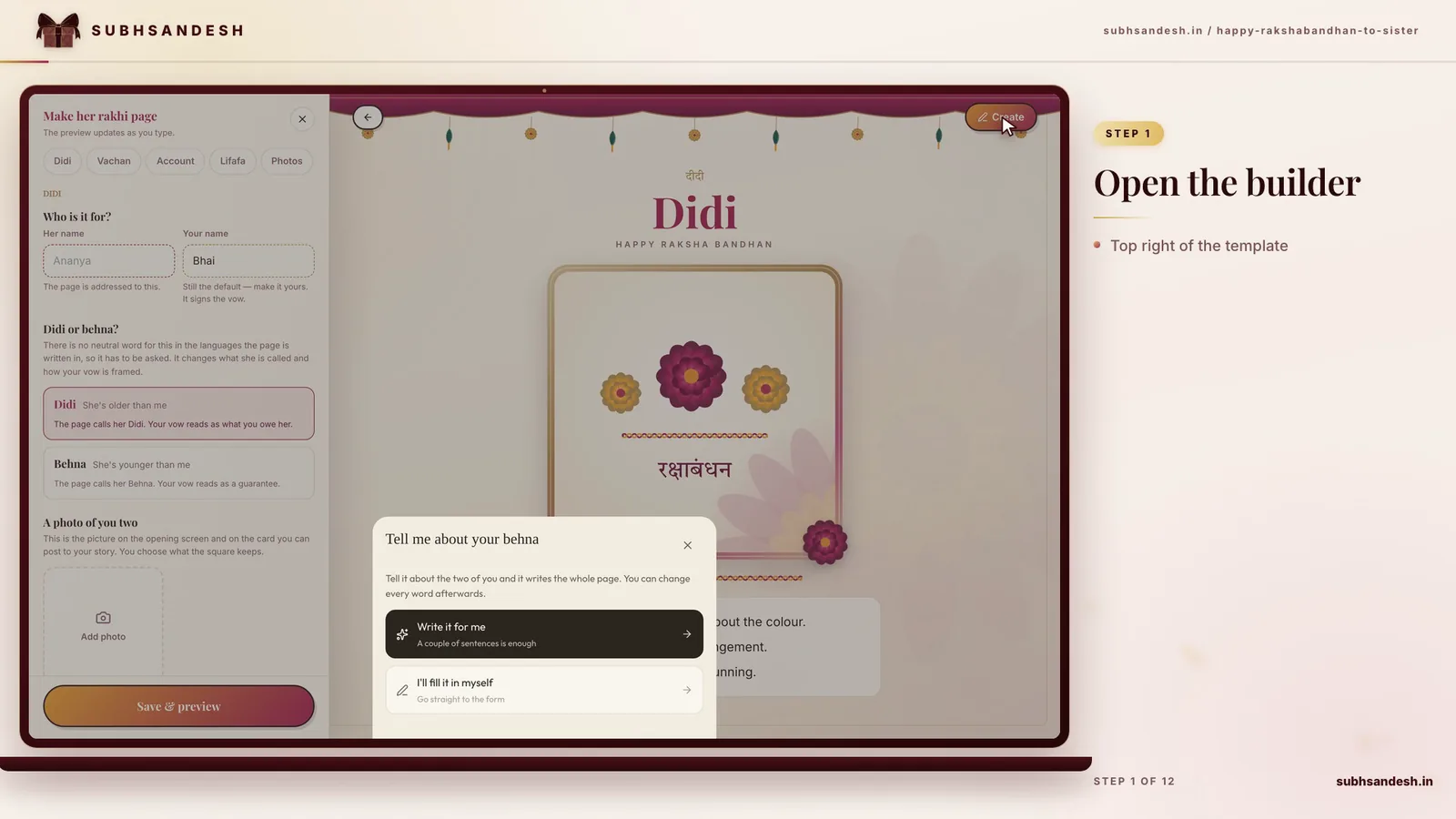
A Raksha Bandhan wish with a name and photo comes in two shapes, and they are not interchangeable. One is a rendered JPG: you type your brother's or sister's name into a form, pick a rakhi design, and download an image you can forward. The other is a page — name, photo, message, and a private link you send.
Both are free and both take under ten minutes, so the choice is really about where the wish has to land. Of the 32,683 views SubhSandesh's shared pages have recorded, 51.9% (16,952) happen on a phone, and 44.3% of the 2,718 people who built one password-protected it before sending.
A link works when there is one recipient who will actually tap it. A flat image works when the wish has to sit inside a forty-person family group. Below: both formats, the wording that goes next to the name, and the case where the JPG genuinely wins.
What a Raksha Bandhan wish with a name and photo actually is
A Raksha Bandhan wish with a name and photo is a greeting in which the name and the photograph are part of the artefact itself, not typed into a chat box above it. Two formats dominate.
The first is a name-on-image generator: a design with a reserved text slot, into which a server renders the name and hands back a flat JPG or PNG. The second is a personalised page: a template that stores the name, photo and message as fields, publishes them at a private URL, and gives you a link.
The difference is larger than it sounds. An image is a finished file — it compresses, it forwards, and it can never change. A page is live: it reflows on a six-inch screen, it can carry music and animation, and it can be locked behind a password, which 44.3% of SubhSandesh creators do before sending anything.
Does putting their name on it actually change anything?
Yes, measurably, and less than most marketing copy implies. The largest field test on record comes out of Stanford's Graduate School of Business, where randomised experiments across millions of emails found that adding the recipient's name to the subject line raised the probability of opening it by 20%, lifted sales leads by 31% and cut unsubscribes by 17% (Sahni, Wheeler and Chintagunta, Stanford GSB Research Paper 3409, 2016).
The same effect shows up in clinical research. A randomised study inside the GRASP shoulder-pain trial sent 618 participants either a text message containing their own name or a standard one; 60% of the personalised group returned their first questionnaire against 52% of the standard group, an eight percentage-point gap (Trials, 28 July 2021).
There is a reason it is not a gimmick. An EEG study of 25 listeners found that a person's own name evokes a distinct frontocentral negativity 210 to 350 milliseconds after they hear it, and that a friend's name does not produce the same component (Social Cognitive and Affective Neuroscience, 7 November 2023).
Now the inconvenient number. A 2024 replication with 100 caregivers recorded 78% response to the personalised message against 68% to the plain one, but the adjusted absolute risk difference of 7.1% ran from −10.2% to 24.4% (Trials, 7 February 2024). The effect is real, small, and not guaranteed on any single message.
Five ways to send a named Raksha Bandhan wish with a photo
Ordered by how much of the personalisation survives the trip to the recipient, least to most.
1. A rendered name-on-image JPG
What it is: a rakhi design with the name burned into a fixed slot, downloaded as one image file. Who it suits: family group chats, and anyone whose phone is short on data, because the file downloads once and renders inline.
Cost: free on every generator that ranks for this search. Time and the catch: three steps — type the name, choose a design, download. The photo is usually stock artwork; where an upload is offered the crop is fixed, and a long Devanagari name can clip.
2. A WhatsApp status with the name and photo
What it is: the same rendered image, posted to your own status rather than sent to one person. Who it suits: wishing every cousin at once without messaging forty people individually.
Cost: free. Time and the catch: four steps, and it expires after 24 hours. Status is a broadcast, so it reaches nobody in particular — the brother you actually meant it for may never open the tab.
3. An Instagram story with a name sticker
What it is: the photo posted as a story with the name typed over it as a text sticker, usually with a mention. Who it suits: siblings who already live on Instagram and will screenshot it.
Cost: free. Time and the catch: four steps, a 24-hour lifespan, and a 9:16 crop that eats the edges of a horizontal childhood photo. A mention notifies them; a plain sticker does not.
4. A named, photo-bearing page sent as a private link
What it is: a template where name, photo, message and music are saved as fields and published at a URL only you share. Who it suits: one sibling, especially one in another city or country, where the wish is the whole event.
Cost: free to build and share. Time and the catch: four steps to publish, but the median gap between a creator's first save and last edit is 6.9 hours across 913 sampled pages — people come back to fiddle. Start the day before, not on the morning of.
5. The link plus a preview image — the hybrid
What it is: the page, plus one rendered image sent above it as the hook. Who it suits: group chats where you want the wish seen and the page opened.
Cost: free. Time and the catch: five steps, and the only format that survives both contexts. Nothing in the top results offers it: the image sites do not build pages, and the page builders do not export images.
If option four or five is what you want, the Raksha Bandhan page for a brother carries the tilak, aarti and rakhi-tying scenes with your photo and his name.
Name-on-image JPG versus a named shareable page
The four viable formats, with what each actually costs the recipient.
| Option | Steps to produce | Cost | What lands with them | Measured evidence |
|---|---|---|---|---|
| Name-on-image JPG | 3 | Free | One image file, forwardable forever | Mere presence of an image raises engagement, and a human face raises it further (Li and Xie, 2019) |
| WhatsApp status | 4 | Free | A post that disappears in 24 hours | 51.9% of 32,683 SubhSandesh views are on a phone, so the format fits — but nothing persists |
| Named shareable page | 4 | Free | A private URL that stays live | 99.4% of 2,718 started pages get published, and 44.3% are password-protected first |
| Link plus preview image | 5 | Free | Both an image and a page | 2.8 million shared links produced 75 billion potential views but 9.6 million clicks (Gabielkov et al., 2016) |
The takeaway is not that one format wins. The JPG buys guaranteed visibility, the page buys depth, and the last row is the only line that buys both.
What to write next to the name
The generators hand you an image and leave the hardest part to you. Four patterns that work, in rising order of effort.
Open with the name as a vocative, then say one true thing: "Rohan — nine years of you finishing my Maggi, and I'd still pick you." Use the name once, at the front, where the own-name response fires inside 350 milliseconds, and never again in the same message. A name repeated three times reads as a mail merge.
Second, anchor it to a date rather than the festival: "Since 2014, Ananya, you have been the only person who answers on the first ring." Third, name the thing you are actually protecting them from — that is what the thread is for.
Fourth, if they are abroad, state the hour you will call. A wish carrying a specific time gets answered; one that says "miss you yaar" does not.
The rule underneath all four: the name is the hook, not the content. Stanford's 20% lift came from a name on an otherwise unchanged message — it opened the email, it did not write it.
When a flat image beats a link, and when we are the wrong choice
A downloadable JPG beats a shareable page in three situations, and it is worth being blunt about them.
The first is the family group. An image renders inline in a forty-person chat; a link needs someone to choose to tap it.
The Twitter study above is the honest scale of that gap: 2.8 million shared links generated 75 billion potential views and 9.6 million actual clicks (Gabielkov et al., ACM SIGMETRICS, June 2016). Sharing is not opening.
The second is a recipient on a feature phone, on patchy data, or behind a locked-down work laptop. Roughly 48% of SubhSandesh views are not on a phone, and a page that assumes a modern browser will look wrong on part of that. The third is proximity: if your sister is in the next room on 28 August 2026, hand her a rakhi and a printed photo.
We should also name our own gap. Of the 2,718 pages built on SubhSandesh since March 2026 across 13 page types, the top five are a romantic page (913), a digital bouquet (710), an apology dashboard (521), a dramatic partner page (311) and a miss-you page (109). Rakhi is not on that list, so we have no rakhi-specific open rate to quote and will not invent one.
The platform-wide numbers here describe how personalised pages behave in general, not how rakhi pages behave. To see the range before you decide, browse all SubhSandesh templates and pick the format that matches where the wish has to land.
Sources
- Sahni, Wheeler and Chintagunta, Personalization in Email Marketing, Stanford GSB Paper 3409, 2016
- PROMPTS, personalised versus standard text prompts, Trials, 28 July 2021
- Personalised text prompts for telephone follow-up, Trials, 7 February 2024
- Specificity in the processing of a subject's own name, Social Cognitive and Affective Neuroscience, 7 November 2023
- Li and Xie, Is a Picture Worth a Thousand Words?, Journal of Marketing Research, 18 November 2019 (abstract only)
- Gabielkov and others, Social Clicks, ACM SIGMETRICS, June 2016 (abstract only)
Frequently Asked Questions
Turn this inspiration into an unforgettable surprise
Build a page with photos, a heartfelt message, music and a ready-to-share link.
- Photos, message & music
- Ready-to-share link

Written by
Suyash Agrahari
Founder
Suyash Agrahari is a Software Engineer at HireQuotient and the founder of SubhSandesh and DrawFlow (drawflow.in). He builds AI agents and full-stack products with Next.js, Node.js, and the OpenAI and LangChain ecosystems, having shipped autonomous multi-agent systems, AI copilots, and large-scale outreach platforms — and scaled side projects from a few hundred to millions of users. He writes about AI engineering, web development, and building products that grow through SEO and organic reach.
Stay Connected
Follow SubhSandesh
New templates, festival ideas and step-by-step walkthrough videos — first on our socials.
Product guide
See it built, step by step
Keep reading
Thala Deepavali: A Couple's First Deepavali at the Bride's Home
Thala Deepavali is a Tamil couple's first Deepavali after marriage, at the bride's home. In 2027 it is Thursday 28 October, oil bath 4:40–6:01 AM in C…
 Suyash Agrahari· 9 min
Sugar-Free Diwali Sweets: Swaps, Label Warnings and the Evidence
Five original no-added-sugar Diwali sweets, why jaggery and honey do not count, the warnings FSSAI requires on a sugar-free box, and what an Indian su…
Suyash Agrahari· 9 minShort Diwali Quotes: 34 Original One-Liners Under 10 Words
34 original short Diwali quotes, each under ten words and marked with its word and character count, grouped by mood: lamps, family, friends, gratitude…
Suyash Agrahari· 9 min