
What to Do on Raksha Bandhan If You Don't Have a Brother
Five workable answers, one of which is doing nothing. Who this applies to, what a sister, cousin, friend, partner or parent does and does not replace, bereavement, estrangement, and what not to say.
Make this into a page you can send
Photos, a message, music and a ready-to-share link — in a couple of minutes.
or browse all occasionsKey takeaways
- • There are five workable answers and one of them is doing nothing — opting out of Raksha Bandhan is a legitimate observance choice, not a failure of tradition.
- • At least six groups are affected: only children, women with sisters only, the bereaved, the estranged, people whose brother will not take part, and people with a distant half- or step-brother.
- • In the 807-respondent Hidden Voices survey, 90% of estranged adults found the holiday season challenging and 85% said the same of birthdays; a scheduled family festival works the same way.
- • A rakhi tied for someone who has died functions as a ritual when it carries structure, symbolism and one witness — the three criteria found in a 2009 study of 14 memorial acts.
- • SubhSandesh's only rakhi template is addressed to a brother by name, so for this reader it is the wrong artefact; of 2,718 pages made here, none was designed for a memorial.
On this page
What to Do on Raksha Bandhan If You Don't Have a Brother
There are five workable answers, and one of them is to do nothing. Tie the rakhi to a sister or a cousin; tie it to a friend you have chosen as family; tie one for a brother who has died; tie it to no one and mark the day privately; or let 28 August pass unmarked. None of these replaces a brother, and this page will not pretend otherwise. SubhSandesh's own numbers show how privately people handle this: of the 2,718 personalised pages created since 2026-03-12, 1,205 — 44.3% — were password-protected before being shared, and 51.9% of the 32,683 recorded views were on a phone. Below: who this applies to, what each substitute covers, bereavement, estrangement, what to say, and the feed.
Who this applies to, named plainly
This is not one audience. It is at least six: only children; women with sisters and no brother; people whose brother has died; people estranged from a brother, by their choice or his; people whose brother is alive, reachable and simply will not take part; and people whose half- or step-brother was never close enough for the ritual to mean anything.
The last two groups are the ones festival content ignores hardest. In the Stand Alone and University of Cambridge survey of 807 estranged adults, 51% of those estranged from a brother said they wished the relationship could be different. Wanting it and having it are separate things, and Raksha Bandhan is the day that gap becomes public.
Raksha Bandhan 2026 falls on Friday 28 August — mid-workweek, with no weekend gathering to disappear into.
Who you can tie a rakhi to instead, and what each one does not replace
Seven options, most common first. Each covers what it is, who it suits, what it substitutes for, and what it does not.
1. A sister
Two sisters tie rakhis to each other, each protector and protected. It suits siblings with no brother between them and is now unremarkable in many families. It reproduces the reciprocity of the ritual almost exactly. What it does not give you is the asymmetry some people actually want on the day — being the one looked after.
2. A cousin
A first cousin, particularly a father's brother's son, is a brother in most Indian kinship systems and needs no re-framing. It suits joint-family gatherings and substitutes fully in ritual terms. What it cannot do is manufacture closeness: a cousin you see twice a year is still a cousin you see twice a year on Saturday.
3. A friend you have chosen as family
A friend who has tied rakhi with you for years is not a substitute brother. That is fictive kinship, which anthropology treats as a real kin category rather than a stand-in, and making a dharam bhai through rakhi is older than any of us. It suits people whose functional family is not their genetic one, and it replaces both relationship and ritual. It will not stop relatives asking whose wrist that was.
4. A partner
Some couples mark the day with a rakhi as a gesture of protection rather than siblinghood. It suits people who want the day to contain something rather than nothing. Honestly, it substitutes for very little: the rakhi's grammar is sibling-shaped, and borrowing it for a romantic relationship reads as odd to many Indian families. If it works for you it works; do not expect it to travel.
5. A parent
Tying a rakhi to a father or mother reassigns the protective role upward, which is where it began anyway. It suits only children in small households and is the usual choice for people who want the day to stay inside the house. It replaces the company, not the peer relationship — most people know the difference while doing it.
6. A brother who has died
A rakhi tied to a photograph, left at a shrine, knotted around a tree he planted, or kept in a drawer. It suits the first years after a death, and for many people it never stops. It substitutes for the act, not the person. Sands, which sends remembrance rakhis to bereaved families through its Forever Tied in Love campaign, says families develop their own way of observing the day after a loss — there is no correct form.
7. Nobody
Not observing Raksha Bandhan is legitimate and needs no reason you can explain to an aunt. It suits people for whom the ritual would be performance, and people in a first year of grief who cannot face it. It substitutes for nothing, which is the point. What it costs is the questions, and "I don't do rakhi" is a complete sentence.
Compared on what the day demands, and on whether a private shareable page fits:
| Option | Who it fits | Needs to be in person | A private page fits |
|---|---|---|---|
| Sister or cousin | Families with no brother | Yes, or a video call | Rarely — you are already together |
| Chosen-family friend | Functional family is not genetic | No | Yes — 44.3% of SubhSandesh's 2,718 pages are password-protected |
| Partner | Couples wanting the day marked | Yes | No — private, not shareable |
| Brother who has died | Bereaved siblings | No | Sometimes, for photographs; 51.9% of views open on a phone |
| Nobody | Anyone opting out | No | No |
Substitutes involving a living person are physical. Distance and memory are the only cases where a page earns its place.
The first Raksha Bandhan after a brother's death
The first one is the hardest, and it does not end there. In her doctoral study of bereaved adult siblings at the University of Toronto, Brenda Marshall found adult sibling loss to be a disenfranchised loss: attention goes first to the spouse and children, then the parents, and the surviving sibling is expected to supply strength. Her participants described the pain being rekindled with each passing family milestone, and families falling silent about the dead sibling to protect elderly parents.
That is the mechanism behind a bad 28 August — not the absence itself, but a calendar date that makes it speakable inside a family that has agreed not to speak.
If you want to do something, the useful test comes from grief research rather than festival content. A 2009 Smith College study of 14 people who had memorialised someone with a tattoo found the act worked as a ritual when it carried structure, symbolism and the inclusion of at least one other person. A rakhi tied to a photograph at a fixed time, kept afterwards, witnessed by one relative, meets all three. A rakhi tied alone and binned meets none.
Observing nothing in the first year is also reasonable. Sands's position — that families find their own form — includes the form where you do not.
When the absence is a decision, not a loss
Estrangement differs from bereavement in one important way: nothing is unresolved, and being told the relationship could be repaired is not help. The 807-respondent Hidden Voices survey by Stand Alone and the Centre for Family Research at Cambridge, published 10 December 2015, found 90% of estranged adults found the holiday season challenging and 85% said the same of birthdays.
Festivals are hard because they are scheduled, public and family-shaped, which describes Raksha Bandhan exactly. The same survey found 68% felt stigma around estrangement, judged for contradicting what a family is supposed to look like.
Two practical things. Decide before the day whether you will answer "and your brother?" or deflect it; deciding in the moment costs more. And roughly four in five respondents reported some positive outcome from estrangement, usually freedom — a day you have declined to observe is one of those.
What to say, and what not to say
The line to avoid is "you can tie one to me!". It is meant warmly and lands badly, because it recasts a real absence as a logistics problem with an easy fix and leaves the person declining a kindness.
Also avoid "at least you don't have to buy a gift", "he's still with you in spirit", and asking an estranged person whether they have considered reaching out. Dr Lucy Blake, who worked on the Cambridge research, described social media as a highlight reel of family life; most well-meant lines on this day are the conversational equivalent.
What works is shorter. "Thinking of you today." "Do you want company or quiet?" If their brother died, use his name — 807 respondents' worth of evidence on family silence suggests the name is the thing nobody says.
The feed, on one specific day
For about 24 hours, Instagram and WhatsApp statuses become a wall of sibling photographs. Photos on social media appear on Stand Alone's own ranked list of what estranged adults find hardest, alongside the holiday season and birthdays.
The practical option is the boring one: do not open it. Mute "rakhi" and "Raksha Bandhan" on X and Instagram for two days, skip stories, and read messages from the notification tray rather than in-app. That is not clinical avoidance — it is declining to scroll several hundred photographs of other people's siblings today.
If you do post, you owe nobody an explanation or a caption about strength.
Where SubhSandesh is the wrong tool for this
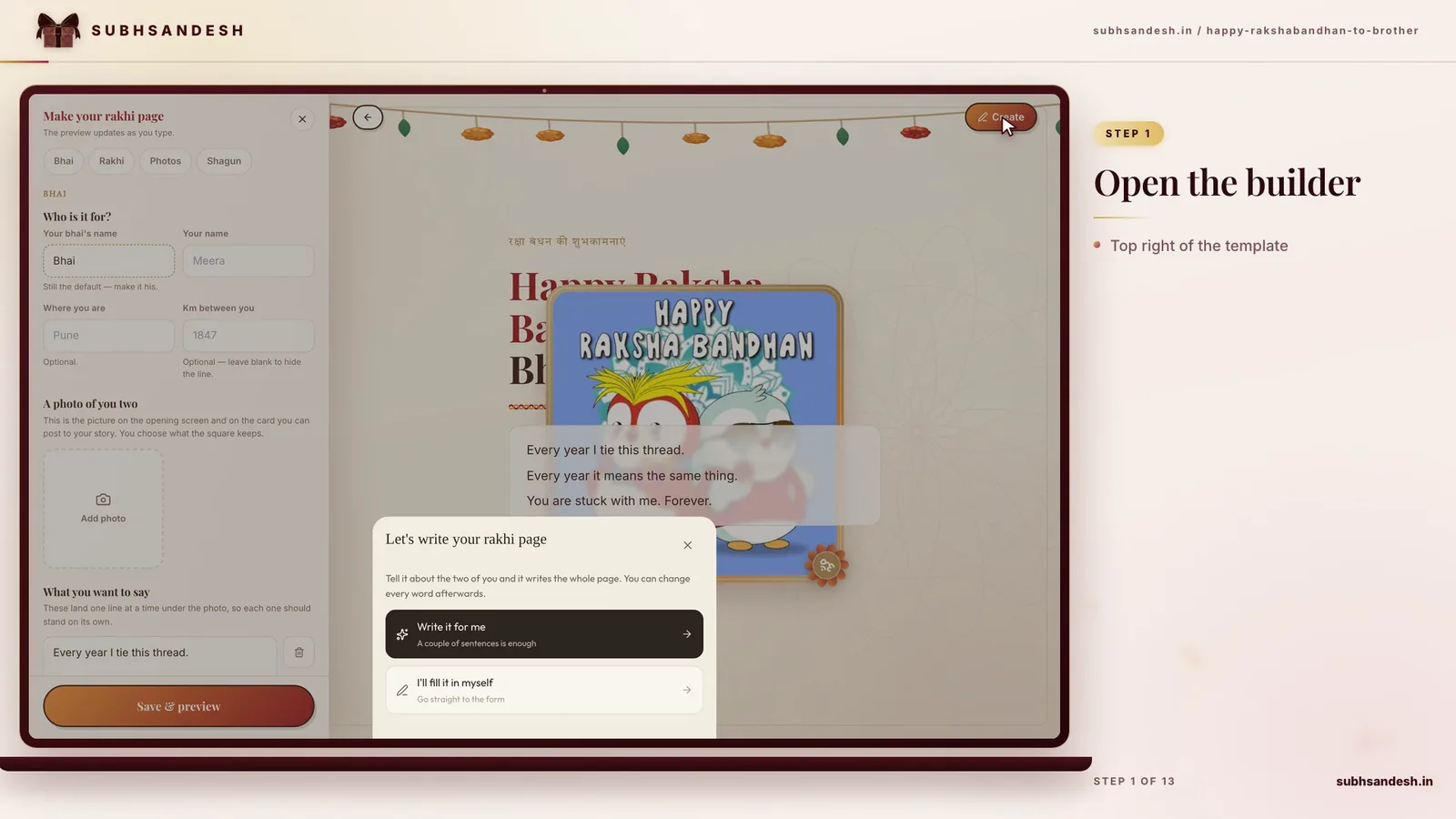
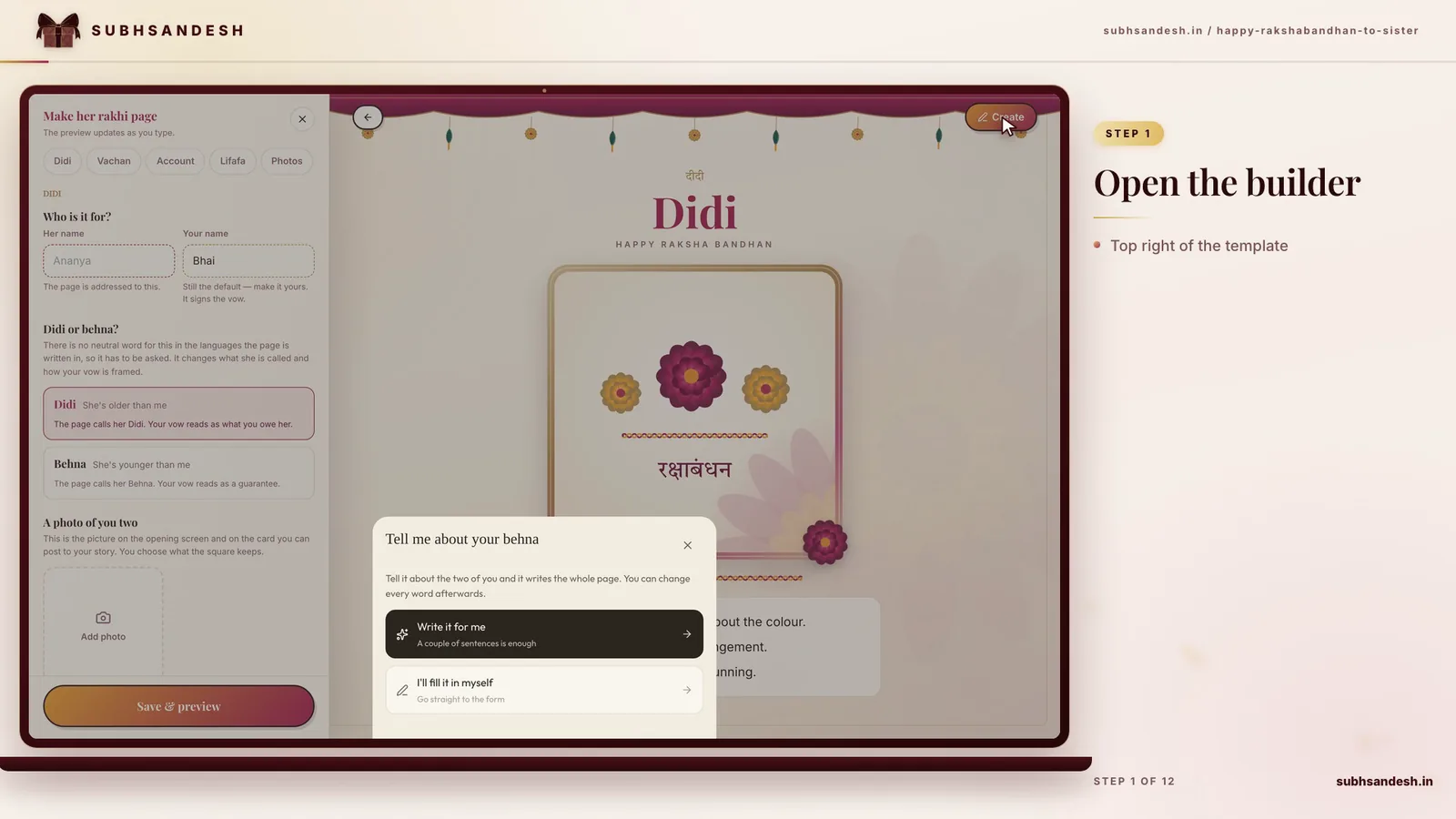
Plainly: our only Raksha Bandhan template, the Raksha Bandhan page for a brother, is written brother-first — the copy, the scenes and the tilak-and-aarti sequence all address a brother by name. For a reader without one it is precisely the wrong artefact, and typing a friend's name into a brother's name field is a workaround, not a fit.
Two honest alternatives. For a chosen-family friend at a distance, the best friend page is closer to the relationship even though it is not a rakhi page, and the full template gallery covers 13 page types, none designed for a memorial. If you are marking a brother who died, a physical rakhi in a box beats anything on a screen. None of the 2,718 pages made here was built for that, and we will not claim otherwise.
Sources
- Hidden Voices: Family Estrangement in Adulthood, Stand Alone with Cambridge's Centre for Family Research, 10 December 2015.
- University of Cambridge research news, 10 December 2015 — Dr Lucy Blake.
- Brenda J. Marshall, Silent Grief: Narratives of Bereaved Adult Siblings, University of Toronto, 2010.
- Elizabeth Schiffrin, Memorial tattoos and their functions for the bereaved, Smith College, 2009.
- Sands, Forever Tied in Love — remembrance rakhis for bereaved families.
Frequently Asked Questions
Turn this inspiration into an unforgettable surprise
Build a page with photos, a heartfelt message, music and a ready-to-share link.
- Photos, message & music
- Ready-to-share link

Written by
Suyash Agrahari
Founder
Suyash Agrahari is a Software Engineer at HireQuotient and the founder of SubhSandesh and DrawFlow (drawflow.in). He builds AI agents and full-stack products with Next.js, Node.js, and the OpenAI and LangChain ecosystems, having shipped autonomous multi-agent systems, AI copilots, and large-scale outreach platforms — and scaled side projects from a few hundred to millions of users. He writes about AI engineering, web development, and building products that grow through SEO and organic reach.
Stay Connected
Follow SubhSandesh
New templates, festival ideas and step-by-step walkthrough videos — first on our socials.
Product guide
See it built, step by step
Keep reading
Thala Deepavali: A Couple's First Deepavali at the Bride's Home
Thala Deepavali is a Tamil couple's first Deepavali after marriage, at the bride's home. In 2027 it is Thursday 28 October, oil bath 4:40–6:01 AM in C…
 Suyash Agrahari· 9 min
Sugar-Free Diwali Sweets: Swaps, Label Warnings and the Evidence
Five original no-added-sugar Diwali sweets, why jaggery and honey do not count, the warnings FSSAI requires on a sugar-free box, and what an Indian su…
Suyash Agrahari· 9 minShort Diwali Quotes: 34 Original One-Liners Under 10 Words
34 original short Diwali quotes, each under ten words and marked with its word and character count, grouped by mood: lamps, family, friends, gratitude…
Suyash Agrahari· 9 min