
Surprise Gift for Girlfriend at Work: Plan the Delivery First
A workplace gift delivery is a hand-off chain: courier, building security, reception, then whoever walks it to her floor. This covers who signs for it, whether she is at that desk today, who watches her open it, and four routes compared on what each one asks of her.
Make this into a page you can send
Photos, a message, music and a ready-to-share link — in a couple of minutes.
or browse all occasionsKey takeaways
- • Office attendance is coordinated, not fixed: in-person attendance ran 29% higher when an employee's manager was in the building, across about 43,000 employees, so pick the day from her team's pattern rather than your own calendar.
- • There may be no 'her desk' to deliver to: among 433 staff under a mandated hybrid policy, a dedicated desk with no desk sharing was the strongest single influence on workspace preference.
- • An office delivery hands the choice of audience to you; a link hands it back to her, and 50.2% of shared pages are opened on a phone (21,130 of 42,099 views).
- • No study measures embarrassment from a gift arriving at work. What is measured is 'intrusion' - blending work and personal life while preferring them separate - across 1,229 managers, with boundary control mitigating it.
- • Privacy is a step, not an automatic gain: 42.7% of creators password-protect their page before sharing it (1,462 of 3,425), which is one more thing she has to do on an office network.
On this page
Surprise Gift for Girlfriend at Work: Plan the Delivery First
A surprise gift for your girlfriend at work is a logistics problem before it is a romantic one, so settle three things before you buy anything: whether she is physically in that office on the day, who receives the parcel on her behalf, and whether she gets to choose the moment she opens it. Two numbers from SubhSandesh's own database say how much that last point matters — 42.7% of creators password-protect their page before sharing it (1,462 of 3,425), and 50.2% of shared pages are opened on a phone (21,130 of 42,099 views). Attendance is the part people get wrong: in one study of roughly 43,000 employees, in-person office attendance was 29% higher when the manager was in the building. Below is the delivery chain end to end, then four routes compared on what each one asks of her.
What a workplace gift delivery actually involves
A workplace gift delivery is a hand-off chain, not a doorstep drop. Four people usually touch it before she does: the courier, building security, reception, and whoever walks it to her floor — none of whom were expecting your parcel or have any reason to treat it as urgent.
Most Indian office buildings put couriers through a gate register, and larger campuses will not let one past the lobby at all. So the name on the docket has to be a name reception can find in a staff directory, with a department and a floor, not a nickname.
The phone number on the docket is the decision that quietly settles everything. Put hers and she knows something is coming; put a colleague's and you have spent the secret; leave yours and the courier calls you from a lobby you cannot reach.
Will she even be at that desk today?
Assume she is not, unless you actually know her office days. A 2023 study of coattendance at a large global technology company, using anonymised building-access data from about 43,000 employees, found in-person attendance was 29% higher when an employee's manager was present, and that a one-standard-deviation rise in the share of teammates present lifted that employee's own attendance by 16%.
That is the useful finding for you: office days cluster around other people rather than following a fixed personal routine. If her manager is travelling or the team has drifted to Thursdays, the Tuesday you picked can quietly become a work-from-home day.
There is a second question underneath it — whether "her desk" exists at all. In a discrete-choice experiment published in December 2025, 433 operational support staff working under a mandated hybrid policy rated a dedicated desk, meaning no desk sharing, as the strongest single influence on workspace preference, ahead of personalisation and territoriality.
It ranks that high because it is not guaranteed. In a hot-desking office there is no seat that belongs to her, which means there is nowhere for a parcel to wait and nobody who considers it their job to look after it.
Who else sees it, and whether that is what you want
A delivery to an office is a public event by default. Reception logs it, somebody signs for it, and it lands in front of the people she works with — so the gesture performs for an audience neither of you selected.
For some people that is the best part. The question is whether you know that about her specifically, or are assuming it because you would enjoy it.
Beliefs about romance and work are measurable, and privacy is one of them. A nationwide survey of 259 organisational members identified three underlying belief structures about workplace romance, and one was the right to demand privacy about it; of the four kinds of advice people gave, one was simply silence — do not discuss it at work.
That study is about relationships between colleagues, not about a partner sending something in from outside, so it does not transfer directly. What it does establish is that "keep my romantic life out of this building" is a real, measured position that a sizeable number of working people hold.
What the research actually says about embarrassment at work
The honest answer is that no study measures embarrassment caused by a romantic gift arriving at someone's workplace. I searched Europe PMC and DOAJ for unwanted attention at work, embarrassment and audiences, public recognition and discomfort, gift recipients and audiences, and workplace romance and coworkers, and the literature on that specific event is not there. So treat the risk as reasoning, not as a finding — anyone telling you it is proven is guessing too.
The mechanism underneath it, though, has been measured. Boundary research separates the boundary a person enacts from the one they prefer, and calls it "intrusion" when someone is blending work and non-work while preferring them kept apart. Across 1,229 managers in Sweden, intrusion was associated with more work-life conflict than the opposite mismatch, and perceived boundary control reduced that effect.
Map that onto a box on her desk. You have merged your relationship into her work sphere on your schedule, and how that lands depends on whether she wanted the two kept separate — and on how much control she has over when the personal part becomes visible. Control is the one variable you can hand her.
Four ways to reach her at work
1. A courier delivery to the reception desk
This works when you know she is in that day and you have the exact building, floor and legal name. Address it as HR would, add the department, and accept that the surprise now depends on strangers.
The usual failure is not theft, it is limbo: a parcel parked at a security desk for two days because nobody could match the name to a person. If what you sent is perishable, that limbo is the entire risk.
2. A parcel a named colleague agrees to hold
This is the most reliable physical route and the one that gives away the most. One person now knows, and that person decides whether the handover is quiet or an announcement, so tell them plainly which you want.
It also settles the attendance question outright, because a colleague can simply tell you whether she is coming in on Thursday. Pick the teammate who sits nearest her rather than the one you get on with best.
3. Something she finds at work that you left at home
A note in the laptop sleeve, a photograph in the notebook she carries, something in the side pocket of her bag. Nothing is delivered, nobody signs, and it still lands in the middle of her working day.
The limit is obvious: you need access to her things the night before, so this is unavailable if you do not live together or are in different cities. It is also the only one of the four where nobody at her office ever knows it happened.
4. A link she opens on her own phone
A page she can open at her desk, in a stairwell, or in the car on the way home moves the decision about audience from you to her. That is the reason to use it, not the speed. SubhSandesh has 3,425 personalised pages created since 2026-03-12, across 15 page types, and the most-made is the plainest romantic kind — the "I love you" page (/love-gf) — 1,001 created, 29.2% of all pages.
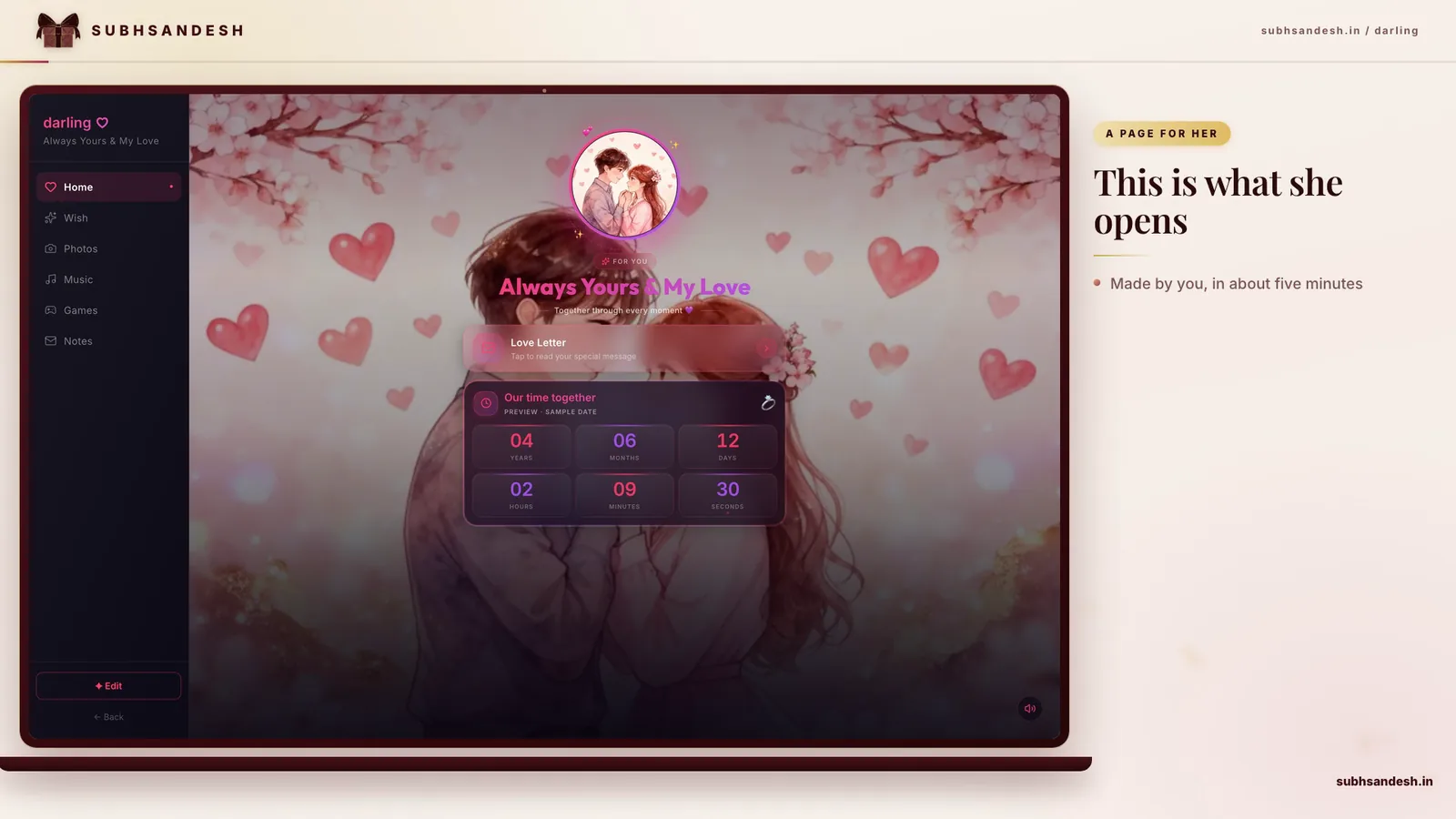
Two quieter ones suit a working day better than a big set piece does. The dark, dramatic Darling page sits at 349 created, 10.2% of all pages, and a birthday page for a partner at 258 created, 7.5%, for the years her birthday lands on a working Tuesday. The most-reached-for remains the romantic "I love you" page.
The four ways it can reach her at work, compared
The comparison that matters is not how much effort each route takes from you, but what each one requires of her. All three columns below describe her circumstances, not yours.
| Route | Needs a person at her office | Survives a work-from-home day | Opened on her own phone |
|---|---|---|---|
| Courier to reception | Yes | No | No |
| Named colleague holds it | Yes | No | No |
| Hidden at home, found at work | No | Yes | No |
| Private link | No | Yes | Yes — 50.2% of shared pages are opened on a phone (21,130 of 42,099 views) |
Only two of the four survive the most likely disruption, which is her not being in the building that day. Both of those two are also the two she opens without anybody else present.
When her workplace is the wrong place to send anything
Some jobs put a phone out of reach for eight hours — a factory floor, an operating theatre, a classroom, a trading desk in market hours. A link that sits unopened until 7pm is not a surprise at work, it is a surprise on the commute, and if the workday moment was the whole idea, a page has failed at it.
A page is also the wrong call when she likes being made a fuss of in front of her team. There is nothing to pass round a lunch table, no box that sits on the desk for a week, and nothing for a colleague to photograph. When the visible object is the point, send the object.
The privacy feature cuts both ways too. If you add a password — and 42.7% of creators password-protect their page before sharing it (1,462 of 3,425) — you have added a step she must complete before she sees anything, and on a slow office network at 3pm that step is friction rather than romance.
One last thing worth knowing: 99.4% of started pages are actually published and shared (3,405 of 3,425). Almost nobody abandons the making — the part people get wrong is the timing and the address.
Sources
- Charpignon M-L, Yuan Y, Zhang D, et al. "Navigating the new normal: Examining coattendance in a hybrid work environment." PNAS, 11 December 2023.
- Aboagye E, Botha W, Ljungberg H, Danielsson C, Jensen I. "Employee workspace preferences in a mandated hybrid work policy: A discrete choice experiment." Scandinavian Journal of Work, Environment & Health, published online 11 December 2025.
- La France BH. "'Don't Get Your Meat Where You Get Your Bread': Beliefs and Advice about Workplace Romance." Behavioral Sciences, 11 August 2022.
- Mellner C, Peters P, Dragt MJ, Toivanen S. "Predicting Work-Life Conflict: Types and Levels of Enacted and Preferred Work-Nonwork Boundary (In)Congruence and Perceived Boundary Control." Frontiers in Psychology, 15 November 2021.
Frequently Asked Questions
Turn this inspiration into an unforgettable surprise
Build a page with photos, a heartfelt message, music and a ready-to-share link.
- Photos, message & music
- Ready-to-share link

Written by
Suyash Agrahari
Founder
Suyash Agrahari is a Software Engineer at HireQuotient and the founder of SubhSandesh and DrawFlow (drawflow.in). He builds AI agents and full-stack products with Next.js, Node.js, and the OpenAI and LangChain ecosystems, having shipped autonomous multi-agent systems, AI copilots, and large-scale outreach platforms — and scaled side projects from a few hundred to millions of users. He writes about AI engineering, web development, and building products that grow through SEO and organic reach.
Stay Connected
Follow SubhSandesh
New templates, festival ideas and step-by-step walkthrough videos — first on our socials.
Product guide
See it built, step by step

Keep reading
How to Surprise Someone on Their Birthday at Midnight
The Indian midnight birthday wish, treated as a timing problem: aim for 23:55 rather than 00:00, check the Bedtime schedule that silences a 00:00 noti…
 Suyash Agrahari· 9 min
How to Surprise Husband on Birthday When the Day Is His Alone
A birthday is his day, not a shared one, so unlike an anniversary the contents can genuinely surprise him — and the gesture fails when it becomes abou…
Suyash Agrahari· 9 minHow to Surprise Best Friend on Friendship Day in India
Friendship Day in India falls on the first Sunday of August — a different date from the UN's International Day of Friendship on 30 July. Four things w…
Suyash Agrahari· 9 min