
Surprise Gift for Girlfriend Instant: Minutes, Not Days
A surprise gift for your girlfriend, instant, means a page she opens on her phone within the hour. But SubhSandesh pages take a median 7.2 hours from first save to last edit, so here is what genuinely compresses into minutes and what does not.
Make this into a page you can send
Photos, a message, music and a ready-to-share link — in a couple of minutes.
or browse all occasionsKey takeaways
- • Only three things genuinely arrive in minutes: a personalised page at a link, a voice note, and a photograph she has never seen with one honest line under it.
- • Sending is fast; finishing is not. The median gap between a SubhSandesh page's first save and its last edit is 7.2 hours, sampled on 1,001 "I love you" pages.
- • The worry that a digital gift looks lazy is mostly the giver's: across five gift-card studies, givers chose digital less often than recipients preferred to receive it.
- • Nothing posted is instant. India Post's fastest domestic express product promises next-day delivery, not same-hour.
- • 50.2% of SubhSandesh page views happen on a phone, 21,130 of 42,099 - which also means half do not, so a link is a bad bet for a recipient who ignores notifications.
On this page
Surprise Gift for Girlfriend Instant: Minutes, Not Days
A surprise gift for your girlfriend, instant, means something she can open on her phone inside the hour you decided to send it: a personalised page at a link, a voice note, or a photograph she has never seen with one line under it that only you could write. Two of those take under fifteen minutes. What does not compress is the finishing — on SubhSandesh the median gap between a page's first save and its last edit is 7.2 hours, sampled on 1,001 "I love you" pages. Almost everyone gets there: 99.4% of started pages are published and shared, 3,405 of 3,425. They just come back to them. This page separates what genuinely arrives in minutes from what only looks instant, what to write when there is no time to be clever, and when a link tonight is the wrong move.
What counts as an instant surprise gift?
An instant surprise gift is one with no delivery window in front of it: you decide, you make it, she opens it, all inside the same hour. That leaves two families — something digital that travels as a link, and something you buy within walking distance and hand over yourself.
Everything else has a queue. India Post's fastest domestic express product, marketed as 24/48 Speed Post, promises next-day delivery on a dedicated high-speed network — next day, not next hour. That is the ceiling on anything posted, which makes "instant" a real category but a narrow one.
Five surprises you can actually send in the next fifteen minutes
Each one is described the same way: what it is, what it needs from you, how long it takes, what it will not do.
1. A personalised page with her name on it
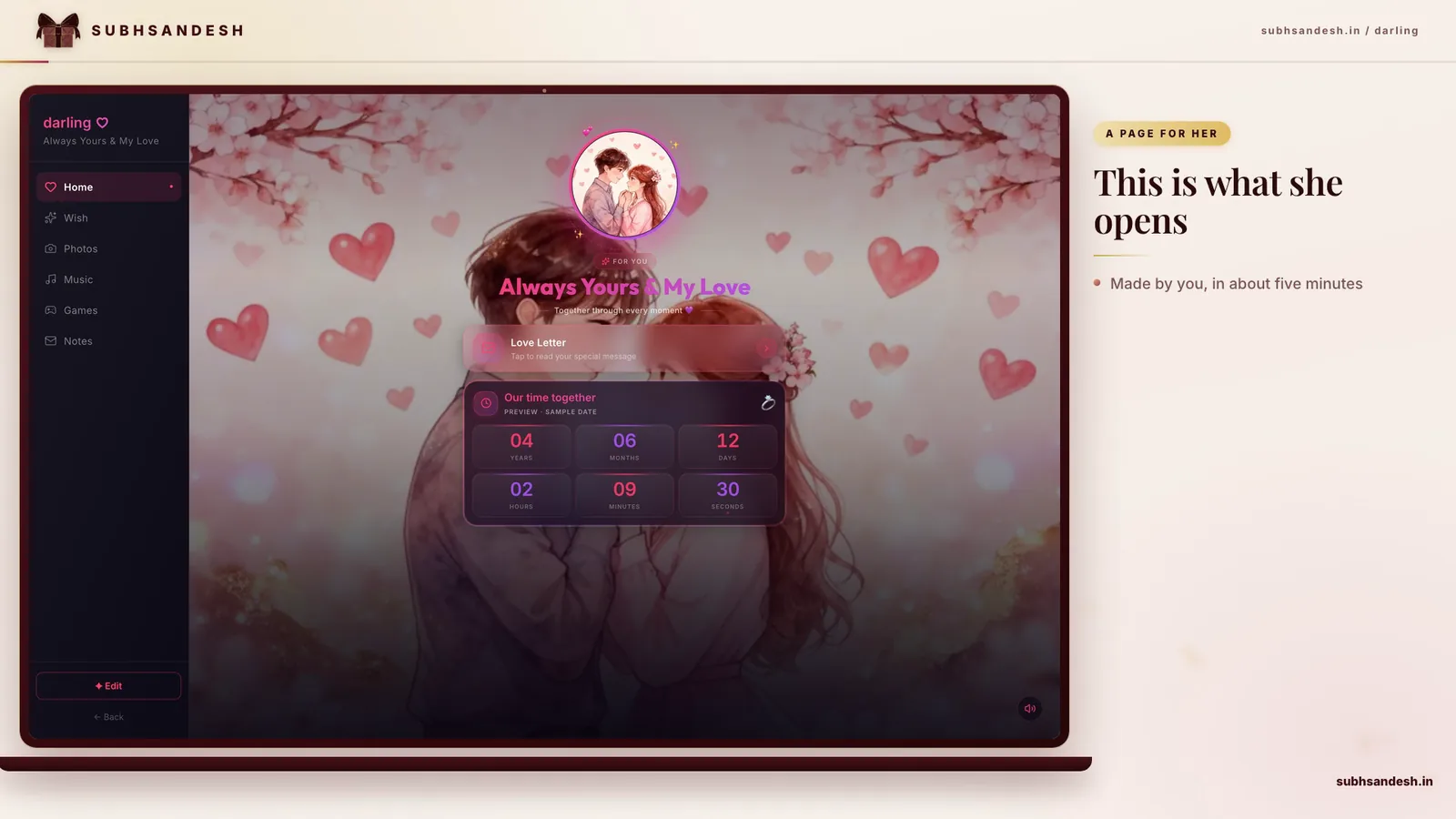
A single web page built for one reader — her name, a message, a photograph, animation — that you send as a link. It needs her name, one detail nobody else would know, and a decision about the closing line. Ten to fifteen minutes if you write instead of browsing templates. It will not survive being read as a template: if the words could be addressed to anyone, the link is the gift and the gift is empty.
2. A voice note you do not re-record
Forty seconds of you saying the thing you would say if she were in the room. It needs privacy and one take. Under a minute, and the first take is the one to send. It will not work if you script it — the reason a voice note lands is the hesitation in it, and a second take sands that off.
3. One photograph she has never seen, captioned
A photograph from your camera roll she has never been shown, sent with a line explaining why you kept it. It needs three minutes of scrolling and one honest sentence. Two to five minutes. It will not carry an occasion on its own; sending it on a day that demanded more reads as a substitute.
4. A dated plan she can hold you to
A specific commitment with a date on it, written down: the restaurant, the Saturday, the train. It needs you to check your calendar before you name the date, which is the step people skip. Five minutes. It will not do anything at all tonight — it is a promise, and it converts into a gift only on the day you keep it.
5. Something bought within walking distance
Flowers, a book, something from the shop at the end of the road, handed over in person. It needs shops open and you outdoors. Thirty to ninety minutes door to door. It will not reach her in another city, which is the case that pushes most people toward a link.
The five options, compared on time and what each one leaves out
Read the first two rows together: same object, sent and finished.
| Option | Ready in | Needs from you | First-party signal |
|---|---|---|---|
| Page, sent | 10–15 min | Her name, one detail | /love-gf: 1,001 pages, 29.2%, the most-created type |
| Page, finished | Median 7.2 hours | Coming back once | 99.4% published and shared, 3,405 of 3,425 |
| Voice note | Under 1 min | One take, no script | None — SubhSandesh records pages, not audio |
| Photo plus caption | 2–5 min | A photo she has never seen | 50.2% of views on a phone, 21,130 of 42,099 |
| Bought nearby | 30–90 min | Shops open, you outdoors | India Post's fastest posted option is next-day |
Only the first three rows are genuinely instant, and only the first can carry an occasion.
Why a link does not read as lazy to the person opening it
The fear that stops most people is that a digital gift looks like a shortcut. The best available evidence says that fear is mostly the giver's. Across five studies of gift cards specifically, Reshadi, Givi and Das found givers were less likely to choose a digital card than recipients were to prefer receiving one, partly because givers overestimated how far recipients saw a digital card as violating gift-giving norms (Psychology & Marketing, January 2023).
Read the scope precisely: that is gift cards, not every digital gift, and the authors frame it as one new instance in which givers' and recipients' preferences diverge rather than a general law. The direction still helps, because the worry it measures is the worry you have at 11pm.
A page written for one person sits further from a gift card than it looks, because what is delivered is the writing. If you want a shape to work inside, the animated "I love you" page is the most-created type on SubhSandesh at 1,001 pages, 29.2%; the darker Darling page sits fourth at 349, 10.2%, and reads better if sweet is not your register.
What cannot be rushed, and what to do about it
The writing. The first-party number says it plainly: the median gap between a page's first save and its last edit on SubhSandesh is 7.2 hours, sampled across 1,001 "I love you" pages. People do not sit down and finish these — they start, walk away, and come back. You do not have 7.2 hours tonight, so cut the scope rather than the sentences: one detail, two sentences about it, properly.
Two findings help. In a study of surprising gifts among close relations, Lindgreen and colleagues identified six variables that produce surprise — occasion, time of giving, type of gift, place, giver and surroundings — from 48 respondents plus eight interviews (European Journal of Marketing, September 2020). Time of giving is one of the six levers, so an ordinary Tuesday is doing work a birthday would not. And in dictator-game experiments using monetary transfers rather than romantic gifts, Khalmetski, Ockenfels and Werner showed there is more room to create a positive surprise when the recipient's expectation is low (Journal of Economic Theory, September 2015). Surprise is measured against what she expected, not against how long you took.
The same EJM study names the trap: people who prefer a surprising gift may still give an unsurprising one to avoid disappointment. Tonight, that trap is the generic option.
For next time, two experiments on last-minute task completion found a temporal landmark signalling a new beginning speeds up how promptly people finish — the "fresh start" effect (Applied Cognitive Psychology, July 2024). Put the next date you care about in your calendar on the first of a month.
What to write on it, and whether to post it as a status
Do not paste a quote. A borrowed line is the one element that reliably reads as instant in the bad sense: she can tell in a second it was not written by you, and a page whose best sentence belongs to a stranger has told her how much time you had.
Three lines is enough, in this order — the thing you noticed, the thing it made you think, the thing you are promising. "You left the balcony light on for me again on Thursday" beats any amount of borrowed poetry. If no first line comes, describe a specific day instead.
A public status is a different object. A screenshot posted to your followers is an announcement; a link sent to her is a message to one person. Doing the public one first is the version she is most likely to resent. If the point is that you miss her rather than that you are celebrating, the "I miss you" page fits better than a romantic template.
One thing to check before sending: 42.7% of SubhSandesh creators password-protect their page before sharing it, 1,462 of 3,425 — which matters when the link will sit in a chat other people can scroll.
When an instant surprise gift is the wrong answer
If she is asleep, instant is not a virtue. A link that lands at 1am is read at 8am anyway, and you have swapped a moment you could have chosen for one you did not.
Some people are not reachable this way at all. 50.2% of SubhSandesh page views happen on a phone, 21,130 of 42,099 — which is also the plainest way of saying half do not, and a recipient who keeps her phone face-down all evening is a poor match for anything depending on a notification. Average views per created page is 12.3, so pages get reopened, just never by someone who missed the first open.
If what she is waiting for is an apology, a gift page is the wrong object: an apology has to name the thing you did, and a surprise deliberately withholds. The apology dashboard exists for that case and is the third most-created page type at 753, 22.0% — but it is a separate job, not a wrapper for this one.
If the occasion was on the calendar and you missed it, an instant gift is a patch and not a repair. Send it, then do the un-instant thing: put the next date in your calendar tonight, while you still feel like this.
Sources
- Lindgreen et al., "The paradox of surprise", European Journal of Marketing, 18 September 2020 — open copy
- Reshadi, Givi and Das, "Gifting digital versus physical gift cards", Psychology & Marketing, 7 January 2023 — article
- Min et al., "Oops!… I waited until the last minute again", Applied Cognitive Psychology, July 2024 — article
- Khalmetski, Ockenfels and Werner, "Surprising Gifts", Journal of Economic Theory, September 2015 — manuscript
- India Post, Speed Post service features — next-day delivery
Frequently Asked Questions
Turn this inspiration into an unforgettable surprise
Build a page with photos, a heartfelt message, music and a ready-to-share link.
- Photos, message & music
- Ready-to-share link

Written by
Suyash Agrahari
Founder
Suyash Agrahari is a Software Engineer at HireQuotient and the founder of SubhSandesh and DrawFlow (drawflow.in). He builds AI agents and full-stack products with Next.js, Node.js, and the OpenAI and LangChain ecosystems, having shipped autonomous multi-agent systems, AI copilots, and large-scale outreach platforms — and scaled side projects from a few hundred to millions of users. He writes about AI engineering, web development, and building products that grow through SEO and organic reach.
Stay Connected
Follow SubhSandesh
New templates, festival ideas and step-by-step walkthrough videos — first on our socials.
Product guide
See it built, step by step

Keep reading
How to Surprise Someone on Their Birthday at Midnight
The Indian midnight birthday wish, treated as a timing problem: aim for 23:55 rather than 00:00, check the Bedtime schedule that silences a 00:00 noti…
 Suyash Agrahari· 9 min
How to Surprise Husband on Birthday When the Day Is His Alone
A birthday is his day, not a shared one, so unlike an anniversary the contents can genuinely surprise him — and the gesture fails when it becomes abou…
Suyash Agrahari· 9 minHow to Surprise Best Friend on Friendship Day in India
Friendship Day in India falls on the first Sunday of August — a different date from the UN's International Day of Friendship on 30 July. Four things w…
Suyash Agrahari· 9 min