
Surprise Gift for Girlfriend on Valentine's Week: When to Send It
7 and 14 February are the two dates she already expects something, so the surprise belongs in the four slots between them. Four placements compared on expectation and lead time, plus the 7.2-hour median edit gap on 1,001 SubhSandesh pages.
Make this into a page you can send
Photos, a message, music and a ready-to-share link — in a couple of minutes.
or browse all occasionsKey takeaways
- • Valentine's week runs 7 to 14 February as a popular Indian convention, not an official calendar; 14 February is the only fixed Gregorian date in it.
- • Put the peak on 13 February rather than 7 February: the opening day is the most heavily covered in the week and the eve is the one nobody plans for.
- • Seven gestures in seven days trains expectation faster than one a month; the 2013 hedonic adaptation review names variety and appreciation, not volume, as what slows it.
- • Allow elapsed time rather than minutes: the median gap between first save and last edit on SubhSandesh's /love-gf page is 7.2 hours across 1,001 pages.
- • 42.7% of SubhSandesh creators password-protect a page before sharing it (1,462 of 3,425), which matters if she shares a device with family.
On this page
Surprise Gift for Girlfriend on Valentine's Week: When to Send It
The best surprise gift for your girlfriend on Valentine's week is one that lands on a day she is not watching for it — 9, 11 or 13 February — because 7 and 14 February are the two dates the convention has already promised her, and timing is the lever rather than the object. Give yourself elapsed days rather than hours: on SubhSandesh's most-created page type, the "I love you" page, the median gap between a creator's first save and their last edit is 7.2 hours across a sample of 1,001 pages, and 99.4% of the 3,425 personalised pages started here since 12 March 2026 were finished, published and shared. This post sets out the four slots in the week, which one deserves the peak, why the seventh gesture lands softer than the first, and when a week-long plan is the wrong idea.
What counts as a surprise gift for your girlfriend during Valentine's Week?
A surprise gift during Valentine's week is one whose timing, contents, place, sender or delivery she could not have predicted — not merely a gift she did not pick herself. That framing comes from a 2020 European Journal of Marketing study of surprising gifts between close relations, which worked through 43 accounts of gifts given and 38 of gifts received from 48 respondents, plus eight in-depth interviews, and sorted every surprising gift into six variables: why, when, what, where, who and how.
Its most useful line for this week is about obligated occasions — Christmas, birthdays, anniversaries. On those dates, the authors write, "recipients are not surprised per se that they receive a gift." Valentine's week is that problem in its purest form: she knows a gift is coming, and the calendar told her a week in advance. The surprise has to come from one of the other five variables, and the easiest one to move is when.
Valentine's Week is a convention, not an official calendar
Valentine's week is a popular Indian convention rather than an official observance, and it is worth saying so out loud before you plan around it. It runs from Rose Day on 7 February through Propose Day, Chocolate Day, Teddy Day, Promise Day, Hug Day and Kiss Day, ending on Valentine's Day itself. Hindustan Times published the full date-wise calendar on 8 February 2026, and Wikipedia's entry on Valentine's Week records it as a week-long celebration observed in India from 7 February to 14 February.
Two consequences. 14 February is a fixed Gregorian date, so the anchor never moves and you can plan years ahead of it. The seven days in front of it are a convention that plenty of couples ignore entirely — which is precisely why the middle of that week is unguarded, and why a gesture placed there does not have to compete with anything.
Four places a surprise can land in the week
There are only four meaningfully different slots. Each entry below gives the slot, whether she is expecting anything there, what suits it, and how much lead time it needs.
1. 7 February, the opening, deliberately small
Rose Day starts the week and is the most heavily written-about day in it, so it is the worst possible slot for your main gesture. Anything that arrives here reads as compliance with a calendar.
Use it to signal that you know the week exists and nothing more — a single line of writing, sent early in the morning. Lead time: an hour, and no build. Save the effort.
2. 9 to 11 February, the midweek lull
Chocolate Day, Teddy Day and Promise Day are named but low-attention, and this is where anticipation sags. A 2025 Marketing Letters study of a ten-week wait found that emotional engagement across a long wait is "cyclical rather than steadily fading, with peaks and lulls punctuating the wait" — and the lull is where an unannounced arrival does the most work.
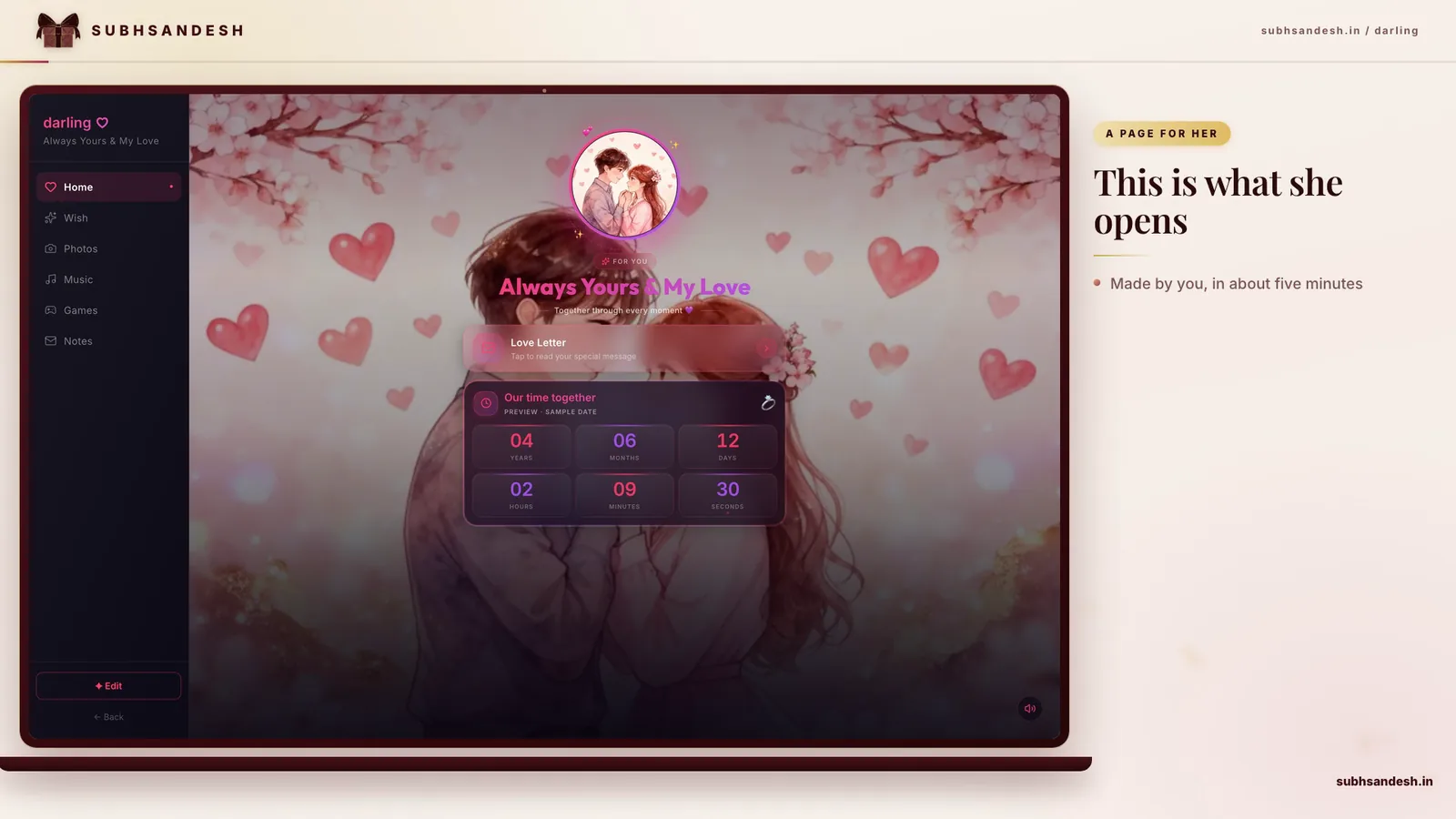
A personalised page she was never told about suits this slot; the animated "I love you" page is the most-created one on SubhSandesh, at 1,001 pages and 29.2% of everything built here. Lead time: two sittings, not one.
3. 13 February, the eve
Kiss Day is the last day of the convention and the one nobody plans for, because by then attention has already jumped to the 14th. This is where I would put the peak.
Something that lands the night before reframes the next day instead of competing with it, and it removes the comparison to whatever everyone else is posting. The dark, dramatic "darling" page — 349 built, 10.2% of all pages — fits a night-before send better than a daytime one. Lead time: start on the 11th.
4. 14 February, but off-schedule
If the main gift has to be on the 14th, move the hour instead of the day. The 2020 study records recipients being surprised purely by receiving a gift "at a slightly different time than gifts normally are given" — before a meal rather than after it, over morning coffee rather than at dinner.
A link that arrives at 7 a.m. is a different object from the same link at 8 p.m. Lead time: build on the 12th, hold the link, send it early.
Why the seventh gesture lands softer than the first
Because she adapts, and faster than you think. Bao and Lyubomirsky's 2013 review in the Journal of Positive Psychology applies the hedonic adaptation prevention model to romantic relationships: positive events "become expected and predictable", aspirations then rise, and each repeat delivers less than the one before. Their worked example is a couple whose standing Friday night out produces a smaller lift every week.
Compress that curve into seven consecutive days and it steepens. Seven gestures in seven days teaches the expectation quickly, and the paper's warning about entitlement is the real hazard: a partner who is treated constantly "may begin to feel entitled to those gestures", after which the same act stops registering as generosity.
The review names variety and appreciation, not volume, as the two things that slow adaptation. Two or three unevenly placed surprises beat seven evenly placed ones, and that is the opposite of what a day-by-day gift list tells you to do.
The four slots, compared on what she is expecting
This table compares the same four slots on expectation, lead time and the platform behaviour behind each one.
| Slot | Is she expecting something? | Lead time to allow | First-party signal |
|---|---|---|---|
| 7 Feb, Rose Day | Yes — the opening day is the most covered in the week | About an hour | 3,425 pages created here since 12 March 2026, across 15 page types |
| 9–11 Feb, midweek | Weakly — themed days with low attention | Two sittings; median first-save-to-last-edit gap is 7.2 hours | 1,001 /love-gf pages, 29.2% of everything created |
| 13 Feb, the eve | No — attention has moved to the 14th | Start on the 11th | 42.7% of creators password-protect before sharing (1,462 of 3,425) |
| 14 Feb, off-schedule hour | Yes, but at dinner, not at 7 a.m. | Build on the 12th, hold the link | 50.2% of shared pages are opened on a phone (21,130 of 42,099 views) |
The pattern is that expectation and effort should run in opposite directions: least effort where she is most prepared, most effort where she is least.
If the week has already started without you
Missing Rose Day is not a loss, it is a saving. The opening slot was the weakest one anyway, so arriving on 10 or 11 February with nothing announced drops you straight into the lull, which is where an unscheduled gift does the most work.
Write the thing first and design it second — the words are what she rereads. Of the 3,425 pages started on SubhSandesh, 99.4% were published and shared (3,405 of 3,425), so the step that actually stops people is finishing the writing, not the sending.
Two practical notes. 50.2% of shared pages are opened on a phone, so check yours on a phone before you send it, not on a laptop.
And 42.7% of creators password-protect the page before sharing. That is worth doing if she shares a device with family, because a surprise opened by the wrong person is not a surprise. If she is in another city for the week, the animated "I miss you" page carries the distance itself rather than pretending it is not there.
When a week-long surprise plan is the wrong choice
Sometimes it is, and the honest cases are worth naming.
The clearest one comes out of the same 2020 study, which reports a paradox: even people who prefer surprising gifts will give or ask for an unsurprising one to avoid disappointment, and several respondents said that for obligated occasions they simply buy what the person asked for. If your girlfriend has told you what she wants, buy that. A surprise you have imposed over a stated preference is your preference, not hers.
Escalation is the second case. If a week of daily gestures is going to set an expectation you cannot hold for the rest of the year, Bao and Lyubomirsky's aspiration path says you are borrowing against next February.
Third, a shareable page is the wrong format for some recipients. Half of all views here are not on a phone, and a page is a poor answer for someone who is in the same room as you every evening, has no smartphone of her own, or would rather have an object she can keep on a shelf. A digital page also cannot be unwrapped, and for some people that is the part that matters.
Sources
- Vanhamme, J., Lindgreen, A. and Beverland, M., "The paradox of surprise: empirical evidence about surprising gifts received and given by close relations", European Journal of Marketing 55(2), published 18 September 2020 — open-access copy
- Bao, K. J. and Lyubomirsky, S., "Making it last: Combating hedonic adaptation in romantic relationships", The Journal of Positive Psychology 8(3), published 27 March 2013 — open-access copy
- Ryan, G., Pàmies, M. and Valverde, M., "The joys of waiting: how consumers do waiting together", Marketing Letters, published 27 November 2025 — open access, CC BY 4.0
- "Valentine's Week full list 2026", Hindustan Times, published 8 February 2026
- "Valentine's Week", Wikipedia — entity reference for the Indian week-long observance
Frequently Asked Questions
Turn this inspiration into an unforgettable surprise
Build a page with photos, a heartfelt message, music and a ready-to-share link.
- Photos, message & music
- Ready-to-share link

Written by
Suyash Agrahari
Founder
Suyash Agrahari is a Software Engineer at HireQuotient and the founder of SubhSandesh and DrawFlow (drawflow.in). He builds AI agents and full-stack products with Next.js, Node.js, and the OpenAI and LangChain ecosystems, having shipped autonomous multi-agent systems, AI copilots, and large-scale outreach platforms — and scaled side projects from a few hundred to millions of users. He writes about AI engineering, web development, and building products that grow through SEO and organic reach.
Stay Connected
Follow SubhSandesh
New templates, festival ideas and step-by-step walkthrough videos — first on our socials.
Product guide
See it built, step by step

Keep reading
How to Surprise Someone on Their Birthday at Midnight
The Indian midnight birthday wish, treated as a timing problem: aim for 23:55 rather than 00:00, check the Bedtime schedule that silences a 00:00 noti…
 Suyash Agrahari· 9 min
How to Surprise Husband on Birthday When the Day Is His Alone
A birthday is his day, not a shared one, so unlike an anniversary the contents can genuinely surprise him — and the gesture fails when it becomes abou…
Suyash Agrahari· 9 minHow to Surprise Best Friend on Friendship Day in India
Friendship Day in India falls on the first Sunday of August — a different date from the UN's International Day of Friendship on 30 July. Four things w…
Suyash Agrahari· 9 min