
Surprise Gift for Girlfriend Website: How to Build and Send One
A surprise gift website for your girlfriend is one personalised page sent as a link. What belongs on it, how to send it, and how to keep it private - with SubhSandesh data on 4,357 pages, a 40.6% password rate and a 6.2-hour median build.
Make this into a page you can send
Photos, a message, music and a ready-to-share link — in a couple of minutes.
or browse all occasionsKey takeaways
- • A surprise gift website is one personalised page you send as a link - 94.1% of pages started on SubhSandesh are actually published and shared (4,098 of 4,357).
- • It is not a five-minute job: the median gap from first save to last edit is 6.2 hours, sampled across 1,125 "I love you" pages.
- • The link is the password. 40.6% of creators add a real password on top of it before sharing (1,767 of 4,357).
- • Build for a phone - 49.0% of the 49,968 recorded views came from one, and pages average 11.5 views each.
- • If you are in the same room tonight, buy the physical thing instead; this format is for distance and odd hours.
On this page
Surprise Gift for Girlfriend Website: How to Build and Send One
A surprise gift for girlfriend website is one personalised web page — her name, your photos, one thing she has to tap — that you build in a browser and send her as a link, usually on WhatsApp. It is not a public post and it is not a five-minute job. On SubhSandesh, 40.6% of creators password-protect the page before they share it (1,767 of 4,357 pages), and the median gap between a page's first save and its last edit is 6.2 hours, sampled across 1,125 "I love you" pages. Most people build it across an evening, then guard the link. Below: what belongs on the page, how to send the link, how to keep it private, and when a link is the wrong gift.
What is a surprise gift website for a girlfriend?
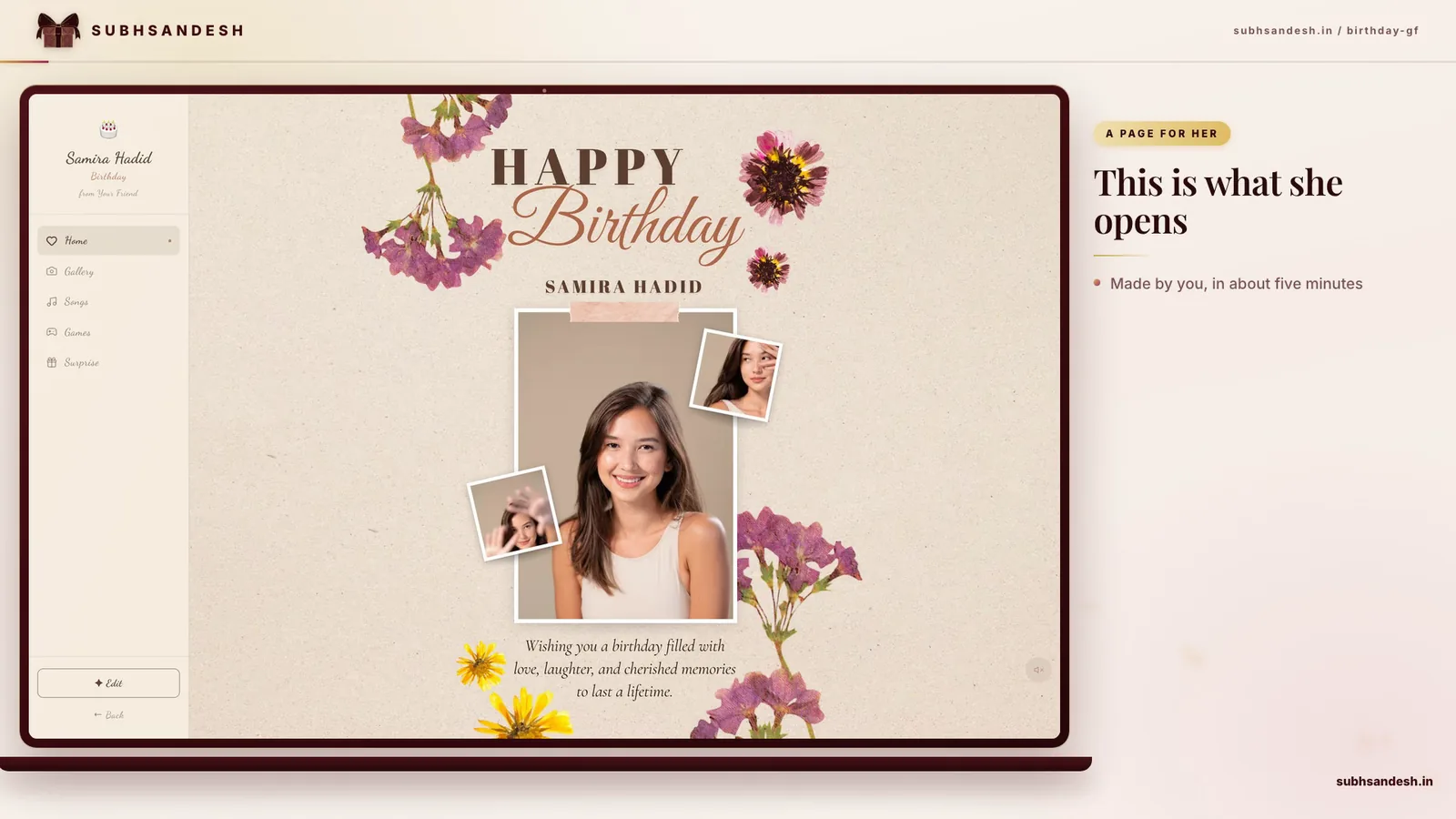
It is a one-page website built for exactly one reader. You fill in a template — her name, a message, a few photos, a date — and the platform publishes it at its own URL, which you send her. She installs nothing and signs up for nothing.
The format is narrower than "website" suggests. Across 4,357 pages built on SubhSandesh since 12 March 2026, three of the 16 page types account for 74.3%: an "I love you" page (1,125, 25.8%), a digital bouquet (1,070, 24.6%) and an apology dashboard (1,043, 23.9%). Nobody is building a portfolio.
The W3C Technical Architecture Group has a name for what you are sending: a capability URL, a URL that "grants access to a resource to anyone who has the URL". That sentence decides the privacy section below.
Six things that belong on the page, and what each one costs you
Most templates offer more slots than you should fill. These six earn their place, in the order she meets them, with what each one is, who it suits, what it costs you and how long it takes.
1. An opening line under twelve words
What it is: the sentence on the first screen, before a single photo has loaded. Who it suits: everyone — it is the one element you cannot skip.
What it costs you: nerve, since a vague line reads as something a template wrote. How long: ten minutes.
Name something only the two of you have, like the auto fare you argued about.
2. Three to five photos, not thirty
What it is: a short run of pictures, chronological or deliberately not. Who it suits: couples with more than a few months of history.
What it costs you: fifteen minutes in your own gallery. How long: fifteen to twenty minutes.
A page loading thirty images over a mobile connection is one she abandons at image nine — and 49.0% of the 49,968 views recorded on SubhSandesh came from a phone.
3. One thing she has to do with her thumb
What it is: one interaction — a bouquet she assembles, an envelope she opens, a button she has to chase. Who it suits: anyone sending this instead of being in the room.
What it costs you: nothing; it comes with the template. How long: two minutes.
One interaction is the difference between a page and a long message; two or three turn it into a chore.
4. A detail nobody else could have written
What it is: a fact, a date, an inside joke, a number of days. Who it suits: relationships past the first month, where shared history exists to draw on.
What it costs you: the most thought of anything here. How long: twenty minutes.
No template can supply this one, and it is the reason she screenshots the page instead of closing it.
5. A date, a countdown or a plan
What it is: something pointing forward — a countdown to a visit, an invitation she has to answer. Who it suits: long-distance couples, and anyone whose surprise needs a second act.
What it costs you: committing to the date. How long: five minutes.
A page that only looks backwards is a memorial; one with a date is a plan.
6. An ending that says what happens next
What it is: a closing line telling her what you want her to do — call you, open the envelope at midnight, say yes. Who it suits: everyone.
What it costs you: one sentence. How long: five minutes.
Pages ending without an instruction get a heart emoji; pages ending with one get a phone call.
For a starting point rather than a blank page, the romantic "I love you" page template is the most-built of the sixteen, and the Build-a-Bouquet digital flower page handles item three for you.
How a surprise website compares with the other ways to send something
Five ways to reach her at 11pm. The prep-time figure for the website is SubhSandesh's own measured median, not an estimate.
| Way to send it | What she gets | Typical prep time | How private by default |
|---|---|---|---|
| Surprise gift website | A page with her name, your photos and one thing to tap | 6.2 hours median, first save to last edit (n=1,125) | Unlisted URL; 40.6% of creators add a password |
| Long WhatsApp message | Text in the same thread as everything else | 10–20 minutes | As private as her chat backup |
| Couriered physical gift | An object she can hold and keep | 30 minutes to order, then out of your hands | Visible to whoever takes the delivery |
| Public Instagram post | A caption her followers read too | 15 minutes | Not private, which is usually the point |
| Midnight video call | Your face and your voice | 0 minutes | Private, but nothing is left afterwards |
The website wins on keepability and loses on immediacy: the only row taking hours to prepare, and the only one she can reopen a year later.
How to send the link so she opens it first
Send the bare link with one line of context and nothing else. A link dropped into a thread of thirty messages gets scrolled past; one sent at 11:58pm with "open this" does not. SubhSandesh pages average 11.5 views each across 49,968 recorded views, so the typical page is reopened ten times after the first visit.
Do not send it during her working hours if the page has audio. Half of everything is opened on a phone (49.0% of views), and a phone in an office is a phone on silent.
One statistic worth knowing before you start: 94.1% of pages started on SubhSandesh are actually published and shared (4,098 of 4,357). The failure mode is over-editing for six hours and then deciding it isn't good enough, which is what the other 5.9% did. If you have the opening line and the photos, send it.
For a built-in reason to reply, the Invitation page she has to answer turns the send into a yes-or-no she cannot leave on read.
How to keep the page private after you have sent it
This is the half every competing page skips, and the half that matters most in India. A capability URL gives access to "anyone who has the URL" — the link is the password, and a link forwarded once is a link you no longer control. That is why 40.6% of SubhSandesh creators add a password on top of the URL before sharing (1,767 of 4,357).
Three layers, in the order they matter.
Set a password if anyone else uses her phone. Parul Bhandari's 2017 study of pre-marital relationships in urban India, published in the South Asia Multidisciplinary Academic Journal, documents partners and families routinely "checking their text messages, emails, and keeping a track of their whereabouts" — surveillance the people doing it treat as intimacy rather than a breach. A page about a relationship her parents do not know about should not be one tap from her lock screen.
Check the page is not indexable. Google's own documentation on blocking search indexing with noindex states that a page carrying the rule is dropped from results entirely, "regardless of whether other sites link to it" — and that the crawler must be allowed to fetch the page to see the rule at all.
If a builder blocks crawlers in robots.txt instead, the page can still surface. Search the URL yourself after a week.
Do not assume a shared password is private. Pew Research Center's 2014 survey of American couples found that two-thirds of couples share passwords to at least one account. A password only helps when it is one she has not already given to the person you are hiding the page from.
When a surprise gift website is the wrong choice
If you are in the same city and free tonight, buy the thing and hand it to her. A link cannot be unwrapped in front of people, put on a shelf, or picked up when the phone is flat. Physical gifts win every time the two of you are in one room.
It is also wrong if her connection is bad, if she shares a phone, or if the surprise needs her to be alone when it opens — none of which you control after you press send.
And be careful with intensity in a new relationship. The finding in Valenzuela, Mellers and Strebel's cross-cultural study of unexpected incentives, published in the Journal of Consumer Research in 2009, is that reactions to a surprising event are generally stronger than reactions to an identical expected one — and stronger is not automatically better.
A six-hour website in week three lands as pressure. For a first birthday together, the birthday page for a partner is a proportionate version of the same idea.
And if what she wants is your time, a page substitutes for the thing rather than being it. Occasion-dated pages are only 3.7% of everything built on the platform; the other 96.3% are ordinary Tuesdays. That ratio is the honest case for this format — it is good at the small unprompted gesture, not at replacing the big planned one.
Sources
- W3C Technical Architecture Group, Good Practices for Capability URLs, 18 February 2014
- Parul Bhandari, Pre-marital Relationships and the Family in Modern India, South Asia Multidisciplinary Academic Journal 16, 2017
- Ana Valenzuela, Barbara Mellers and Judi Strebel, Pleasurable Surprises: A Cross-Cultural Study of Consumer Responses to Unexpected Incentives, Journal of Consumer Research, 15 July 2009
- Pew Research Center, Couples, the Internet, and Social Media, 11 February 2014
- Google Search Central, Block Search indexing with noindex
Frequently Asked Questions
Turn this inspiration into an unforgettable surprise
Build a page with photos, a heartfelt message, music and a ready-to-share link.
- Photos, message & music
- Ready-to-share link

Written by
Suyash Agrahari
Founder
Suyash Agrahari is a Software Engineer at HireQuotient and the founder of SubhSandesh and DrawFlow (drawflow.in). He builds AI agents and full-stack products with Next.js, Node.js, and the OpenAI and LangChain ecosystems, having shipped autonomous multi-agent systems, AI copilots, and large-scale outreach platforms — and scaled side projects from a few hundred to millions of users. He writes about AI engineering, web development, and building products that grow through SEO and organic reach.
Product guide
See it built, step by step

Keep reading
What Is a Virtual Gift and How to Send One That Gets Opened
A virtual gift arrives as a link, a code or an in-app item instead of a parcel, and four different things go by that name. Here is how to send each on…
 Suyash Agrahari· 9 min
What Is a Digital Gift? The Four Kinds, and Which to Send
A digital gift arrives as a file, a code or a link. Four families — stored value, access, downloads and personalised pages — compared on delivery, Ind…
Suyash Agrahari· 9 minWhat Can I Gift My Girlfriend? Four Questions That Settle It
Buy something physical if you will hand it over in person and she has named what she wants. Send a personalised page if you are apart, out of time, or…
Suyash Agrahari· 9 min