
Surprise Gifts for Girlfriend on Valentine's Day, Hour by Hour
Seven of the eight page-one results for this search are shops, so nobody answers what to actually do on 14 February. Six reveal moments ranked by lead time, grounded in a 7.2-hour median build window across 1,001 pages and peer-reviewed research on late gifts and gift failure.
Make this into a page you can send
Photos, a message, music and a ready-to-share link — in a couple of minutes.
or browse all occasionsKey takeaways
- • Valentine's Day is 14 February, a fixed date, so she already expects something: the reveal hour is the only axis of surprise you still control.
- • The median gap between a SubhSandesh creator's first save and their last edit is 7.2 hours, sampled on /love-gf with n=1,001 - an evening's work, not a click.
- • Gift givers overestimate how much a late gift harms the relationship: 65% of Americans think an occasion-based gift should arrive on time, a penalty recipients never charge (six studies, Journal of Consumer Psychology, reported 9 December 2024).
- • 50.2% of shared page views are on a phone (21,130 of 42,099), so a reveal designed for a wide screen loses half its audience before it starts.
- • Effort cuts both ways: in a 2025 study whose scenarios 342 participants rated realistic, givers who invested more effort for close recipients felt stronger social exclusion when the reaction was flat.
On this page
Surprise Gifts for Girlfriend on Valentine's Day, Hour by Hour
The gift is the easy half. What decides whether a Valentine's surprise lands is which hour of the day she meets it in — and the first page of Google for this search barely touches that, because seven of its eight results are shops. Valentine's Day is 14 February, a fixed date, so the deadline is never a surprise to you; the only open question is which moment of it you own. On SubhSandesh the "I love you" page (/love-gf) is the most-built thing on the site — 1,001 created, 29.2% of all pages — and the median gap between a creator's first save and their last edit is 7.2 hours, sampled on /love-gf with n=1,001. That is the planning number nobody else can print: these are not five-minute jobs, nor fortnight projects. Below are six reveal moments for 14 February, what each demands of you, and the cases where a surprise gift is the wrong move.
What makes a gift on 14 February a surprise at all
A surprise is a gift she could not have predicted on either its content or its timing. Valentine's Day quietly removes one of those axes: she already knows something is coming, so novelty of content is mostly spent before you start.
Timing is the axis you still control, and the one no shop can sell you. A parcel arriving between 10 a.m. and 8 p.m. is not a moment you chose; a thing that appears at 6.05 a.m. is.
What she does with it afterwards matters more than the object. In an experiment with 199 college students in Mexico, Puente-Díaz and Cavazos-Arroyo found that recalling an experiential gift rather than a material one led indirectly to greater gratitude by making the memory feel more meaningful (indirect effect 0.38, 95% CI 0.16 to 0.61; Humanities and Social Sciences Communications, 21 December 2022).
A timed reveal is an experience. A parcel is an object.
Six reveal moments for 14 February, ranked by lead time
Each one: what it is, who it suits, the lead time, how it fails.
1. The pre-dawn arrival
What it is: something finished the night before and sent so it is the first thing on her lock screen. Who it suits: couples who wake up apart, and anyone whose 14 February is a working day. Lead time: one evening — well inside the 7.2-hour median build window. How it fails: she wakes, half-reads it, and never comes back to it, so anything with more than one screen of content is wasted here.
2. The commute drop
What it is: a link timed for the 30–50 minutes she is on a bus, a metro or in a cab with nothing to do. Who it suits: anyone whose girlfriend commutes alone. Lead time: an evening, plus knowing her actual departure time. How it fails: motion sickness and patchy mobile data — 50.2% of shared pages are opened on a phone (21,130 of 42,099 views), and a moving train is the least forgiving screen there is.
3. The mid-afternoon interruption
What it is: one unannounced thing at the flattest hour of her day, roughly 3 p.m. Who it suits: girlfriends with desk jobs and predictable slumps. Lead time: minutes to send, hours to build. How it fails: it lands mid-meeting and she cannot react, which reads to you as indifference and to her as bad luck.
4. The evening single-screen reveal
What it is: the main event, opened together on one device, in one sitting. Who it suits: couples in the same city. Lead time: build it a day ahead, so you are not watching a loading spinner. How it fails: you hover and narrate.
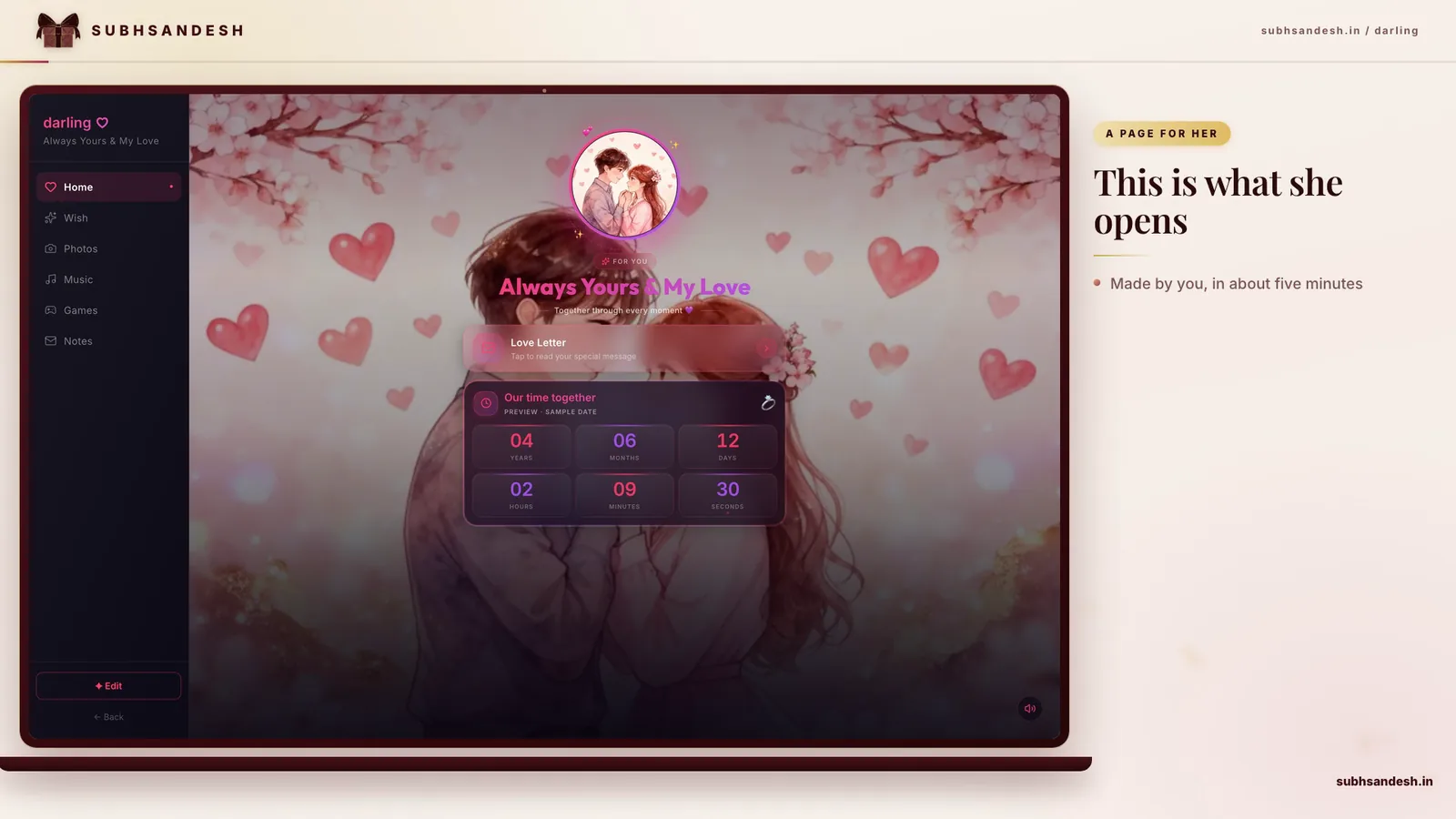
Pages here average 12.3 views each, which is the tell — the second and third openings, alone, are where most of the reading happens. For something less sweet and more dramatic, the Darling romantic page is the fourth most-built page type, with 349 created and 10.2% of all pages.
5. The late-night addendum
What it is: a short second thing sent after the day is officially over, when she has stopped expecting anything. Who it suits: everyone; it is the least contested slot on the clock, expectation having collapsed by then. Lead time: ten minutes. How it fails: it competes with the main gift instead of closing the day, so keep it to one line and one image.
6. The 15 February follow-through
What it is: a gesture the day after, when every other couple has stopped. Who it suits: anyone whose relationship outlasts the occasion. Lead time: none — a decision, not a build. How it fails: it reads as an apology for a thin 14 February, so it only works if the day itself was fine.
If you want a page for one of these slots rather than a parcel, the animated "I love you" page is the format 1,001 SubhSandesh creators have built more than any other. The database records what was created, not who it was sent to — evidence about builders, not recipients.
Which reveal window fits the time you actually have
The four windows people most often ask about, by the lead time each demands and what has to be true at her end.
| Reveal window | Lead time you need | What must be true for her | First-party signal |
|---|---|---|---|
| 6 a.m. lock screen | One evening (median build 7.2 h) | Phone charged, notifications on | 50.2% of views are on a phone |
| 3 p.m. interruption | Same day, minutes to send | A gap in her calendar | 12.3 views per created page |
| 7 p.m. shared screen | One day ahead | You are in the same room | 99.4% of started pages get published and shared |
| After 11 p.m. | Ten minutes | She is awake and alone | 42.7% lock the page first (1,462 of 3,425) |
The pattern: the earlier the slot, the less content survives it; the later, the more privacy matters.
How to surprise a long-distance girlfriend on Valentine's Day
Distance changes the goal from "hand her something" to "give her something to do at a specific hour". Sociologist Iveta Jurkane-Hobein's study of 19 in-depth interviews with people in long-distance relationships in Latvia (Innovative Issues and Approaches in Social Sciences, January 2015) found that the practices holding these couples together work by triggering imagination — they let a partner picture the other's day, and support four dimensions of intimacy: embodied, emotional, daily and imagined.
The practical reading: a surprise that gives her a picture of your side of 14 February beats one that only proves you placed an order. Photographs of ordinary things, in order, with times on them, do this better than a bouquet delivered by a stranger.
If the distance is the point rather than an inconvenience, an "I miss you" page says that directly. It sits outside the five most-built page types, so there is no creation figure to quote — only what it does.
If you have left it until the 13th
Being late is the fear that drives panic buying on 13 February, and the evidence says it is overblown. Across six studies, Haltman, Herziger, Donnelly and Reczek found that givers overestimate how much a late gift harms the relationship; recipients were more forgiving than givers expected, and did not read lateness as caring less (Journal of Consumer Psychology, via Ohio State University, 9 December 2024).
Why the gap opens: 65% of Americans in the researchers' survey believed an occasion-based gift should arrive on time, so givers brace for a penalty recipients never charge. Participants also worried less about a late gift they had assembled themselves than an identical pre-made one.
There is a limit: both sides expected more harm the later it ran — two days, two weeks, two months — though no gift at all was judged worse than a very late one. So this licenses a made thing on 15 February, not a forgotten one in March.
This is the honest argument for building rather than buying late. The 7.2-hour median edit window is an evening's work, not a click — which is what makes it legible as effort.
When a surprise gift is the wrong move
Three cases, and they are not edge cases.
She is in the same room. A link is a worse object than a thing she can hold. Send a page when she is elsewhere; hand her something when she is not.
Effort carries a risk to you, not just to her. A 2025 study in Humanities and Social Sciences Communications, using scenarios rated as realistic by 342 participants plus an ERP experiment, found that givers invest more effort in gifts for close recipients, which raises their expectations, and a flat reaction from someone close produces stronger feelings of social exclusion than the same reaction from an acquaintance (19 November 2025). The more you build, the more her three-second reaction can hurt you. The authors' own advice is to treat the act as the expression and not to hunt for validation in the response.
A gift can read as a bill. Validating a gift reciprocation anxiety scale on 763 Bangladeshi youths and adults in romantic and marital relationships, Shahrier and Khatun (Heliyon, January 2025) treat reciprocation anxiety as a measurable trait, and argue gift reciprocation works better read as trust and care than obligation. If your girlfriend is the sort who immediately starts planning what she owes you, scale down and say so out loud.
And if she has told you she dislikes surprises, believe her. The research on gift failure is about mismatch, not generosity.
Sources
- Puente-Díaz, R. and Cavazos-Arroyo, J. — "Experiential gifts and the construal of meaningful consumption episodes", Humanities and Social Sciences Communications, 21 December 2022.
- Grabmeier, J. — "Giving a gift? Better late than never, study finds", Ohio State News, 9 December 2024, reporting Haltman, Herziger, Donnelly and Reczek in Journal of Consumer Psychology.
- Jurkane-Hobein, I. — "Imagining the absent partner: intimacy and imagination in long-distance relationships", Innovative Issues and Approaches in Social Sciences, January 2015.
- "Greater effort, greater pain: Givers' feelings of social exclusion in gift failures across close and distant relationships", Humanities and Social Sciences Communications, 19 November 2025.
- Shahrier, M. A. and Khatun, S. — "Development and validation of the gift reciprocation anxiety scale (GRAS) for youths and adults in intimate relationships", Heliyon, January 2025.
- Valentine's Day — entity reference for the 14 February date.
- SubhSandesh first-party product data, measured 3 September 2026.
Frequently Asked Questions
Turn this inspiration into an unforgettable surprise
Build a page with photos, a heartfelt message, music and a ready-to-share link.
- Photos, message & music
- Ready-to-share link

Written by
Suyash Agrahari
Founder
Suyash Agrahari is a Software Engineer at HireQuotient and the founder of SubhSandesh and DrawFlow (drawflow.in). He builds AI agents and full-stack products with Next.js, Node.js, and the OpenAI and LangChain ecosystems, having shipped autonomous multi-agent systems, AI copilots, and large-scale outreach platforms — and scaled side projects from a few hundred to millions of users. He writes about AI engineering, web development, and building products that grow through SEO and organic reach.
Stay Connected
Follow SubhSandesh
New templates, festival ideas and step-by-step walkthrough videos — first on our socials.
Product guide
See it built, step by step

Keep reading
How to Surprise Someone on Their Birthday at Midnight
The Indian midnight birthday wish, treated as a timing problem: aim for 23:55 rather than 00:00, check the Bedtime schedule that silences a 00:00 noti…
 Suyash Agrahari· 9 min
How to Surprise Husband on Birthday When the Day Is His Alone
A birthday is his day, not a shared one, so unlike an anniversary the contents can genuinely surprise him — and the gesture fails when it becomes abou…
Suyash Agrahari· 9 minHow to Surprise Best Friend on Friendship Day in India
Friendship Day in India falls on the first Sunday of August — a different date from the UN's International Day of Friendship on 30 July. Four things w…
Suyash Agrahari· 9 min