
Virtual Date Night Ideas for Couples That Both of You Can Open
A virtual date fails on logistics, not ideas. A five-part virtual date night plan for couples, four formats compared on setup steps and time-zone tolerance, and the four things that break the evening — grounded in 41,486 views of shared SubhSandesh pages.
Make this into a page you can send
Photos, a message, music and a ready-to-share link — in a couple of minutes.
or browse all occasionsKey takeaways
- • A virtual date needs an agenda, not more ideas: a start, two or three segments and a stated ending, owned by one named planner.
- • Plan for a phone. 50.3% of the 41,486 views of shared SubhSandesh pages happen on a phone (20,853 of them), so a laptop-only plan writes off half the audience.
- • One shared link beats one shared screen: /love-gf is our #1 template at 987 pages (29.2%) and our most-viewed at 14,607 views, because its Cover, Games, Gallery and Music tabs already are the agenda.
- • Time zones pick the format. Neustaedter and Greenberg’s furthest long-distance couples were 10–12 hours apart with the fewest overlapping hours, so under an hour of overlap the date should be asynchronous.
- • Watching something together is the segment that fails most: 7 of their 14 participants co-watched, and the show’s audio drowns the conversation.
On this page
Virtual Date Night Ideas for Couples That Both of You Can Open
A virtual date night works when it has an agenda one of you can hand to the other, not when it has more ideas. Build it as a sequence — a start, two or three segments, a stated ending — and put it somewhere both people can open on a phone: 50.3% of the 41,486 views of pages shared on SubhSandesh happen on a phone (20,853 of them), so "let's both get on a laptop" writes off half the audience before minute one. Our most-viewed romantic page, /love-gf, has drawn 14,607 views — 35.2% of all page views across the 3,377 pages built since 2026-03-12 — and it carries its own agenda in tabs: a typed letter, a Love Quiz, a Truth-or-Dare round, an "Our Story" history, a gallery and a soundtrack. Below: a five-part plan, four formats compared, the four logistics that kill a virtual date, and the case for not having one.
What is a virtual date night, and how is it different from a video call?
A virtual date night is a scheduled block of time in which two people who are apart do one agreed thing together, in an agreed order, with an agreed end. A video call is open-ended and has no agenda; a virtual date has both, and that is the entire difference.
The distinction is not pedantry, because couples already have the open-ended version. In Carman Neustaedter and Saul Greenberg's interviews with fourteen people in long-distance relationships (CHI 2012), eleven described parallel activities over an open video link — each on their own thing — and one couple simply left the connection open for an hour or two after dinner.
A date is what you schedule when parallel time is not enough. And a date is mutual and scheduled — the opposite of a surprise, which works precisely because only one person knows.
A five-part virtual date night plan for couples, in order
A sequence, not a menu. Each part names what it is, who it suits, how long it takes and who owns it.
1. One person plans it, and says so in writing
The plan is a message naming the date, the start time in both time zones, and the three things you will do. It suits every couple, especially the pair who have said "we should do something" for three weeks. Five minutes to write. The planner is one named person — Ames and colleagues found the 22 families they studied treated fixing a specific time as the awkward part, many parents calling it "strange and unnatural."
2. Do the setup before the clock starts
Setup is everything that is not the date: installing the app, finding the room code, testing audio, uploading photos. It suits anyone who has watched the first ten minutes vanish into "can you hear me now." Budget ten to fifteen minutes before the start time, alone. Ames et al.'s CSCW 2010 study of 22 families named this work — coordination, presentation, behavioural and scaffolding work, technical work on top — and only seven of those 22 used video chat at all.
3. Open one shared page instead of one shared screen
A shared page is a single private link holding the date's content, so neither of you is screen-sharing or narrating. It suits couples on mismatched devices, which is most of them. One tap to open. Whoever built it owns it — and our median gap between a page's first save and its last edit is 7.2 hours on /love-gf (n=987), so people build these across sittings.
This is where our own product is the right shape for the job. The romantic "I love you" page is our #1 template at 987 pages and 29.2% of everything created, and its four tabs — Cover, Games, Gallery, Music — are an agenda you move through together, on one link, on whatever device each of you is holding.
4. Put one game round in the middle, and cap it
One round means one game, one time limit, one winner or none. It suits couples who go quiet after twenty minutes of face-to-face video. Cap it at fifteen to twenty minutes. The person who did not plan the date owns this segment — the simplest way to make the evening mutual.
Virtual date games ideas are the most crowded corner of this topic, so treat the game as a segment, not the evening. A Love Quiz, a Truth-or-Dare round or an "Our Story" run through your own timeline all work because the material is the two of you.
5. End it deliberately
Ending deliberately means one of you says "last thing" and names the next date. It matters most ten hours apart, where a call dribbling out at 2am costs somebody a working morning. Ninety seconds, owned by the planner.
Four virtual date night plans compared
What decides the format is not how fun it sounds — it is setup steps, phone tolerance and time-zone tolerance.
| Date format | Setup steps | Fine on a phone | Survives a 10-hour gap | First-party evidence |
|---|---|---|---|---|
| Video call only | 1 — open the app | Yes | No — needs a live overlap window | Not our format |
| Synced streaming, both press play | 3–4 — same service, same episode, countdown | Awkward — two apps at once | No | Not our format |
| Live browser game with a room code | 2–3 — room code, both join | Depends on the game | No | Not our format |
| One private shared page you both open | 1 — open the link | Yes — 50.3% of our 41,486 views are on phones | Yes — the page waits | /love-gf: 987 pages, 14,607 views |
The takeaway: the rows that tolerate a bad time-zone gap are the ones where the content exists whether or not both people are awake.
Virtual date ideas for Valentine's Day, birthdays and anniversaries
Occasion dates fail differently, because the date is fixed and the expectation is loaded. On 14 February you cannot slide the slot, so build the content in advance and agree the start time in both zones a week out.
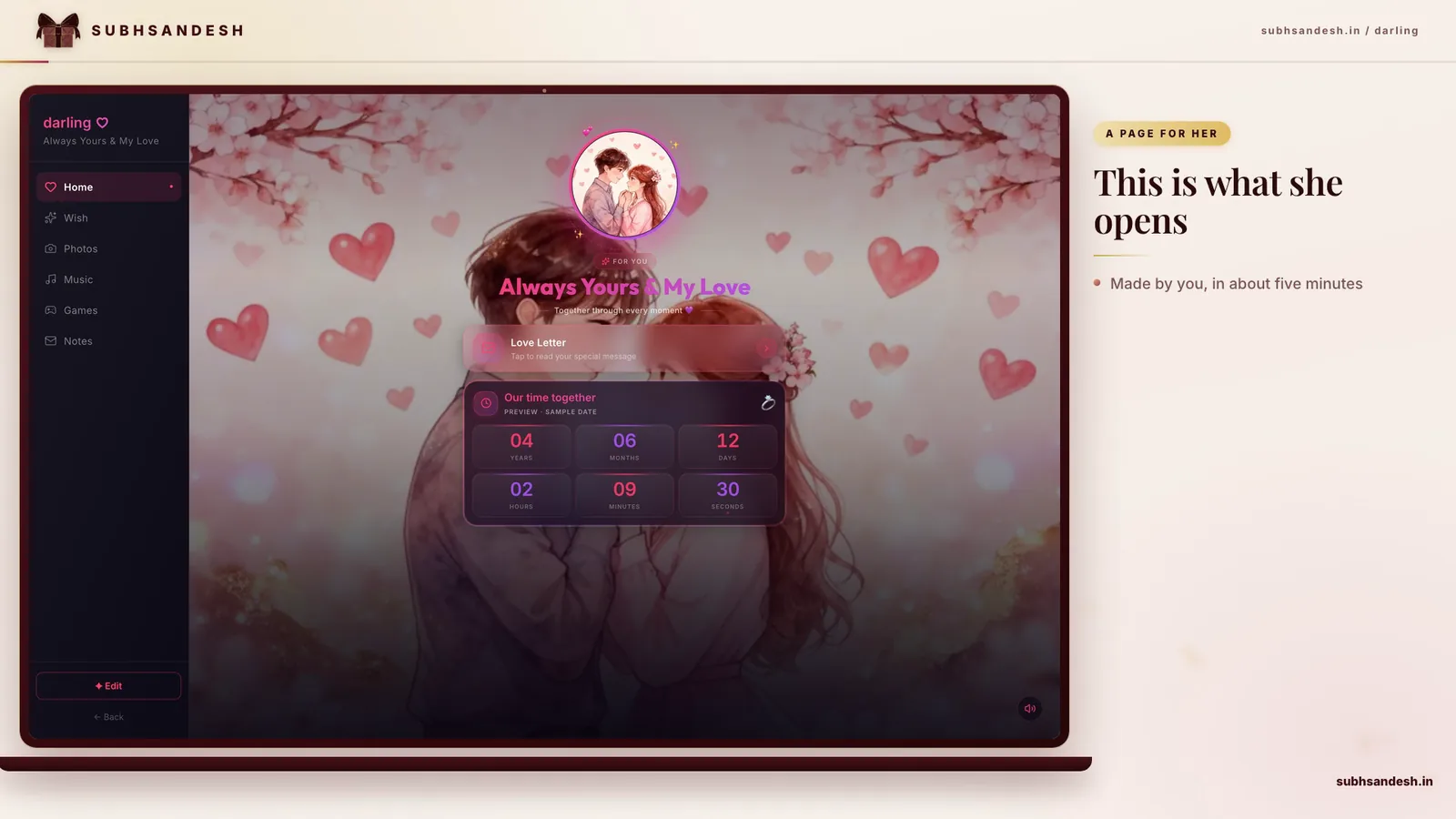
Two things change. The register: a Valentine's plan wants a warmer, more theatrical page than a Tuesday does, which is why we keep two romantic templates — the softer /love-gf and the darker Darling page, our #4 template at 349 pages and 10.3% of everything created. And privacy: 42.8% of our creators password-protect the page before sharing (1,444 of 3,377) — the setting you want on when a link may pass through a family group chat.
If the occasion is the whole point, a Valentine's Day page for a partner fits, and the date night is the hour you open it together.
Virtual date ideas for a long distance relationship across time zones
Time zones are the constraint, not the mood. Neustaedter and Greenberg found their furthest couples separated by 10–12 hours, and reported that a couple in one time zone "would often have three or four hours to spend together in the evenings" while the larger the gap, "the fewer the number of hours they would have together."
Plan for the window you have. Under an hour of overlap: drop the synchronous segment — one builds the page, the other opens it on their morning and records a reply. One to two hours: one call plus one capped game. Three or more: the full sequence.
The asynchronous version is what stops a virtual date with a gf or bf on the far side of the world from shrinking into a 20-minute Sunday call. 99.5% of pages started on SubhSandesh get published and shared (3,359 of 3,377), so the building half is not the fragile part.
What actually breaks a virtual date, and what the research says
Four things break these evenings, and none is a shortage of ideas.
The audio clash. Watching the same thing together sounds perfect and fails most reliably. Seven of Neustaedter and Greenberg's fourteen participants watched television or video together, and one described it exactly: "you can't talk because the audio is so loud from the show on both ends." Mute the show and talk, or watch and talk after — not both.
The setup tax. Video calls in Ames et al.'s 22 families "always started with a phone call or chat," with coordination and technical work stacked on top.
The missing senses. Yumei Gan's Social Interaction article, drawing on two years of video-based fieldwork on habitual calls in migrant families (2021), asks how people build "love at a distance" when touch, smell and taste are unavailable. That study is about parents and children, not couples, but the constraint is the one your date works around.
The flatness. Törnqvist and Kania Lundholm's 2025 analysis of Zoom-fatigue commentary found accounts of "failed social relations" and "a disrupted sense of self" alongside the headaches, and quote Randall Collins: co-presence "facilitates mutual focus, shared emotion, and rhythmic entrainment." A video window gives you two of those three at best.
When a virtual date is the wrong call, and SubhSandesh loses
If you are in the same city, do not do this. A shared link is a worse Saturday than a bad restaurant, and the honest advice is to close the laptop and get on the metro.
Three more cases where we lose outright. If the person has no smartphone, or shares a family handset, a private link is a liability rather than a gift — the same 50.3% phone share that makes a page work is what makes it useless to someone without one. If the relationship needs a hard conversation, a page with games in it is the wrong register; that is a plain call with nothing to click. And under half an hour of overlap in a week, the answer is an asynchronous exchange, not a date.
One limit worth stating plainly: nothing here says what a virtual date should cost. Our database holds no pricing data, so this post makes no claim about cost in either direction.
Sources
- Neustaedter & Greenberg, "Intimacy in Long-Distance Relationships over Video Chat", CHI 2012 (May 2012)
- Ames, Go, Kaye & Spasojevic, "Making Love in the Network Closet", CSCW 2010
- Gan, "Capturing love at a distance", Social Interaction 4(3), August 2021 — abstract only
- Törnqvist & Kania Lundholm, "Why Zoom Hurts", Culture Unbound 17(1), 19 May 2025
- First-party figures from SubhSandesh's database, measured 2026-09-02
Frequently Asked Questions
Turn this inspiration into an unforgettable surprise
Build a page with photos, a heartfelt message, music and a ready-to-share link.
- Photos, message & music
- Ready-to-share link

Written by
Suyash Agrahari
Founder
Suyash Agrahari is a Software Engineer at HireQuotient and the founder of SubhSandesh and DrawFlow (drawflow.in). He builds AI agents and full-stack products with Next.js, Node.js, and the OpenAI and LangChain ecosystems, having shipped autonomous multi-agent systems, AI copilots, and large-scale outreach platforms — and scaled side projects from a few hundred to millions of users. He writes about AI engineering, web development, and building products that grow through SEO and organic reach.
Stay Connected
Follow SubhSandesh
New templates, festival ideas and step-by-step walkthrough videos — first on our socials.
Product guide
See it built, step by step

Keep reading
How to Surprise Someone on Their Birthday at Midnight
The Indian midnight birthday wish, treated as a timing problem: aim for 23:55 rather than 00:00, check the Bedtime schedule that silences a 00:00 noti…
 Suyash Agrahari· 9 min
How to Surprise Husband on Birthday When the Day Is His Alone
A birthday is his day, not a shared one, so unlike an anniversary the contents can genuinely surprise him — and the gesture fails when it becomes abou…
Suyash Agrahari· 9 minHow to Surprise Best Friend on Friendship Day in India
Friendship Day in India falls on the first Sunday of August — a different date from the UN's International Day of Friendship on 30 July. Four things w…
Suyash Agrahari· 9 min