
Virtual Raksha Bandhan Celebration Ideas for a Family Group Call
The group case: three or more households on one Raksha Bandhan call. Who hosts, what works with eight people that fails with two, the IST-Gulf-UK-US split, the audio anchor, recording consent, and a 40-minute run-sheet — grounded in 33,007 recorded views across 2,739 SubhSandesh pages.
Make this into a page you can send
Photos, a message, music and a ready-to-share link — in a couple of minutes.
or browse all occasionsKey takeaways
- • In a group call the floor belongs to one household at a time: budget 3–4 minutes per sibling pair, so five pairs fills 20 of a 40-minute call.
- • Host on connection quality, not seniority — a CSCW study of 22 families found grandparents had more technical trouble and less ability to troubleshoot.
- • Nominate one audio anchor household whose mic stays open; everyone else unmutes only for their turn, and one device per room prevents feedback.
- • When the family spans IST to US Eastern, two 20-minute calls beat one 90-minute call: 10:00 am IST is 12:30 am in New York.
- • Recording a family call is outside the Digital Personal Data Protection Act, 2023 (section 3(c)(i)), so consent is social — and 44.3% of SubhSandesh creators password-protect a page before sharing it.
On this page
Virtual Raksha Bandhan Celebration Ideas for a Family Group Call
The virtual Raksha Bandhan celebration ideas that survive three or more households are the ones that hand the floor to one household at a time: a round-robin rakhi, a single shared screen, and one named person calling the order. Rituals that work one-to-one — a simultaneous tilak, everyone reciting together — collapse once four kitchens are unmuted at the same time. Our own data explains why the fixed point of a group call should be a link, not a live feed: 33,007 recorded views across 2,739 personalised pages, 12.1 views per page on average, and 51.8% of those views on a phone — the device most relatives will hold on Friday 28 August 2026. Below: who hosts, what breaks past four screens, the timezone split, the audio anchor, recording consent, and a 40-minute run-sheet.
What a group virtual Raksha Bandhan celebration is
A group virtual Raksha Bandhan celebration is one video call carrying three or more separate households through the rakhi ritual, rather than a private call between one sister and one brother. The defining number is not how many people join but how many rooms they are in.
Eight people in one house is a party. Eight in four cities, on a working Friday like 28 August 2026, is a coordination problem: four audio sources, four clocks, one relative who cannot find mute.
Who hosts the call, and why it should not be the eldest
Give the meeting link to whichever household has the steadiest connection and the most patience for troubleshooting — it need not be in India — then let the eldest lead the ritual. Two jobs, two people.
There is field evidence for splitting them. A CSCW study of 22 families and their video-chat practices by Ames and colleagues, covering 77 local and 39 remote family members, found grandparents "tended to have more technical trouble and less ability to troubleshoot" while also carrying the scheduling burden of grandchildren's bedtimes and time-zone differences.
Name three roles in the family group chat before 28 August:
- Host — owns the link, admits people, mutes the room that forgot, restarts the call if it dies.
- Sequence lead — calls whose turn it is. Usually the eldest, and the only voice that should interrupt.
- Timekeeper — one cousin who says "two minutes" out loud. Without one, the first pair takes eleven minutes and the last gets ninety seconds flat.
Five virtual Raksha Bandhan celebration ideas that scale to eight people
For each: what it is, who it suits, how long, what breaks.
1. The round-robin rakhi
One sister-and-brother pair holds the floor while everyone else stays muted and watching. It suits families with three or more pairs, cousins included. Budget three to four minutes per pair, so five pairs is about 20 minutes. It breaks if nobody announces the order first: pair two starts while pair one is mid-aarti, and both feeds turn to noise.
2. One shared screen instead of eight faces
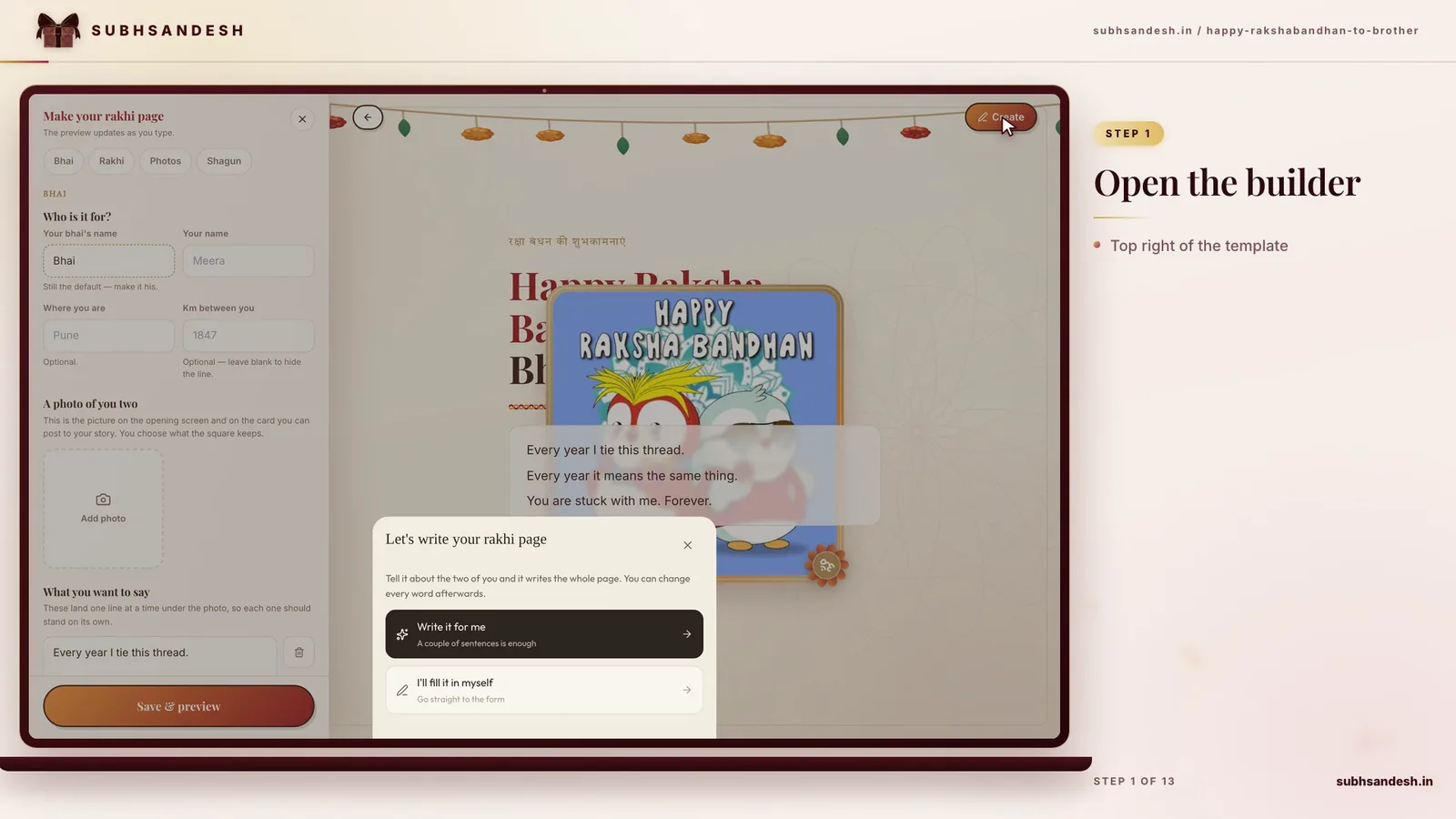
The host shares one screen showing a single page — photos, names, a message — and that page, not the grid of faces, is what everyone looks at. It suits families where half the relatives are on phone screens. Setup is ten minutes if the page exists already; a Raksha Bandhan page for a brother works because the link outlives the call. It breaks if you share video with sound.
3. The sequenced tilak
The eldest woman present makes the tilak gesture on camera, one household at a time, and each brother's household applies the real tilak on her count. It suits three-generation families where ritual authority sits with one person. Two minutes per household. It breaks the moment two households try it at once, because there is no shared reference for "now".
4. A cousins-only stretch, 15 minutes
After the ritual the parents leave and the cousins stay on. This is the part nobody plans and everybody remembers. It suits families whose cousins never get unsupervised airtime. Fifteen minutes is plenty. It breaks if it happens first: the elders then join a call already halfway into a private joke.
5. The blessing chain in 20-second turns
Each household records one 20-second blessing beforehand and the host plays them in birth order. It suits large families where a live round would eat 40 minutes. Playback for eight households runs under three minutes. It breaks if people send four-minute monologues, so state 20 seconds as a hard limit — and keep them on a durable page from the SubhSandesh template gallery.
What works with eight people, and what only works with two
This compares four anchors for the celebration at two household sizes, against our own usage data.
| Anchor for the celebration | Two households | Four or more households | SubhSandesh first-party number |
|---|---|---|---|
| Live ritual on camera | A 20-minute ceremony works unassisted | Needs a named sequence lead; 3–4 min per pair | 51.8% of page views are on a phone |
| A shareable page link | Pleasant extra | The reference relatives reopen afterwards | 12.1 average views per created page |
| A recorded blessing | Optional | The only route for absent relatives | 44.3% password-protect before sharing (1,213 of 2,739) |
| A family group chat album | Works fine | Fragments across four chats | 99.4% of started pages get shared (2,722 of 2,739) |
At two households the live call carries everything. At four or more, something asynchronous has to hold the day together.
IST, Gulf, UK and US: why two calls beat one bad one
Raksha Bandhan 2026 falls on Friday 28 August, a working day in India, the UK and North America. That is the starting point, not an afterthought.
The arithmetic is fixed. IST is UTC+5:30, Gulf Standard Time UTC+4, British Summer Time UTC+1, US Eastern Daylight Time UTC−4. So an 8:00 pm IST call is 6:30 pm in Dubai, 3:30 pm in London, 10:30 am in New York — workable.
A morning muhurat slot is not. 10:00 am IST is 5:30 am in London and 12:30 am in New York, which asks somebody to attend a religious ceremony at half past midnight on a work night.
When the spread is that wide, run two calls: a morning IST ritual for India and the Gulf, and a second in the IST evening that lands in the American morning. Two twenty-minute calls where everyone is awake beat one 90-minute call where a third of the family is a black rectangle.
Over-scheduling has a cost too. A survey of 3,530 employees producing 814 usable responses on virtual meetings and wellbeing linked more virtual meetings to higher workload, stress and fatigue.
Crosstalk, echo and the audio anchor household
Nominate one household as the audio anchor: its microphone stays open through the ritual, and everyone else unmutes only for their turn. Somebody has to be the room the call sounds like.
Audio is where multiparty calls degrade first, and it is measurable. A study of multiparty videoconferencing quality of experience in IEEE Transactions on Multimedia in 2018 put groups of four through a collaborative task and found interaction — measured through visual and auditory cues — shifted with encoding bitrate and packet loss.
Two rules follow. One device per room — two phones on one call in one kitchen produce feedback loud enough to end the ritual. And keep the thali half a metre from the mic: an aarti thali and a bell clip most laptop microphones badly.
Recording the call, and consent in a family group
The legal question is smaller than people expect. India's Digital Personal Data Protection Act, 2023 — Act No. 22 of 2023, assented on 11 August 2023 — states in section 3(c)(i) that it does not apply to personal data processed by an individual for any personal or domestic purpose. A family recording its own rakhi call sits outside its scope.
So the constraint is social, not legal — the harder of the two. Ask household by household before pressing record, and accept a no from any one of them.
Then treat the file carefully: not everyone who agreed to be recorded agreed to be forwarded. Sharing behind a password is the norm on our platform — 44.3% of creators password-protect a page before sharing, 1,213 of 2,739.
The 40-minute run-sheet, and the relatives who cannot join
Forty minutes is the realistic budget for four to six households.
| Minutes | What happens | Who is unmuted |
|---|---|---|
| −10 to 0 | Host opens early, admits people, fixes audio, seats the elders | Everyone |
| 0–5 | Sequence lead greets each household and states the order | Sequence lead |
| 5–10 | Sequenced tilak, two minutes per household | Anchor household |
| 10–30 | Round-robin rakhi, 3–4 minutes per pair | One pair at a time |
| 30–35 | Recorded blessing chain plays in birth order | Anchor household |
| 35–40 | Group photo of the screen grid, then the cousins stay on | Everyone |
For relatives who cannot join there are two bridges. Use the platform's dial-in number if it has one — an audio-only participant is still a participant. If not, put a phone on speaker beside the anchor household's microphone and leave it open.
Either way, assign one grandchild as narrator: "Dadi, Ritu is tying now." Ames and colleagues call this scaffolding work, and it is the difference between an elder attending and an elder overhearing.
When one big group call is the wrong choice
If the relationship that matters is one sister and one brother, a group call dilutes it. Run the pair call separately and let the group call be the family occasion, not a substitute for the private one.
If two or more households have unreliable connections, drop video and run the ritual on audio with photos afterwards. A call spending 15 of its 40 minutes on "can you hear me" is worse than a clear phone call.
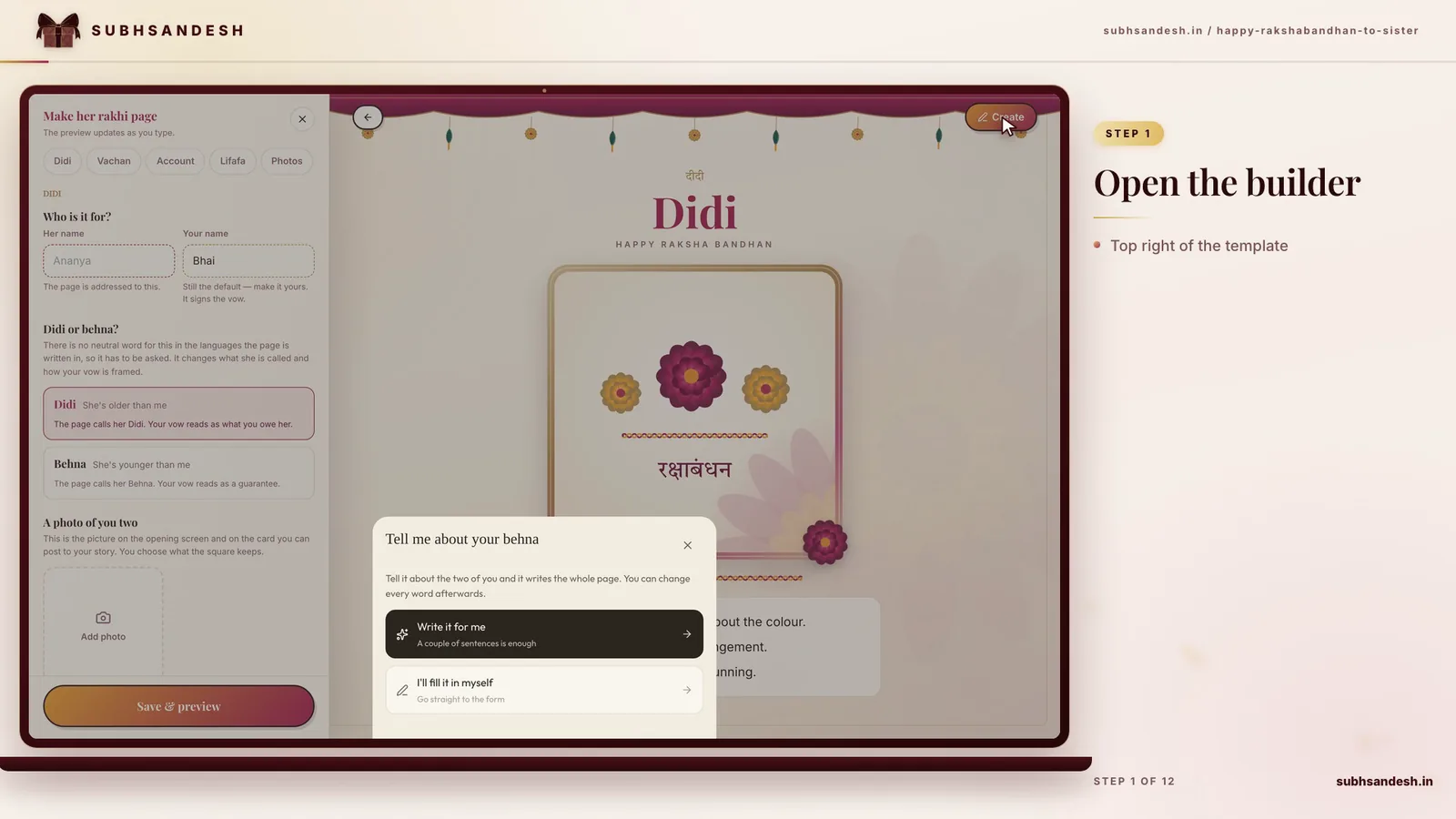
SubhSandesh is the wrong tool for parts of this. We do not host video calls and have no group-call feature, and our only rakhi template — the Raksha Bandhan page for a brother — is brother-first, so a page addressed to a sister needs rewording by hand.
Sources
- Ames et al., The Work of Family Videochat, CSCW 2010: morganya.org
- Schmitt et al., Individual QoE for Multi-party Video Conferencing, IEEE Trans. Multimedia 20(7), July 2018: ir.cwi.nl
- Standaert et al., Virtual meetings and wellbeing, 2023: orbi.uliege.be
- Digital Personal Data Protection Act, 2023, s.3(c)(i), 11 August 2023: egazette.gov.in
Frequently Asked Questions
Turn this inspiration into an unforgettable surprise
Build a page with photos, a heartfelt message, music and a ready-to-share link.
- Photos, message & music
- Ready-to-share link

Written by
Suyash Agrahari
Founder
Suyash Agrahari is a Software Engineer at HireQuotient and the founder of SubhSandesh and DrawFlow (drawflow.in). He builds AI agents and full-stack products with Next.js, Node.js, and the OpenAI and LangChain ecosystems, having shipped autonomous multi-agent systems, AI copilots, and large-scale outreach platforms — and scaled side projects from a few hundred to millions of users. He writes about AI engineering, web development, and building products that grow through SEO and organic reach.
Stay Connected
Follow SubhSandesh
New templates, festival ideas and step-by-step walkthrough videos — first on our socials.
Product guide
See it built, step by step
Keep reading
Thala Deepavali: A Couple's First Deepavali at the Bride's Home
Thala Deepavali is a Tamil couple's first Deepavali after marriage, at the bride's home. In 2027 it is Thursday 28 October, oil bath 4:40–6:01 AM in C…
 Suyash Agrahari· 9 min
Sugar-Free Diwali Sweets: Swaps, Label Warnings and the Evidence
Five original no-added-sugar Diwali sweets, why jaggery and honey do not count, the warnings FSSAI requires on a sugar-free box, and what an Indian su…
Suyash Agrahari· 9 minShort Diwali Quotes: 34 Original One-Liners Under 10 Words
34 original short Diwali quotes, each under ten words and marked with its word and character count, grouped by mood: lamps, family, friends, gratitude…
Suyash Agrahari· 9 min