
What to Write in a Raksha Bandhan Card When You’re Stuck
Every page on this query hands you lines to copy. This one covers the six situations where copying fails — a near-stranger, a falling-out, the first rakhi after a death, a no-contact sibling, English to a Hindi-first reader, and having nothing new to say.
Make this into a page you can send
Photos, a message, music and a ready-to-share link — in a couple of minutes.
or browse all occasionsKey takeaways
- • Write one line only you could have written; the greeting, blessing and sign-off carry no information about you.
- • 51.1% of pages shared on SubhSandesh open on a phone (18,497 of 36,202 views), so the message is read once, on one screen.
- • The harder the situation, the shorter the message: 15–25 words to a no-contact sibling, 25–40 on the first rakhi after a death.
- • A 2026 study of 39 sibling-estranged adults names a risk-containment pathway — where that applies, a festival card is an intrusion, not an olive branch.
- • Delete any sentence that would survive unchanged if you sent it to a different sibling; what is left is the card.
On this page
What to Write in a Raksha Bandhan Card When You're Stuck
Write one line only you could have written, and let the rest be ordinary. The greeting, the blessing and the sign-off are language your sibling has already read on twenty other cards, so they carry no information about you — the specific line is the whole message. It matters where it lands: 51.1% of pages shared on SubhSandesh are opened on a phone (18,497 of 36,202 views, measured 2026-08-25), so a rakhi message is usually read once, on a small screen, standing in a kitchen. Sending is not the difficult part. 99.4% of pages people start here get published and shared (2,956 of 2,973), and each shared page is opened 12.2 times on average. The difficult part is what to write when the relationship is complicated. Below: six situations where the copy-paste lines fail, and what to write in each instead.
What a Raksha Bandhan card message actually has to do
It has one job — prove that the person writing knows the person reading. Raksha Bandhan is the festival where a sister ties a rakhi on her brother's wrist and he takes on an obligation to look after her; in 2027 it falls on Tuesday 17 August.
The ritual already supplies the occasion, the vocabulary and the sentiment: protection, promise, the thread. What it cannot supply is evidence.
A message that could be addressed to anybody has told the reader only that you remembered the date, which the rakhi itself already said. Evidence is the one thing the words add, and it is the only real reason to write them yourself rather than copy them.
The line that decides the card
Name one thing only the two of you would know, and make it a fact rather than a feeling. "You are the best brother in the world" is a rating; "you still owe me for the window in 2011" is evidence. Ratings are interchangeable between siblings. Evidence is not.
If you are hesitating because the specific line feels like too much, that instinct is measurably wrong. In three experiments in which participants wrote gratitude letters, published in Psychological Science on 27 June 2018, writers underestimated how positive recipients would feel and overestimated how awkward recipients would find it — and that expected awkwardness predicted whether they said anything at all.
The line you are about to cut for being too much is usually the line worth keeping.
Six situations where the standard lines fail
Each of the six breaks a different assumption the ready-made lines quietly make: that you know the person well, that the relationship is intact, that nobody has died, that you are on speaking terms, that you share a first language, and that you have something new to say.
1. You barely know them
A bhabhi's younger brother, a cousin you have met twice, a colleague who ties rakhi at the office. Ready-made lines fail here because every one of them claims a childhood you did not share.
Write what is actually true: how you are related, one thing you noticed about them, and a plain wish. "We only met properly at Neha's wedding, but you were the one who sorted the car at 1 a.m. Happy Raksha Bandhan." Leave out invented memories and any promise bigger than the relationship.
2. There was a falling-out, and nobody ever named it
The kind that never became a fight — just fewer calls. Do not use the card to reopen it, and do not write as though it never happened. One sentence acknowledging the gap without assigning fault, then something ordinary: "It has been a strange couple of years and I have not called enough. Tying this from here anyway."
A mixed-method study of 284 women in emerging adulthood in Family Relations (19 November 2021) found major issues in the wider family play a crucial role in sibling closeness. The rupture is often structural rather than personal, which is exactly why a card should not try to litigate it.
3. It is the first Raksha Bandhan after a death in the family
Say the name. The common mistake is writing around the loss, which leaves the reader alone with it.
Name the person, name one concrete thing they did on this day — the sweets they insisted on, the photograph they took every year — and stop there. Do not offer meaning. Grief scholarship describes families coregulating each other's grief and building shared meaning together over time (Family Process, 18 May 2021), which is slow relational work that forty words cannot do. "Ma always made you sit on the same chair" carries more than "she is watching over us".
4. The sibling has gone no-contact
First ask whether a card is contact they want. Research published in the Journal of Marriage and Family on 18 August 2026, drawn from 39 in-depth interviews with sibling-estranged adults, identifies five pathways to estrangement — including one the authors call risk containment, where the person treats the sibling as a direct threat to self, household or safety.
If that is the shape of it, a festival card is an intrusion rather than an olive branch. Where it is not, write three lines with no history, no request and no expectation of a reply: "Thinking of you today. No need to write back."
5. You are writing in English to someone who thinks in Hindi
A Hindi-first sibling reads English perfectly well and feels it less. The fix is not translation, it is register.
Read the sentence aloud in Hindi in your head. If it comes out as something you would never actually say to them, rewrite it. "May this sacred bond flourish eternally" fails that test; "tu theek hai na" passes, and goes into the card in Roman script exactly as you would say it. One line in the language you genuinely speak to each other in, the rest in whichever is easier to write.
6. You are close, and you have nothing new to say
The commonest case and the least discussed. Twenty years of the same message is not solved by new adjectives — change the tense instead.
Write about the last twelve months rather than childhood: the job they hated, the flat they moved into, the thing they finally fixed. Specificity does not require a new feeling. It requires a recent date.
What to write, by situation
Shapes, not scripts. The final column is sized for the phone screen the message is most likely to be read on, given that 51.1% of shared pages open on a phone.
| Situation | What the message must do | Leave out | Words that fit one phone screen |
|---|---|---|---|
| You barely know them | State the connection, note one real detail | Claimed childhood memories | 25–35 |
| Falling-out nobody named | Acknowledge the gap without blame | Any account of who did what | 30–45 |
| First rakhi after a death | Name the person and one concrete habit | Meaning, comfort, "watching over you" | 25–40 |
| Sibling gone no-contact | Signal presence, ask for nothing | History, requests, questions | 15–25 |
| English to a Hindi-first sibling | Match how you actually speak | Formal register, "eternal bond" | 30–50 |
The pattern holds across all five rows: the harder the situation, the shorter the message.
Where the message gets read, and why that changes the wording
Not at a desk. 51.1% of pages shared on SubhSandesh open on a phone (18,497 of 36,202 views), and the average shared page is opened 12.2 times — so the message gets reread, often by more than one person in the house.
Write for both facts. Nothing that needs a second paragraph to make sense, and nothing you would mind their spouse reading over their shoulder. If it genuinely is private, lock it: 44.2% of creators here password-protect a page before sharing it (1,315 of 2,973).
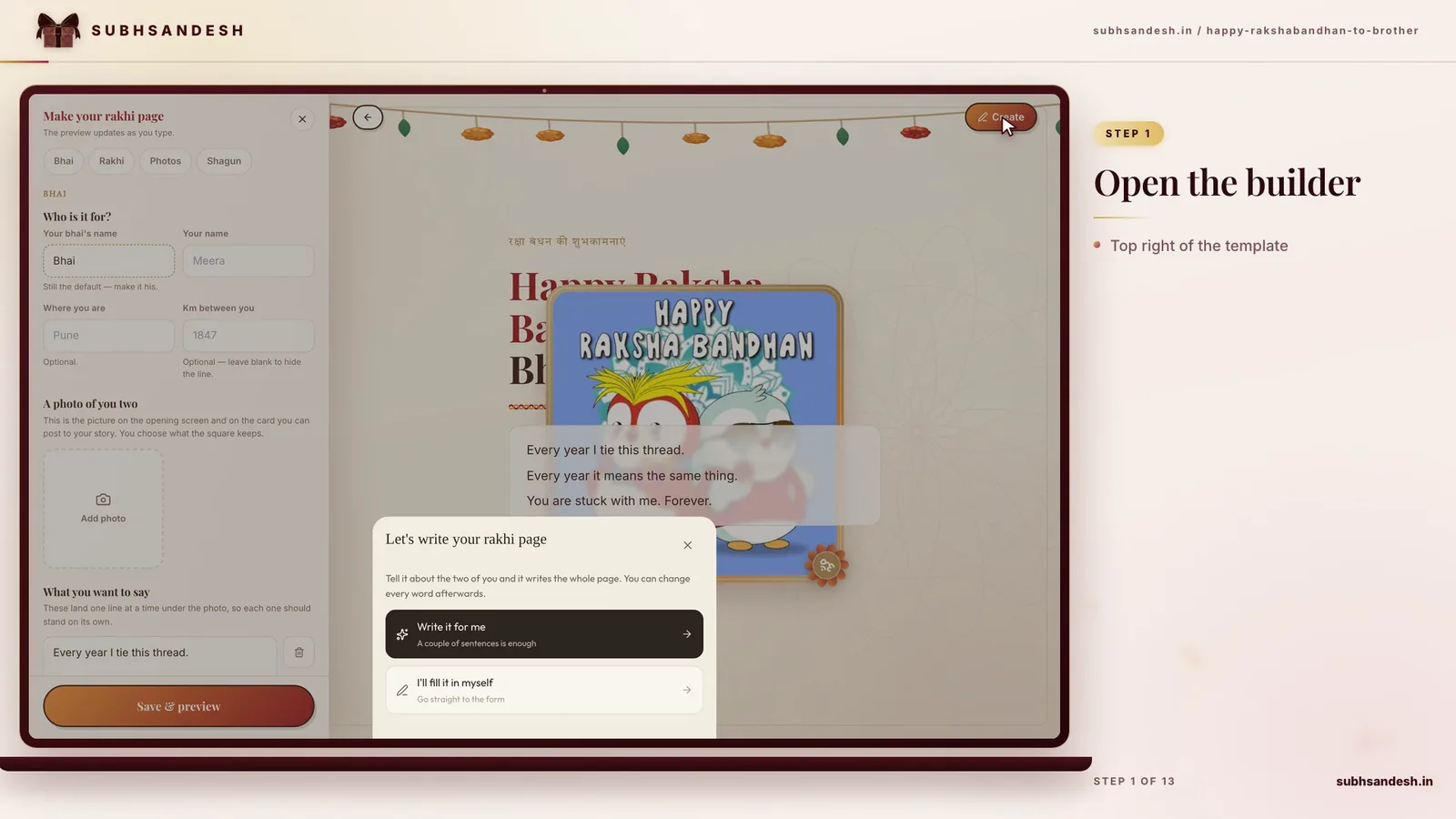
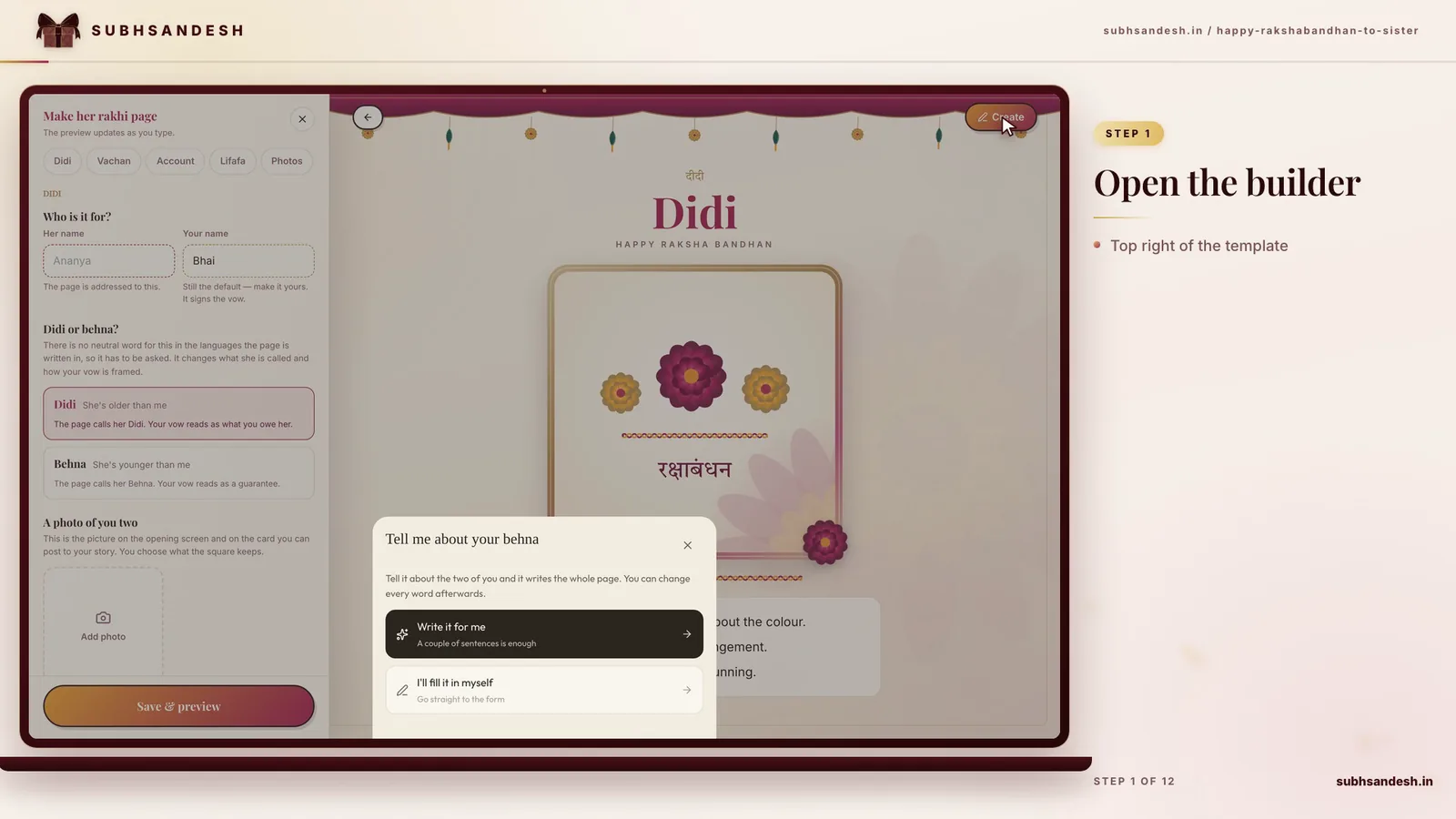
If you would rather the words sat inside something than in a chat bubble, the Raksha Bandhan page for a brother and the Raksha Bandhan page for a sister both take a photo, a name and one shareable link.
Six lines to delete from your draft
Between them, the five pages currently ranking for this phrase publish several hundred ready-made lines — 100+, 100 and 40 on three of them alone. That volume is why the following read as furniture rather than as writing.
"You are not just my brother, you are my best friend." "May this sacred thread protect you always." "Words cannot express." "No matter how far, you are always in my heart." "Wishing you health, wealth and happiness." "I am blessed to have you."
Every one is true and not one is evidence. Delete any sentence that would survive unchanged if you sent it to a different sibling. What is left is usually a single line, and that line is the card.
When a card is the wrong thing to send at all
Three cases, and we lose two of them. Where an estrangement is about safety rather than distance — the risk-containment pathway above — a festival message is contact the other person deliberately ended, and sending it serves the sender.
Where a death is very recent, a phone call beats a card, because the reader gets to answer instead of being written at.
And where the recipient does not use a smartphone, a digital page is the wrong format outright. A 51.1% phone-open rate is an advantage only when the reader has a phone; a posted card or a call is simply better, and the rest of our festival and celebration templates carry the same limit.
Sources
- Kumar, A. & Epley, N. — Undervaluing Gratitude: Expressers Misunderstand the Consequences of Showing Appreciation, Psychological Science, 27 June 2018. Abstract read; the full text sits behind the publisher's paywall.
- Pathways to Adult Sibling Estrangement: Perspectives of Estranged U.S. Adults, Journal of Marriage and Family, 18 August 2026. Open access; abstract read.
- Empathy and Sibling Relationship Dynamics of Women in Emerging Adulthood, Family Relations, 19 November 2021. Abstract read.
- Meaning Co-Construction: Facilitating Shared Family Meaning-Making in Bereavement, Family Process, 18 May 2021. Abstract read.
- SubhSandesh first-party product data, measured 25 August 2026.
Frequently Asked Questions
Turn this inspiration into an unforgettable surprise
Build a page with photos, a heartfelt message, music and a ready-to-share link.
- Photos, message & music
- Ready-to-share link

Written by
Suyash Agrahari
Founder
Suyash Agrahari is a Software Engineer at HireQuotient and the founder of SubhSandesh and DrawFlow (drawflow.in). He builds AI agents and full-stack products with Next.js, Node.js, and the OpenAI and LangChain ecosystems, having shipped autonomous multi-agent systems, AI copilots, and large-scale outreach platforms — and scaled side projects from a few hundred to millions of users. He writes about AI engineering, web development, and building products that grow through SEO and organic reach.
Stay Connected
Follow SubhSandesh
New templates, festival ideas and step-by-step walkthrough videos — first on our socials.
Product guide
See it built, step by step
Keep reading
Thala Deepavali: A Couple's First Deepavali at the Bride's Home
Thala Deepavali is a Tamil couple's first Deepavali after marriage, at the bride's home. In 2027 it is Thursday 28 October, oil bath 4:40–6:01 AM in C…
 Suyash Agrahari· 9 min
Sugar-Free Diwali Sweets: Swaps, Label Warnings and the Evidence
Five original no-added-sugar Diwali sweets, why jaggery and honey do not count, the warnings FSSAI requires on a sugar-free box, and what an Indian su…
Suyash Agrahari· 9 minShort Diwali Quotes: 34 Original One-Liners Under 10 Words
34 original short Diwali quotes, each under ten words and marked with its word and character count, grouped by mood: lamps, family, friends, gratitude…
Suyash Agrahari· 9 min