
Why Raksha Bandhan Is Celebrated, and What Its Name Means
Raksha Bandhan renews a protective obligation, and the Sanskrit is blunter than the usual translation: रक्षा is the amulet itself and बंधन means fettering. The four mythological accounts, each with its evidential status checked against the text it is credited to.
Make this into a page you can send
Photos, a message, music and a ready-to-share link — in a couple of minutes.
or browse all occasionsKey takeaways
- • रक्षा in Monier-Williams (1899, p. 860) means protection and also the amulet itself — the wrist-thread is not a symbol of रक्षा, it is रक्षा.
- • बंधन (p. 721) means binding, fettering, detention and philosophical bondage, so the festival's name describes an obligation rather than a sentiment.
- • The Krishna–Draupadi rakhi story is absent from the Mahabharata's critical edition: 0 occurrences of rakṣābandhana, rakṣāsūtra or rākhī across all 18 parvans, against 626 mentions of Draupadi.
- • The earliest searchable instruction, Agni Purana 33.49, binds the protective thread to the right hand of a temple image, not a brother.
- • The obligation now travels by phone: 51.1% of SubhSandesh's 36,202 recorded views are opened on one, across 2,973 pages by 2,466 creators.
On this page
Why Raksha Bandhan Is Celebrated, and What Its Name Means
Raksha Bandhan is celebrated to renew a protective obligation between two people, marked by tying a thread on a right wrist on the full moon of Shravan. The Sanskrit is blunter than the usual English gloss "bond of protection" suggests: रक्षा is the amulet itself, not only the act of protecting, and बंधन means binding, fettering, even confinement.
That obligation now travels mostly by phone. 51.1% of the 36,202 page views SubhSandesh has recorded were opened on one — 18,497 of them — across 2,973 pages built by 2,466 registered creators since 12 March 2026.
This page does three things the ranking pages do not: it takes the name apart word by word, it sets out the four mythological accounts of why the festival exists, and it says which of them survives a search of the text it is credited to.
What "Raksha Bandhan" means: रक्षा + बंधन, literally
रक्षा (rakṣā) and बंधन (bandhana) are two Sanskrit nouns joined in a compound, normally rendered "bond of protection". Monier-Williams's Sanskrit-English Dictionary of 1899 gives रक्षा on page 860 as "the act of protecting or guarding, protection, care, preservation, security", and also as "a guard, watch, sentinel".
Then comes the sense that changes the reading. रक्षा is also "any preservative, especially a sort of bracelet or amulet, any mysterious token used as a charm", and the entry's last gloss is "a piece of thread or silk bound round the wrist on particular occasions, especially on the full moon of Śrāvaṇa".
So the thread is not something रक्षा produces. The thread is रक्षा.
बंधन is the harder half. The same dictionary, page 721, gives it as "binding, tying, fettering", then "a bond, tie (also figurative), rope, cord, tether", then "catching, capturing, confining, detention, custody, imprisonment or a prison", and finally, in philosophy, "mundane bondage" as the opposite of liberation.
That range is worth sitting with. The name is not a warm word for closeness; it is closer to "the fastening-on of the protective charm", carrying an undertow of obligation and constraint that greeting-card English quietly drops.
There is a second surprise in the same dictionary. रक्षाबन्धन is not a headword in Monier-Williams at all. Page 860 carries रक्षा-गृह, रक्षा-मणि and रक्षा-सूत्र among the रक्षा compounds; the compound the whole country now uses for the festival is not among them.
Why the older Hindi name for the festival was Salono
Where the Sanskrit lexicography is thin, the Hindi and Urdu lexicography is not. John T. Platts's Dictionary of Urdu, Classical Hindi, and English of 1884 records राखी on page 582 and derives it not from रक्षा but from रक्षिका, by way of the Prakrit रक्खिओ.
Platts glosses राखी as a thread bound round the wrist "either as an amulet and preservative against misfortune, or as a symbol of mutual dependence, or as a mark of respect". The same entry then gives three further senses nobody quotes: "fee paid for protection", the share of village land set aside to maintain a watchman, and "the black mail formerly levied by the Sikhs in the parganas on the Jamnā".
Protection, in 1884 Hindustani, was a thing you paid for. The word for the wrist-thread and the word for the protection levy were the same word.
Platts also lists सलूनो on page 670, from Sanskrit श्रावणी: "The day of full moon in the month Sāwan (July-August), the festival of rakshā-ban-dhan". That was the popular name. Salono is what the day was called in ordinary Hindi and Urdu long after "Raksha Bandhan" existed as a Sanskrit description of the rite.
Why Raksha Bandhan is celebrated according to Hindu mythology
Four stories are told to explain the festival. All four are worth knowing, and only some of them can be checked against the text they are credited to, so each one below carries its evidential status rather than being passed on as fact.
1. Indra and Sachi
Losing a war against the asuras, Indra is given a consecrated thread by his wife Sachi and returns to win. The account is credited to the Bhavishya Purana, and it is the source usually named for the mantra recited while tying. Status: uncheckable here. The Bhavishya Purana is not among GRETIL's machine-readable Sanskrit corpus, so it could not be searched; the phrase mā cala from the tying-mantra occurs zero times in the 18 Purana e-texts that are there.
2. Krishna and Draupadi
Krishna cuts his hand; Draupadi tears a strip from her sari and binds the wound; he promises to repay the debt, and later does. It is told everywhere as a Mahabharata episode. Status: not in the epic's critical text. Across all 18 parvans of the critical edition e-text at GRETIL — 14,358,138 bytes of Sanskrit — rakṣābandhana, rakṣāsūtra and rākhī occur 0 times, while Draupadi's name occurs 626 times and Shishupala's 57.
3. King Bali and Lakshmi
Vishnu, as Vamana, becomes gatekeeper to the asura king Bali; Lakshmi ties a thread on Bali's wrist, claims him as a brother, and asks for her husband back. Status: the Bali story is genuinely Puranic, the thread is not. Bali and Vamana are in the Bhagavata and the Vamana Purana; in the 17.7 MB of Purana text searched here, rakṣābandh does not occur in either of them.
4. Yama and Yamuna
Yamuna ties a thread on her brother Yama, who grants her immortality and rules that a brother so bound cannot be harmed. Status: mostly transmitted as the origin of Bhai Dooj, not of Raksha Bandhan, and it carries no rakshā-thread vocabulary in the searched corpus at all.
The earliest instruction I could check ties the thread to a god, not a brother
Of the 18 Purana texts available in machine-readable form at GRETIL, about 17.7 MB of Sanskrit, the protective-thread vocabulary appears in exactly one of them. The Agni Purana, edited by Rajendralal Mitra for the Asiatic Society of Bengal between 1870 and 1879, instructs at 33.49: devasya dakṣiṇe haste rakṣāsūtrañca bandhayet — "and let him bind the protective thread on the right hand of the deity".
The person tying is a priest. The wrist belongs to an image. The occasion is pavitrarohana, the annual renewal of a temple's sacred cord, and three chapters later, at 36.9, the same text has the officiant release the rakṣābandha before taking up the brahmasūtra.
Two things follow, and neither is in the pages currently ranking. The right hand is old: modern practice still ties on the right wrist, and the earliest instruction I could search says the same. And the direction of the rite is older than the sibling reading of it — a protective cord conferred by the ritually competent on the one being protected.
What the ritual asks for, then and now
Each column below pairs a classical sense of the rite with what SubhSandesh actually measures across its own pages, all figures measured 2026-08-25.
| What the ritual does | Classical evidence | How it happens now | SubhSandesh measured |
|---|---|---|---|
| Binds a protective thread on a right wrist | rakṣāsūtra on the deity's right hand, Agni Purana 33.49 | a page opened on a handset | 51.1% of 36,202 views are on a phone |
| Creates an obligation, not a sentiment | बंधन: "bond, confinement… established rule or custom" | the page gets finished and actually sent | 99.4% of started pages are published and shared |
| Keeps a token private between two people | रक्षा: "any mysterious token used as a charm" | a password set before the link goes out | 44.2% of creators do it — 1,315 of 2,973 |
| Reaches someone not in the room | rākhī as a "fee paid for protection", Platts 1884 | one link, forwarded on | 12.2 average views per shared page |
The pattern holds across the four rows: the classical rite is about a transferable, protective, slightly binding token, and every modern number describes the same thing running over a network instead of a wrist.
So why is it still celebrated?
Because the obligation is real and unusually explicit. बंधन's fourth sense in Monier-Williams is "established rule or custom, daily practice or observance" — a festival named after an obligation survives better than one named after a feeling, because it tells you what you owe and when.
Because the calendar fixes it. Shravan Purnima is a full moon, not a date, which is why it moves each year — 28 August 2026, then 17 August 2027 — and why Platts could define the festival simply as the day itself.
And because it survives distance, which most rituals do not. A thread needs two wrists in one room; the obligation does not, and the measured behaviour on our own platform says people now discharge it at range — 12.2 average views per shared page, 99.4% of started pages actually published. If that is where you have landed, the Raksha Bandhan page for a brother and the Raksha Bandhan page for a sister are built for exactly that gap.
When a link is the wrong way to celebrate it
If the two of you will be in the same room, tie the thread. Nothing on a screen replaces a physical object handed over in person, and a page sent to someone sitting across the table is a worse gift than a five-rupee thread.
A link is also the wrong call for a recipient without a smartphone. 51.1% of views arrive on a phone, which means 48.9% do not, and a grandparent on a shared desktop may never open it at all. Post a rakhi instead.
We should also be straight about our own data. SubhSandesh has 2,973 pages across 15 page types, and the rakhi templates are new and lightly used — a handful of pages, not enough to support any rate, percentage or "most creators" claim about rakhi specifically. Every number on this page is platform-wide behaviour, and none of it is a rakhi-specific finding. If you want the full range, the SubhSandesh template library lists all fifteen.
Sources
- Platts, John T. A Dictionary of Urdu, Classical Hindi, and English (1884) — headword rākhī, p. 582 and headword salūno, p. 670, Digital South Asia Library, University of Chicago.
- Monier-Williams, Monier. A Sanskrit-English Dictionary (1899) — रक्षा, p. 860 and बन्धन, p. 721, Cologne Digital Sanskrit Dictionaries, University of Cologne.
- Mahābhārata, critical edition e-text, all 18 parvans — GRETIL, Göttingen State and University Library.
- Agni Purāṇa, ed. Rajendralal Mitra, Asiatic Society of Bengal, 1870–79, e-text — GRETIL, Göttingen State and University Library.
Frequently Asked Questions
Turn this inspiration into an unforgettable surprise
Build a page with photos, a heartfelt message, music and a ready-to-share link.
- Photos, message & music
- Ready-to-share link

Written by
Suyash Agrahari
Founder
Suyash Agrahari is a Software Engineer at HireQuotient and the founder of SubhSandesh and DrawFlow (drawflow.in). He builds AI agents and full-stack products with Next.js, Node.js, and the OpenAI and LangChain ecosystems, having shipped autonomous multi-agent systems, AI copilots, and large-scale outreach platforms — and scaled side projects from a few hundred to millions of users. He writes about AI engineering, web development, and building products that grow through SEO and organic reach.
Stay Connected
Follow SubhSandesh
New templates, festival ideas and step-by-step walkthrough videos — first on our socials.
Product guide
See it built, step by step
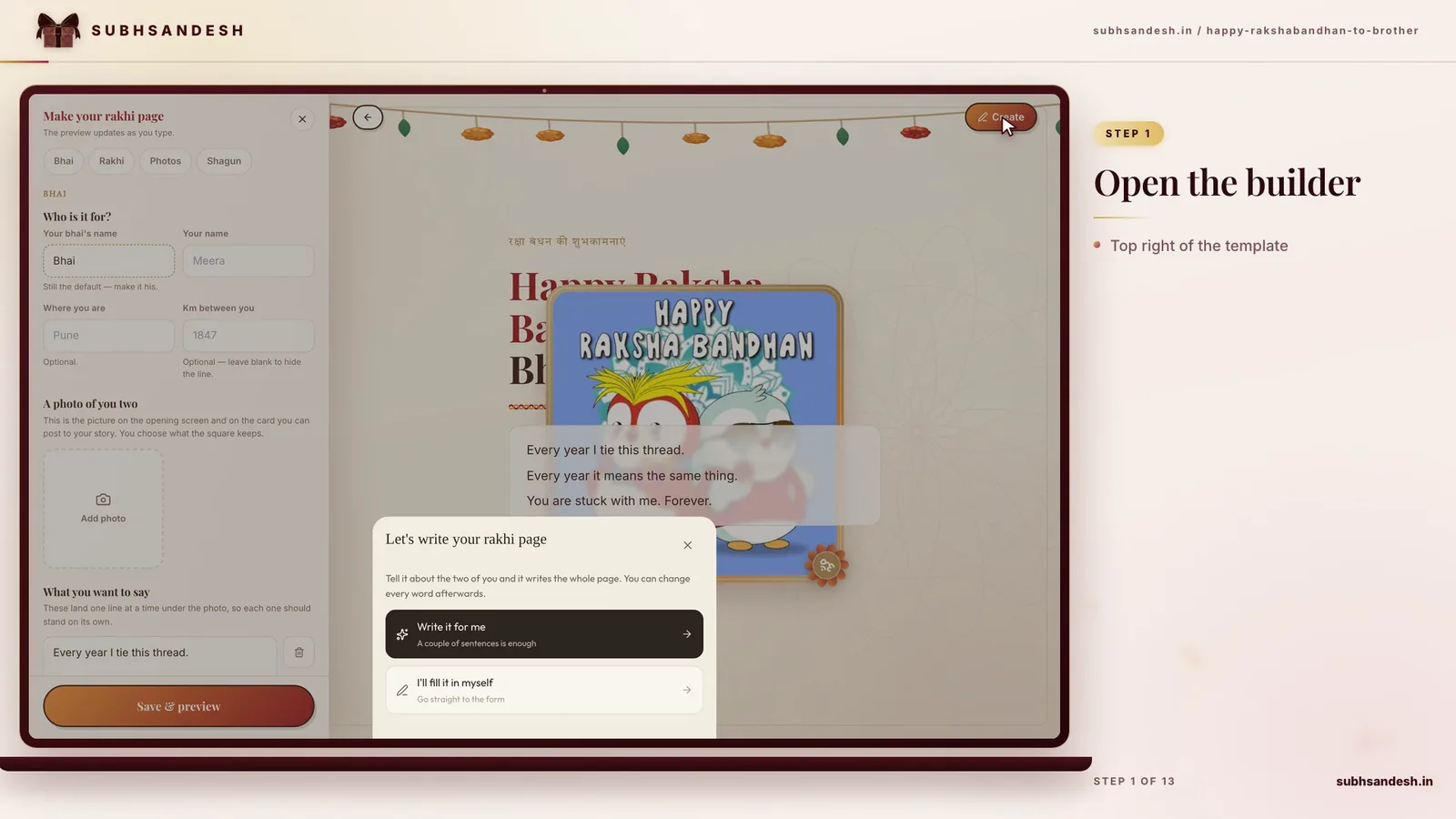
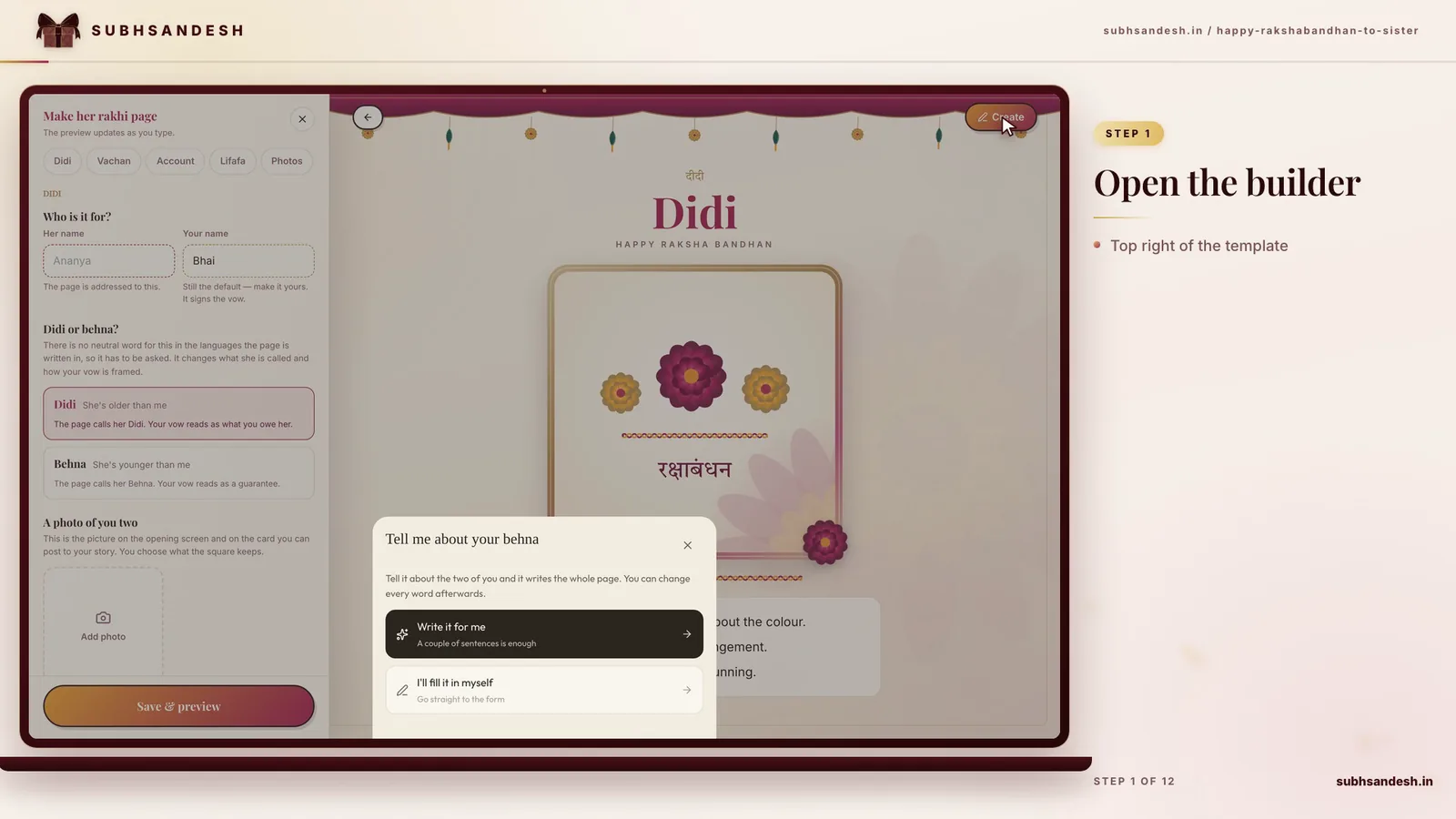
Keep reading
Thala Deepavali: A Couple's First Deepavali at the Bride's Home
Thala Deepavali is a Tamil couple's first Deepavali after marriage, at the bride's home. In 2027 it is Thursday 28 October, oil bath 4:40–6:01 AM in C…
 Suyash Agrahari· 9 min
Sugar-Free Diwali Sweets: Swaps, Label Warnings and the Evidence
Five original no-added-sugar Diwali sweets, why jaggery and honey do not count, the warnings FSSAI requires on a sugar-free box, and what an Indian su…
Suyash Agrahari· 9 minShort Diwali Quotes: 34 Original One-Liners Under 10 Words
34 original short Diwali quotes, each under ten words and marked with its word and character count, grouped by mood: lamps, family, friends, gratitude…
Suyash Agrahari· 9 min