
Would You Rather Questions for Couples, Sorted by Where You Play
30 would you rather questions for couples, grouped by what each pick reveals rather than by mood, with a ruling on which ones survive a text thread and which need a room — plus first-party numbers from 3,377 SubhSandesh pages.
Make this into a page you can send
Photos, a message, music and a ready-to-share link — in a couple of minutes.
or browse all occasionsKey takeaways
- • Would you rather is the only one of the three couple games that requires no disclosure and hides no answer — the reveal is the reason behind the pick, not the pick itself.
- • Sort the 30 prompts by setting rather than mood: openers, funny and preference prompts survive a text thread, and the five deep ones need a call or a room.
- • Self-reported bonding was significantly higher in person than over instant messaging (t = 3.79) among 58 women in close-friend pairs, so a text round is a holding pattern, not an upgrade.
- • A prompt only works when both options cost something; if one is obviously better it is a quiz with an answer, and the round dies in four turns.
- • The "I love you" page (/love-gf) is the most-created SubhSandesh page type at 987 of 3,377 (29.2%), with a median 7.2 hours between a page's first save and its last edit.
On this page
Would You Rather Questions for Couples, Sorted by Where You Play
Would you rather questions for couples work because the format forces a pick — no "neither", no "both" — and the pick is worth nothing without the "why", which is the actual conversation. Sort them by where you are, not by mood: two-line prompts for a text thread, and prompts that need both voices for a sit-down round.
On SubhSandesh the "I love you" page (/love-gf) is the most-created page type at 987 of 3,377 pages, 29.2% of everything built since 2026-03-12, and 50.3% of the 41,486 recorded views of shared pages happen on a phone — the surface most of these rounds get played on. Below: 30 prompts in five groups, a rule for writing your own, and which ones die over text.
What a would you rather round actually does
"Would you rather" is a party or conversation game that poses a dilemma as a two-option question, and answering "neither" or "both" is against the rules. Nothing has to be disclosed and no answer is hidden, so unlike a truth game or a guessing game, nobody has to confess and nobody has to be right.
Which is why it reveals anything. Across ten studies with 9,187 participants, Arvid Erlandsson tested the same choices three ways — rated one at a time, rated side by side, and as a forced choice — and found preferences that appeared in one mode and not another (Judgment and Decision Making, September 2021).
In practice: your partner rating "beach" and "mountains" separately tells you nothing. Making them drop one tells you which they would give up — and the reveal lives in the reason, not the answer.
30 would you rather questions for couples, grouped by what the pick reveals
Each group states what the pick reveals, how many to use, and whether it survives a text thread.
1. Cute openers — seven prompts
Reveals: very little, deliberately. Use: three or four, first. Over text: yes.
- Would you rather get a good-morning voice note or a goodnight call?
- Would you rather share one plate of dessert or order two?
- Would you rather have chai on the balcony at 6am or coffee at midnight?
- Would you rather hold hands the whole walk or keep catching each other looking?
- Would you rather get flowers on a Tuesday or a whole plan on a Saturday?
- Would you rather be sent a photo of my day or a paragraph about it?
- Would you rather fall asleep on a call or wake up to a message?
2. Funny prompts — six prompts
Reveals: how the other one plays, which sets the tone for everything after. Use: two or three. Over text: yes, these travel best.
- Would you rather I narrate your day like a cricket commentator or a wildlife documentary?
- Would you rather I sing every reply for a day or reply only in rhyme?
- Would you rather lose every argument politely or win every argument loudly?
- Would you rather have your playlist judged by my cousins or your camera roll explained to my mother?
- Would you rather always be twenty minutes early or always ten minutes late?
- Would you rather be the one who packs three days ahead or the one who packs in the auto?
3. Flirty prompts, kept clean — six prompts
Reveals: how each of you wants affection delivered. Use: two, once both of you are laughing. Over text: yes — they read better typed than said.
- Would you rather be missed loudly or missed quietly?
- Would you rather get a compliment in front of everyone or one nobody else hears?
- Would you rather slow dance in the kitchen or sit on the terrace saying nothing?
- Would you rather I remember the first thing you said to me or the first thing you wore?
- Would you rather be told you are loved every day or shown it once a week?
- Would you rather hold the umbrella or take the wet side of the road?
4. Preference prompts — six prompts
Reveals: the trade-off itself, because both options cost something. Use: two, mid-round. Over text: yes, but expect the answer an hour later.
- Would you rather live in the city we met in or the city we keep talking about?
- Would you rather have a small wedding and a long holiday or a big wedding and no holiday?
- Would you rather spend Diwali with your family or mine, every single year?
- Would you rather have more money or more time off for the next five years?
- Would you rather live ten minutes from your parents or two hours from everyone?
- Would you rather never move house again or move every three years?
5. Deep prompts — five prompts
Reveals: how the other person wants to be handled when something is wrong. Use: one, never first. Over text: no — call or room only.
- Would you rather be told a hard truth the same day or a softer version a week later?
- Would you rather I fix your problem or sit in it with you?
- Would you rather we finish an argument tonight or pause and pick it up tomorrow?
- Would you rather be understood or be agreed with?
- Would you rather know what I am scared of or what I want most?
Would you rather questions for couples over text, and the two rules that keep it going
Text does something odd here: it gets more out of people and bonds them less. With 168 students paired as strangers, text-only chat and webcam chat both produced significantly more self-disclosure and more direct questions than the same conversation face to face (Cyberpsychology, 2009) — though those were first meetings, not couples.
The other half is less flattering. Fifty-eight women in close-friend pairs held one conversation four ways, and self-reported bonding was significantly higher in person than over instant messaging (t = 3.79), and higher on video than over IM (Cyberpsychology, 2013). Typed laughter tracked real laughter closely, so the "hahaha" works — just not as well as the room.
Hence the two rules. One prompt at a time, because a block of ten reads like a form. And answer your own in the same message, because a prompt sent without your own pick is an interrogation.
There is still a reason to bother. Among 432 adults in relationships of at least three months, women reporting moderate-to-high passive social media use showed a negative association between daily hours of use and relationship satisfaction; low passive use showed none (Cyberpsychology, 2021). Correlational, and absent for men — but two people scrolling separately is the alternative this game replaces.
How to write your own prompt: make both options cost something
Most lists fail here. A prompt where one option is obviously better is not a choice but a quiz with an answer, and the round dies four turns in because nothing was at stake.
The rule: both options must be close enough in appeal that dropping either one hurts. "Beach or a week in the office" is dead. "Beach with your phone off or mountains with your phone on" is alive, because both halves take something away.
Erlandsson's studies matter here for a second reason: some preferences surfaced only when people were made to choose, and not when the options were scored separately. A preference can be real and still invisible until a choice is forced — which is the argument for "would you rather" over "what do you like".
Where the round lives after it ends
Nearly always, nowhere. The answers are funny for an evening and gone by the weekend — the one thing every 250-question list has in common.
The table compares the four most-created SubhSandesh page types on measured numbers, because where a round gets kept is really a question of which page a couple already builds.
| Page type | Pages created | Share of all 3,377 | Median first save to last edit |
|---|---|---|---|
| "I love you" page (/love-gf) | 987 | 29.2% | 7.2 hours (n=987) |
| Digital bouquet (/bouquet-gf) | 789 | 23.4% | Not sampled |
| Apology dashboard (/apology-dashboard) | 736 | 21.8% | Not sampled |
| Darling romantic page (/darling) | 349 | 10.3% | Not sampled |
The 7.2-hour median is the takeaway: people do not build these in one sitting, they come back across an evening — the rhythm a prompt round already has.
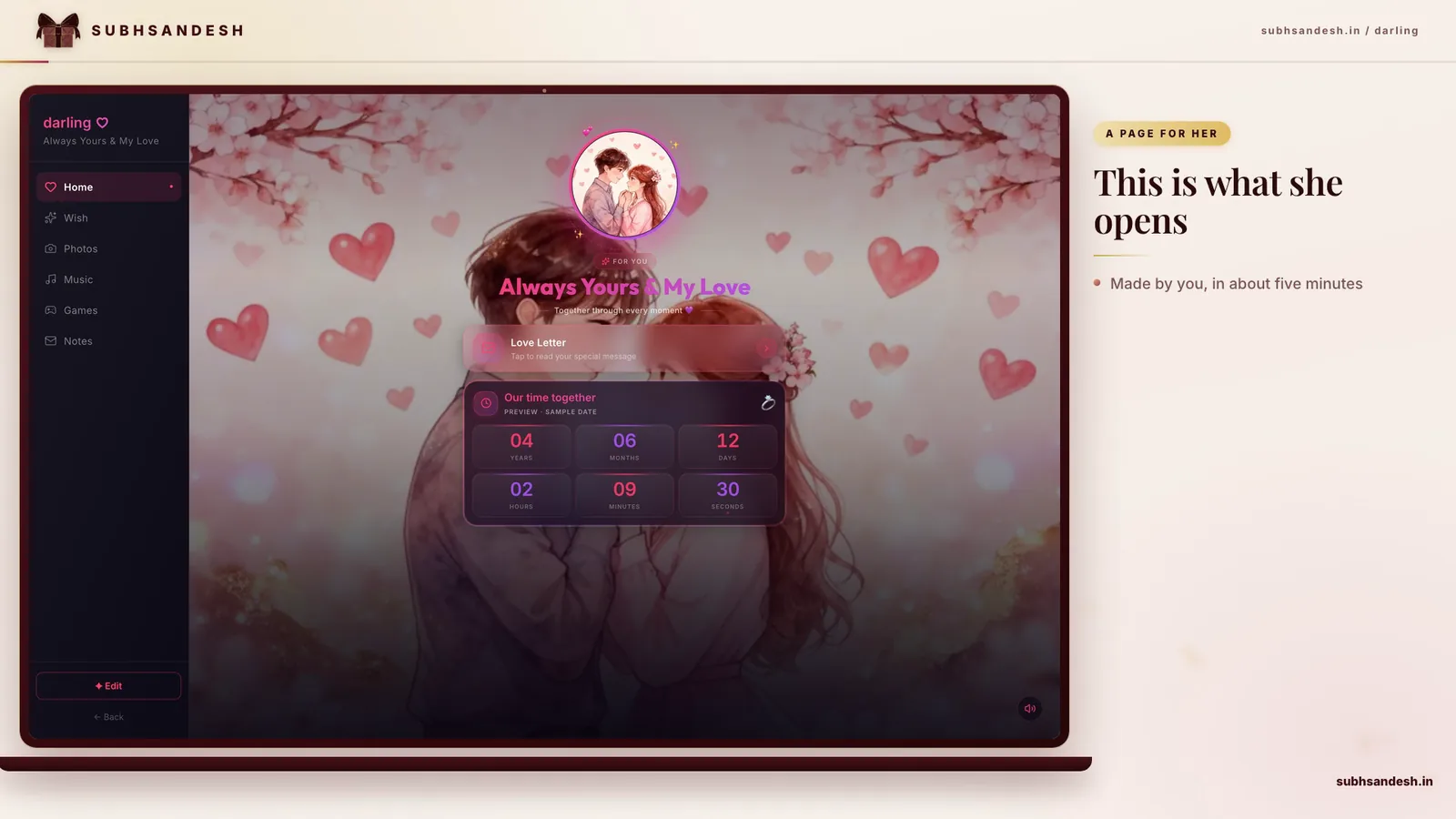
Two of those types can carry one. The romantic "I love you" page for a girlfriend or partner has a Games tab that already runs a Love Quiz, a Truth or Dare round and an "Our Story" history beside the typed-out letter, so a forced-choice round has somewhere to sit with the pair's own answers written in. The darker, more dramatic Darling page does the same in a heavier register, and at 349 pages is the fourth most-built type.
Both publish as a private link, and 42.8% of creators put a password on the page before sharing (1,444 of 3,377) — which matters once deep answers are written down. Of everything started, 99.5% is published and shared (3,359 of 3,377).
When would you rather is the wrong game
When one of you hates hypotheticals. Some people answer "depends" to everything, and forcing a pick from someone who will not pick turns a game into a test.
When you are in the same room with twenty spare minutes. Text bonded measurably less than face-to-face in the 2013 study above, and 50.3% of shared-page views are on a phone — the phone is a convenience, not an upgrade. If you are both on the sofa, put the list down.
And a limit on our own numbers: SubhSandesh measures pages, views and edits per page type. There is no telemetry on individual game rounds, so we cannot say how many couples finished a quiz or how long a round runs. Anyone quoting that figure is guessing.
Sources
- Erlandsson, "Seven helping effects tested in separate evaluation, joint evaluation and forced choice", Judgment and Decision Making 16(5), September 2021 — journal.sjdm.org
- Schouten, Valkenburg and Peter, "Processes Underlying Self-Disclosure in Computer-Mediated Communication", Cyberpsychology 3(2), 2009 — cyberpsychology.eu
- Sherman, Michikyan and Greenfield, "Text, audio, video, and in-person communication on bonding between friends", Cyberpsychology 7(2), 2013 — cyberpsychology.eu
- Quiroz and Mickelson, "Passive versus active social media use on romantic relationships", Cyberpsychology 15(1), 2021 — cyberpsychology.eu
- "Would you rather", Wikipedia — en.wikipedia.org
Frequently Asked Questions
Turn this inspiration into an unforgettable surprise
Build a page with photos, a heartfelt message, music and a ready-to-share link.
- Photos, message & music
- Ready-to-share link

Written by
Suyash Agrahari
Founder
Suyash Agrahari is a Software Engineer at HireQuotient and the founder of SubhSandesh and DrawFlow (drawflow.in). He builds AI agents and full-stack products with Next.js, Node.js, and the OpenAI and LangChain ecosystems, having shipped autonomous multi-agent systems, AI copilots, and large-scale outreach platforms — and scaled side projects from a few hundred to millions of users. He writes about AI engineering, web development, and building products that grow through SEO and organic reach.
Stay Connected
Follow SubhSandesh
New templates, festival ideas and step-by-step walkthrough videos — first on our socials.
Product guide
See it built, step by step

Keep reading
Which Day Comes After Propose Day, and What Happens Now
Chocolate Day comes after Propose Day — Tuesday 9 February 2027. That is one sentence, so this page covers the four situations you are actually in on …
 Suyash Agrahari· 9 min
When to Propose a Girl to Be Your Girlfriend, and When Not To
The timing question, answered with conditions instead of a date: what has to be true before you ask, what politeness and fast replies do not prove, wh…
Suyash Agrahari· 9 minRomantic Proposal Room Decoration: What the Room Must Do
Romantic proposal room decoration, sorted by the work each setup takes and what the room allows: 7 setups with set-up and reversal times, lighting evi…
Suyash Agrahari· 9 min